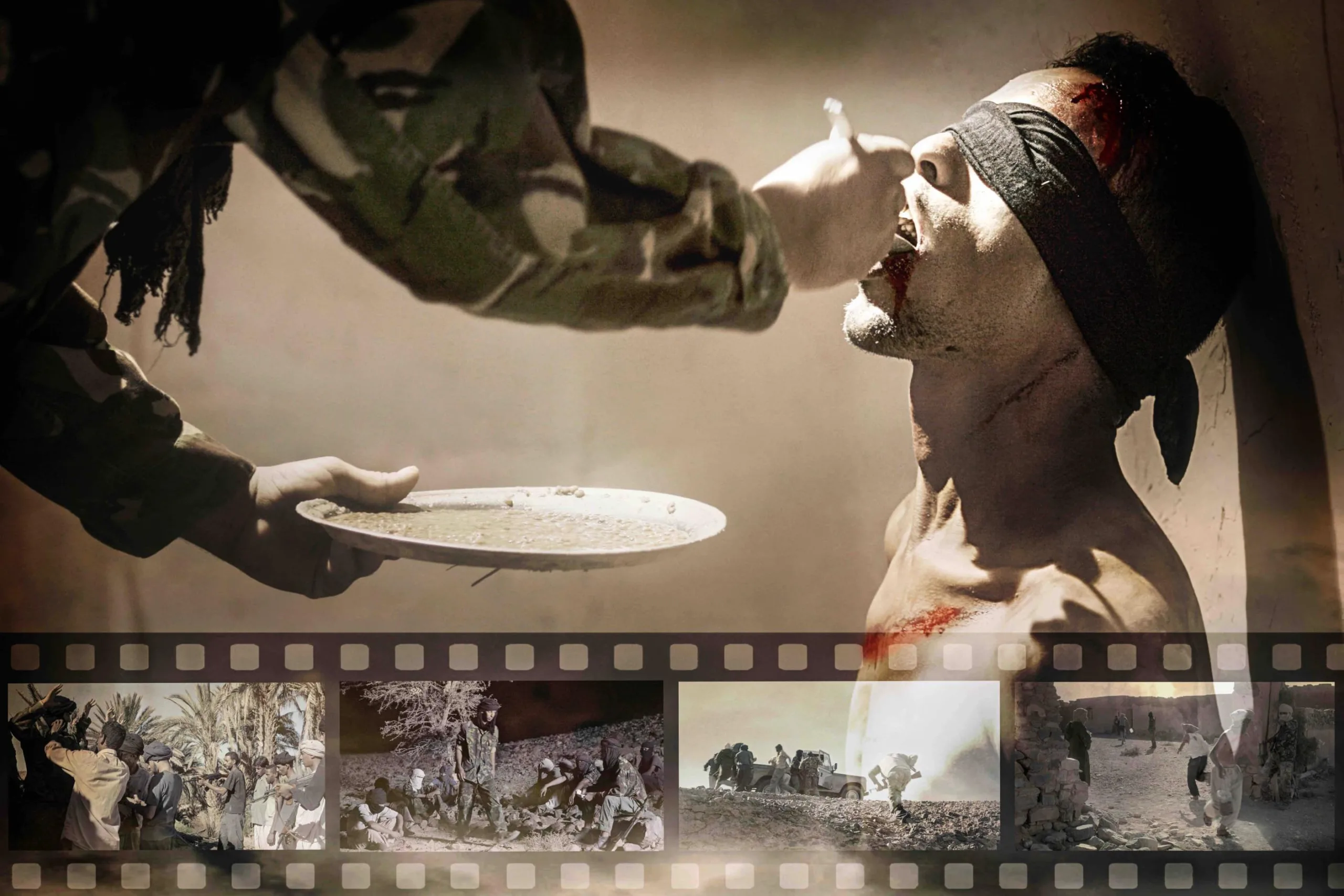
Rabat – “Life Alongside Death”, a documentary by the late Moroccan filmmaker, Lahcen Majid, and screenwriter and producer Abdelohid El Mouhatni, has once more returned the world’s media focus on the suffering of Sahrawis in Polisario-run Tindouf camps in Algeria.
A few weeks ago, the Moroccan-Irish Friendship Association hosted a screening at University College Dublin, further showing the organization’s commitment to justice and human rights accountability.
Majid and El Mouhatni’s documentary resonated deeply with its audience of Moroccans, Irish, and international guests. It tells the story of six Moroccan Sahrawis, five men and one woman, who were kidnapped, detained, and tortured by the Polisario Front in the 70s and 80s.
In a recent interview with Morocco World News (MWN), Abdelohid El Mouhatni, the screenwriter and producer of the documentary, revealed insights on the inspiration behind the film. “The idea for the film project was inspired by a human pain that carries within it heroic stories that faded into oblivion, whose souls came to my ears behind death and cruel silence”.
The heart-rending testimonials and archival footage evoked powerful emotions, especially among viewers like Ali Souih, whose father is among the countless victims whose remains were never recovered.
Souih shared his story with MWN. “I was only two years old when my father disappeared. He used to return every year with gifts, but in 1976, he never came home. Later discovered that he had traveled to Algeria with friends but never returned. His absence left a deep emotional void in our home.”
Souih shared that his motivation for telling this story in the documentary comes from his deep desire to be the voice for thousands who continue to suffer in silence, “I felt I had to speak up so people would know what happened there. Telling our story is a way to honor his memory and make sure others don’t suffer in silence,” Souih said.
A long-standing humanitarian crisis
The Tindouf camps have been a place of harsh, miserable conditions since 1975, when Spain pulled out of Morocco’s southern provinces in Western Sahara. The Polisario Front, fully backed by Algeria, has routinely clashed in armed conflict with Morocco ever since, claiming independence in Western Sahara.
Today, nearly 90,000 Sahrawis live in these camps under harsh conditions. The people are in need of basic necessities like ample food, clean drinking water, decent medical care, and schooling, making daily life a constant struggle.
Inside the camps, the Polisario, with Algeria’s backing, maintains tight control, restricting movement and silencing opposition. This lack of oversight has paved the way for corruption. A 2015 EU anti-fraud (OLAF) report uncovered how humanitarian aid meant for refugees was routinely embezzled and sold on the black market.

To make matters worse, because Algeria still refuses UN calls for an official census, aid organizations can’t even get a clear picture of who needs help, further prolonging the humanitarian crisis.
International watchdogs like Amnesty International and Human Rights Watch have repeatedly warned about the issue. They document arbitrary arrests, forced labor, and brutal suppression of anyone who speaks out.
Souih told MWN that he has received multiple threats from the Polisario supporters for speaking out about his experience. “Speaking out has led to threats, mainly from Polisario Front supporters trying to silence and discredit us. Despite the pressure, I stand still, revealing that the truth is the best way to fight historical erasure.”
Meanwhile, El Mouhatni shared his perspective on the documentary screening, saying that “the reactions were very positive, from diplomats, military prisoners, film critics, and even some of those we considered as separatists.”
As the dispute nears its 50th year, projects such as those by Majid and El Mouhatni serve as crucial reminders that this crisis is not just stuck in history; it is an ongoing humanitarian emergency. Their documentary amplifies the issue at the UN, EU, and other global forums, advocating for a full census of the camps, legal protections for refugees, and humanitarian aid.
El Mouhatni expressed his disappointment at the film’s reach. “As the author and producer of the film, what pains me more is that the documentary has not yet been seen by the Moroccan public, except for those who were able to watch it at festivals. I hope that it will be programmed soon at the level of the National Television (SNRT), because even if some of the cases and witnesses involved in the film had the opportunity to see it, others, including those who died, were not able to meet this beautiful moment that they had waited for so long.”
The producer mentioned that they had in fact sold SNRT rights to the Arabic version of the film in July of 2022, but it has not yet been screened and shared with public. Until this happens, they are unable to share it within Arabic-speaking countries, but they can still share it in international circles with dubs or subtitles in other languages. In 2019 they started their tour screening the story in as many places as possible, but found difficulties to do so in some African countries that wanted to maintain close relations with Algeria, notably Cameroon. The tour faced further obstacles and had to curtail short due to COVID in 2020.
Despite these obstacles Souih concluded that the fight continues to urge human rights organizations “to keep pressing Algerian authorities to allow full access to the Tindouf camps and Arrachid prisons.” He says that without this necessary oversight, “independent monitors cannot track conditions, find the missing, or protect basic rights, leaving families like mine to keep suffering unaddressed”.