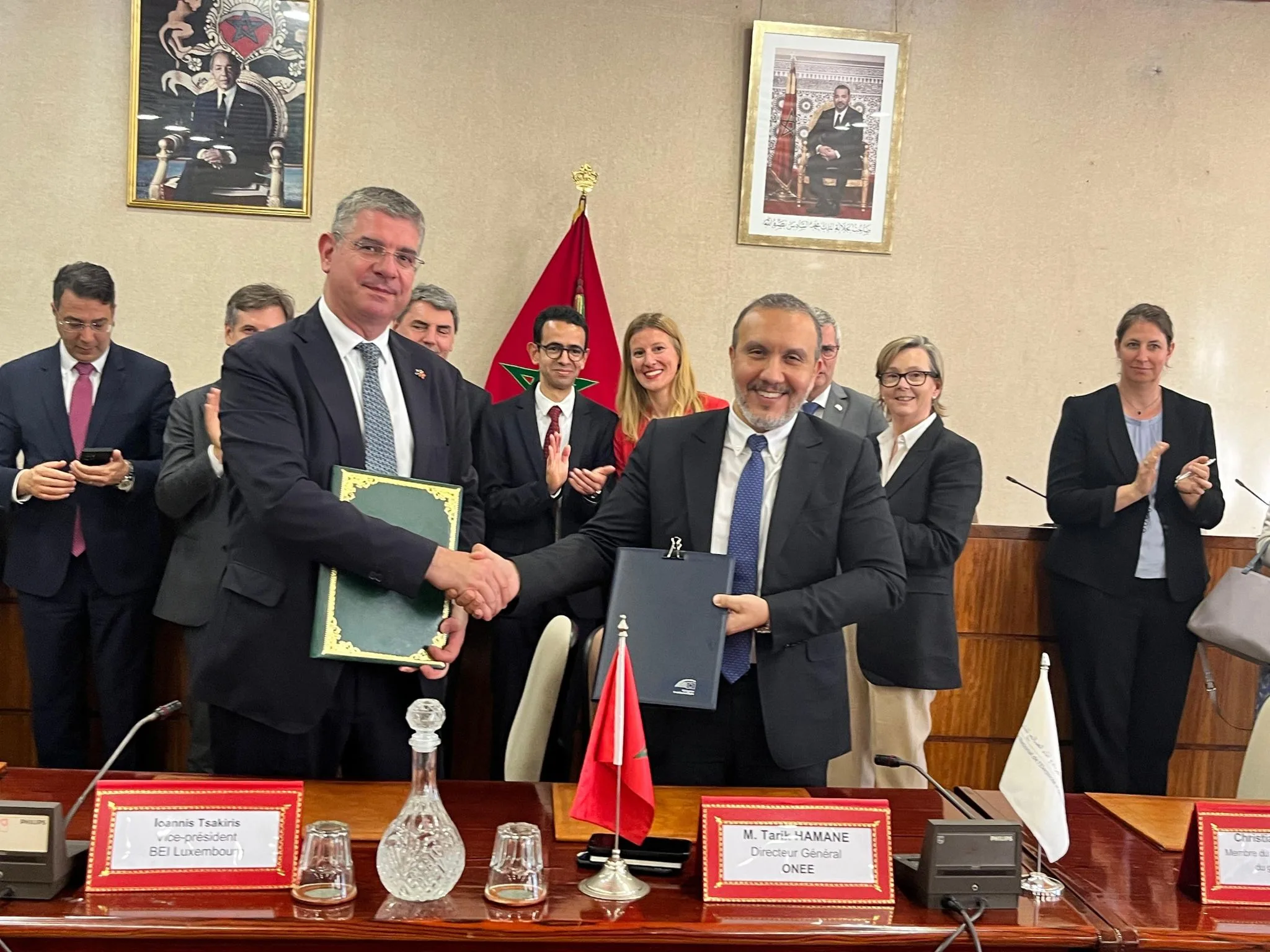
Doha – The European Investment Bank (EIB) has signed a €70 million financing contract with Morocco’s National Office of Electricity and Drinking Water (ONEE).
The funds will strengthen drinking water infrastructure across the country, particularly in small and medium-sized cities and rural areas facing increasing pressure on water resources.
The financing, supported by the European Union through its guarantee mechanism, will help implement ONEE’s 2025-2030 Equipment Plan. It focuses on high-impact local investments to modernize, secure, and optimize drinking water production and transportation systems in multiple regions.
“Ensuring sustainable access to drinking water is a vital priority, especially for territories most exposed to climate change effects,” said EIB Vice President Ioannis Tsakiris. “This new financing demonstrates the EIB’s commitment to supporting Morocco in implementing sustainable, local, and resilient solutions.”
The project addresses Morocco’s growing water stress, exacerbated by rising temperatures, increased drought frequency, and higher consumption. It aims to modernize equipment, reduce network losses, improve energy efficiency, and secure drinking water supply to vulnerable territories.
The funding will also support reconstruction of hydraulic infrastructure damaged by the September 2023 earthquake, strengthening water supply system resilience in affected areas.
EU Ambassador Patricia Llombart Cussac stated that “the signing of this new financing contract responds to one of modern Morocco’s priorities and demonstrates a strong, structured partnership between the European Union and Morocco. For over 20 years, we have worked together to address this common challenge.”
For his part, ONEE Director General Tarik Hamane stressed Morocco’s efforts under royal guidance to secure the country’s drinking water supply.
“Through this financing, ONEE, as the state’s armed wing in the drinking water sector, will continue its deployment to guarantee secure and reliable access to drinking water for populations,” he articulated.
On May 12, King Mohammed VI reviewed Morocco’s water management recovery plan during a ministerial council in Rabat. Agriculture Minister Ahmed Bouari reported that recent rainfall, particularly in March, had a “very positive impact” on cereal production, autumn and spring crops, fruit trees, and vegetation cover.
Water Minister Nizar Baraka reported that Morocco’s average dam filling rate currently stands at 40.3%, allowing the mobilization of 6.7 billion cubic meters of water.
This amount equals one and a half years of potable water consumption nationwide, significantly improving the country’s water security outlook.
This operation aligns with the EIB’s Climate Roadmap 2021–2025 and contributes directly to sustainable development goals, particularly clean water and climate action.
The initiative also supports the National Drinking Water Supply and Irrigation Program (PNAEPI, 2020–2027), advancing Morocco’s climate adaptation priorities and reinforcing EU commitments under the Green Partnership for a resilient and sustainable economy.
Last week, ONEE secured €300 million from European partners to modernize and extend Morocco’s national electricity grid across 731 kilometers, encompassing €170 million from the EIB itself.
The expansion aims to better integrate renewable energy sources and increase transmission capacity by 1,850 megavolt-amperes.
On May 19, Morocco signed a landmark $14 billion agreement with the United Arab Emirates to transform its water and energy infrastructure by 2030.
The megadeal includes a 1,400-kilometer high-voltage transmission corridor and four desalination facilities capable of producing 900 million cubic meters of water annually.
Spain has also committed €340 million toward the construction of Africa’s largest desalination plant in Casablanca. The €620 million facility will provide 300 million cubic meters of water annually for over seven million residents in the metropolitan region.
Read also: African Development Bank: Morocco Sets Water Engineering Standard for Africa