
Marrakech – Archaeological excavations conducted between 2024 and 2025 at Sijilmassa have uncovered exceptional discoveries that reshape our understanding of Morocco’s medieval heritage.
This major campaign, supported by the Ministry of Youth, Culture and Communication, represents the most important research effort on this site since investigations began in the 1970s.
Professor Lahcen Taouchikht initially led the project, followed by Professor Asmae El Kacimi, who directed an all-Moroccan team from the National Institute of Archaeological Sciences and Heritage (INSAP).
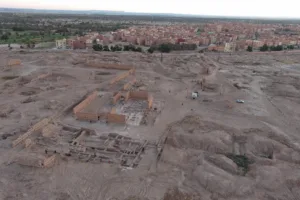
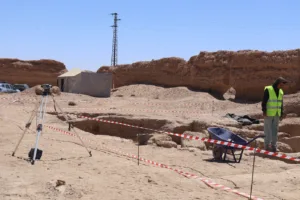
The team excavated nearly 9,000 square meters in the urban core of Sijilmassa, a carrefour city founded in the late 8th century that once stood at the heart of trans-Saharan exchanges between the Maghreb, sub-Saharan Africa, and the Mediterranean world.
Archaeologists unearthed foundations of a substantial religious complex, including a medieval mosque measuring 2,620 square meters with a capacity for approximately 2,600 worshippers.
This mosque reveals multiple construction phases, ranging from the original mosque founded during Abu al-Montasir al-Yasa’s reign (late 8th to early 9th century) through Almoravid and Almohad periods (11th-13th centuries), to the Alaouite mosque with elements still visible today.
This stratification confirms the Sijilmassa mosque as one of Morocco’s oldest, establishing it as a fundamental landmark in the religious and urban history of the Maghreb.
The excavation levels linked to the mosque’s earliest phases yielded a remarkable collection of carved plaster fragments dating to the Midrarid period (8th-10th century).
Treasures of Islamic art and gold coin production come to light
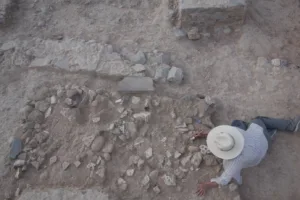
These decorations, featuring finely crafted geometric, vegetal and epigraphic motifs, represent the oldest known Islamic art specimens in Morocco. The discovery showcases the artistic sophistication of early Islamic Morocco.
The team found hundreds of painted wood fragments from the 18th century in the Alaouite madrasa ruins. These cedar pieces display vibrant polychrome and include evidence of gold leaf gilding (tadhhīb), providing the first material evidence of Alaouite architectural decoration at Sijilmassa.
Long sought by archaeologists, evidence of monetary activity in Sijilmassa has finally emerged near the mosque. A “honeycomb” ceramic mold for manufacturing gold coin blanks still contains gold residue in its cavities, confirming its use in producing the famous Sijilmassian dinars.
This unique discovery in Morocco, only the second in Africa after Tadmekka in Mali, validates Sijilmassa’s importance as a major monetary production center in the Islamic West. The artifact constitutes the first tangible material evidence of gold coin minting in the region.
Sijilmassa reveals first complete Alaouite quarter
A major breakthrough came with the discovery of a complete residential quarter from the Alaouite period (17th-18th centuries). This find marks a decisive advance in understanding Sijilmassa’s urban history, which has long focused on its medieval peak.
The quarter consists of 12 houses built according to a uniform plan, demonstrating well-structured domestic urban planning. Each house organizes around a central patio, with living quarters, storage spaces, and rich domestic furnishings, including dishware. These elements help reconstruct the daily life practices of the inhabitants.
Archaeobotanical analysis of samples from these spaces identified remains of dates and other agricultural products, providing valuable insight into the residents’ diet in a pre-Saharan context. The analysis lays bare important information about agricultural practices and food consumption patterns in this semi-arid region.
The scale, state of preservation, and richness of data from this discovery provide the first material evidence of the ancient presence of Alaouite Chorafa in Sijilmassa. It opens a new chapter in the site’s history, shedding light on a previously undocumented occupation phase essential to understanding the city’s urban, social, and political evolution over time.
City of gold confirms its historical legacy
The discovery allows researchers to better understand the territorial roots, population dynamics, and forms of daily life associated with the beginnings of the Alaouite dynasty. This contributes to a renewed reading of the history of Morocco’s reigning dynasty.
The results of these archaeological digs extend beyond the local context. They provide essential elements for understanding the history of settlement, art and trans-Saharan exchanges. The INSAP team’s work brings historical texts to life through material evidence.
The remains unshrouded in these recent campaigns evoke the city described in historical texts. Its mosque, madrasa, streets, houses, and workshops emerge once again from the sands, opening a new chapter in reading Sijilmassa’s rich history.
The discoveries from the 2024 and 2025 campaigns paint a comprehensive picture of this once-thriving desert metropolis, firmly positioning Sijilmassa as a key archaeological site within Morocco’s shared African heritage.