Rabat – The scoop could be misleading. Jumping to conclusions is a move that might serve a scoop in this summer period when the brain is on standby. People are looking to rest a bit. However, there are events that shake intellectual idleness and taunt the analytical mind.
Last week, an event made headlines: the visit of Jacob Zuma, former South African president, to Rabat. He made a statement on July 15, 2025, in his capacity as the leader of the Umkhonto weSizwe (MK) Party, whereby he affirmed the party’s support for the autonomy plan Morocco proposed to end the artificial conflict around the Sahara.
Jacob Zuma’s remarks should come as no surprise, given that he had a meeting with King Mohammed VI in November 2017, on the sidelines of the summit between the African Union and the European Union in Côte d’Ivoire (November 29-30, 2017). A meeting that foreshadowed promising steps toward erasing factors of mutual misunderstandings.
Observers fall into several categories. Firstly, there are the analysts who are very quick to jump the conclusions. They claim that Zuma’s position would be a message the South African decision-makers sent to prepare the ground for a future recognition of the relevance of the Moroccan solution pertaining to the Sahara issue. They refer to the rising voices within the African National Congress (ANC) itself, calling on the South African Government to take a bold stand with respect to the sovereignty over Morocco.
Secondly, there are analysts, including seasoned diplomats, who see Zuma’s behavior as a diplomatic maneuver to make Moroccans believe that if the issue of the so called-Sadr exclusion were raised tomorrow, there would be a strong chance that South Africa would abstain instead of opposing it.
Thirdly, a handful of analysts see Zuma’s new stand as a mercantile maneuver, based on Jacob Zuma’s allegedly previous reputation.
Fourthly, there are commentators, more at ease, who believe that, whatever the case may be, we should be pleased that the opposition of the political class in South Africa to Morocco’s legitimate rights is no longer unanimous. This opening is a good omen.
Fifthly, there are observers who establish a direct relationship between what is happening on the South African political chessboard and two tangible facts. On one hand, the United Kingdom’s new position supporting the Moroccan autonomy plan, and on the other hand, the evaporation of South Africa’s credibility in the United States. The latter, who have recognized Morocco’s sovereignty over its southern provinces since 2020.
Swept away by scoops, analyses miss the mark
All these readings seem relevant on paper. They could have been more relevant if South Africa was still that influential player who could make or break the diplomatic and strategic regional and international chessboard. Pretoria is losing incredible speed. The aura it enjoyed, thanks to Nelson Mandela’s legacy, is being put on hold.
For a week, a video has been shared on the internet where Nelson Mandela pays tribute to Morocco, which was the first African country to financially support the ANC and train its paramilitary members in Oujda-Morocco. Mandela introduces Dr. Abdelkrim El Khatib to an enthusiastic crowd, who was his interlocutor when he traveled to Rabat to ask for the support of the King of Morocco.
This means that History cannot be obscured by the goodwill of South African political leaders who are starting to lose their way. Let’s recall some episodes that should make us think twice before jumping to conclusions.
Jacob Zuma was president of the ANC from 2007 to 2018 and of South Africa from 2009 to 2018. Jacob Zuma showed unprecedented zeal to thwart Morocco. He was among the instigators and promoters of the idea of appointing Joaquim Chissano, the former president of Mozambique, as the African Union’s special envoy in 2014. A nomination without effect and which is killed in the egg despite the vociferations of Pretoria and Algeria within the Peace and Security Council of the African Union.
South Africa had, during its tenure, waged a relentless campaign against Morocco’s return to the African Union in 2017. Similarly, during its three terms as a non-permanent member of the Security Council (2007-2008, 2011-2012, 2019-2020), South Africa displayed astonishing hostility towards Morocco.
The statements by the foreign ministers, Nkosazana Dlamini-Zuma (2004-2009) and Naledi Pandor (2019-2020), and those of the permanent representative of South Africa to the United Nations (2019-2024), during these three terms, made headlines by combining the fragility of the argument with childish stubbornness.
Thabo Mbeki (1999-2008), Jacob Zuma’s predecessor, adopted even more hectic behavior. He would have proposed mediation in the Sahara conflict in 2005. Morocco would have rejected it because this mediation was a trap. Mbeki had already recognized the so-called-Sadr and was overlooking Algeria’s role as the main party in the regional conflict around the Sahara.
A recognition that came in September 2004, despite the efforts that Nelson Mandela would have made to dissuade him. It also took place just after the failure of the Baker I and Baker II Plans James Baker, personal envoy of the United Nations Secretary-General concocted. Baker resigned in June 2004.
History also reveals that the balance of power is changing in an Africa that can no longer feed on ideology and the worship of a past of struggle that, necessarily, cannot help to meet new economic, social, and political challenges.
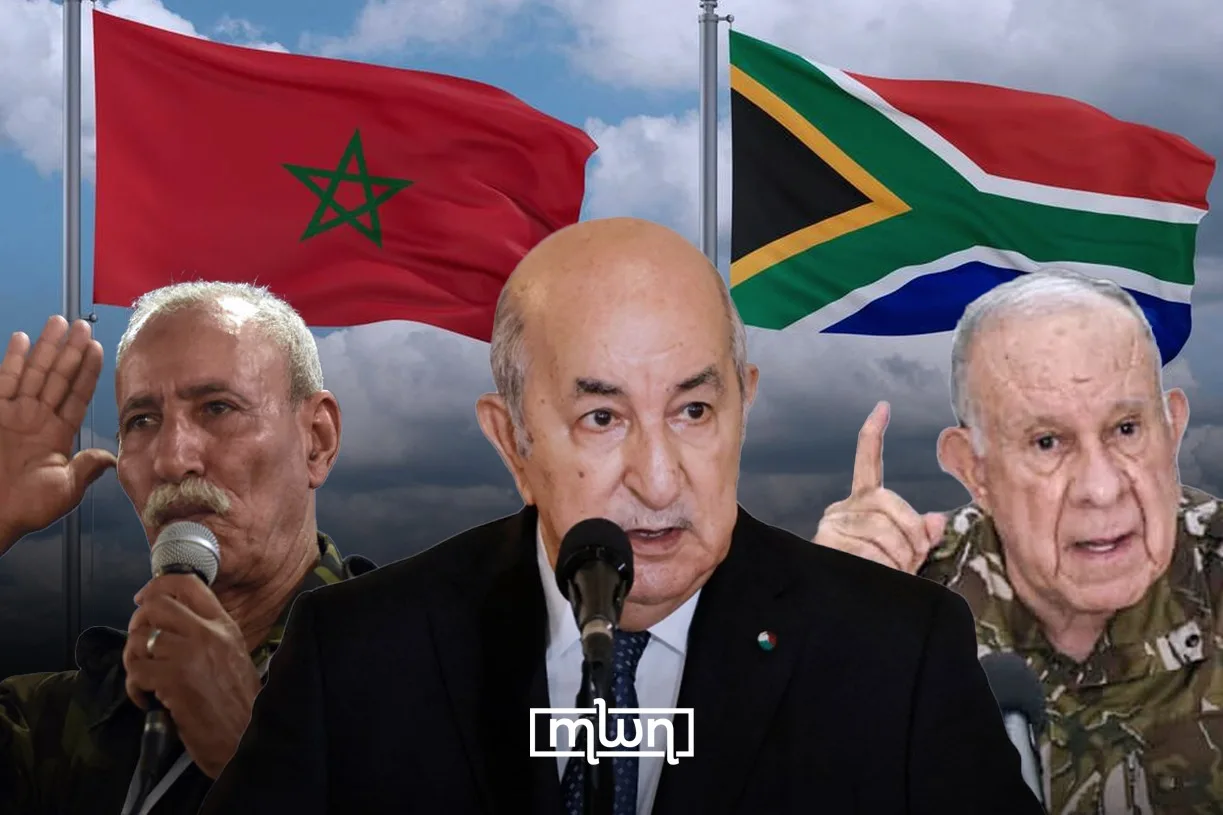
At the time when, in Pretoria, the ANC is gesticulating and demanding explanations from the Moroccan chargé d’affaires regarding the use of the South African flag in the interview between the former South African president and the head of Moroccan diplomacy, Portugal is joining the number of countries supporting Moroccan sovereignty over its southern provinces. Indeed Portugal endorsed the Moroccan initiative, bringing the number to 24 out of 27 countries of the European Union. On a broader scale, more than 118 out of 194 member countries of the United Nations support the Moroccan initiative.
At the same time, the Algerian president, Abdelmajid Tebboune, is traveling to Italy to, it would seem, plead that Rome does not follow the lead of the majority of European states that are now in favor of the Moroccan approach to resolving regional conflicts. The Algerian head of state is making this trip after a delirious appearance on Algerian television where he made incoherent remarks about the Sahara issue.
In a moment of hallucination, now a regular feature in his interventions, President Abdelmajid Tebboune declared that Algeria has spent billions on the Sahara issue and that it would be impossible to back down, no matter the cost. He claimed that more than half of African countries recognize the so-called-rasd. One more hallucination.
This raises a question for those observers who think in terms of numbers. They are a dozen, those among the African countries that still recognize this entity, some of which are adopting a de facto freeze position. The question of the number is outdated. It resembles that of the map of Morocco that some genius play at amputating from time to time to taunt Moroccan public opinion. Because the decision-makers know which way the wind is blowing.
Endemic regional conflicts and business
Geopolitics is in motion. Maintaining the amalgamation is no longer a lucrative business. The reading of geopolitical changes could be relevant if there were political planning centers worthy of the name. Those among the analysts who are quick to pull the trigger or think in terms of clicks on media platforms may end up having a blurry visibility.
What does this new geopolitics say? Perception is deceptive when the compass is myopic. Heading straight towards an iceberg can only be likened to the Titanic in the sequence of panic. Whether they admit it or not, there is a loss of breath in ideology as a determinant of the foreign policy of States. Continuing to defend general principles of international legality, whose definition is ambiguous, means that the ideology, which supports it, becomes its way to oblivion.
So, why African countries, a handful, still make the issue of the Moroccan Sahara a business? Perhaps a senseless question. The answer, the Sahara issue can no longer be a business asset for the simple reason that Morocco had recovered its Southern provinces in 1975.
Of course, there were difficult times during which ideology and petrodollars shared the same room and made it harder for Morocco to resist. Not anymore. Morocco has won its battle of the Sahara, mainly thanks to psychological security (resilience) and economic development (vision).
Two: the Sahara issue has been used as a business asset on the international stage. This was the case in Nigeria. Indeed, observers recall the publication by Nigerian media of information stating that the outgoing Nigerian president Goodluck Ebele Jonathan (2010-2015) had a telephone conversation with King Mohammed VI of Morocco on the eve of the Nigerian presidential elections in 2015.
Morocco denied this information, and in the wake of it, recalled its ambassador for consultation. Morocco issued a public statement in which it distances itself from the Nigerian candidate by reiterating its doctrine of non-intervention in the internal affairs of states (Hassan Hami, Nigeria: Pragmatism and Kite Runner Dilemma, MWN, March 20, 2025).
Some analysts, as mentioned above, do not rule out this hypothesis regarding Jacob Zuma. I strongly doubt it, because the timid rapprochement of certain South African political forces with Morocco is part of a process of recognizing Morocco’s progressive rise to power in its African and Mediterranean space.
Here are my arguments. One, South Africa’s hostility towards Morocco is primarily economic. Morocco is a competitor that is on the verge of surpassing (or has already surpassed) this country in some strategic sectors. Rapprochements between South African and Moroccan economic groups are still timid despite some actions initiated about ten years ago that were deemed promising.
The animosity of the various South African governments since 2004 is motivated by the weight of multinationals whose main capital is mostly British, American, or Dutch. Now that the UK has recognized the relevance of the Autonomy Plan in the Moroccan Sahara, there will undoubtedly be openings. Many British companies are interested in investing in the Southern provinces. The United States recognizes the Moroccan nature of the Sahara, and the Netherlands considers the Autonomy Plan as a realistic and credible solution.
Two, the irreversibility of Atlantic initiatives. The Atlantic African countries are committed, despite South African resistance, to the dynamic of making the Atlantic a zone of shared prosperity. Pretoria is reluctant because Rabat has been the standard-bearer since 2009.
Three, the opening up of the Sahel countries, an initiative wholeheartedly supported by King Mohammed VI, is causing concern for South Africa. Some observers share the view that the Moroccan initiative challenges South Africa’s hegemonic approach within the Southern African Development Community (SADC) and reduces its influence within the African Union.
The tenants of Tindouf camps are henceforth an Algerian-Algerian problem
Already, some countries among the sixteen members of SADC, namely Malawi, Comoros, Zambia, Malawi, and the Democratic Republic of Congo, are challenging the leadership of Secretary-General Elias M. Magosi. They have made public official statements denouncing the latter’s maneuver whereby he had signed a memorandum of understanding with the representative of the so-called-Sadr in March 2025.
It is worth stressing that some SADC members have withdrawn their recognition of the so-called-Sadr (the Seychelles in 2008, Eswatini in 2017, and Zambia in 2018). The Comoros, Eswatini, Zambia, and Malawi have consulates in Laâyoune and Dakhla in the Southern Provinces of Morocco.
Four, the progression of the idea of a unifying Atlantic Ocean bringing together African, European, and American countries is quietly making its way and outlining the contours of a future prosperity zone by 2050.
This is disturbing countries like South Africa, which is being put back in its place within the Commonwealth, as well as being undermined within the BRICS. The BRICS are the next growing force that President Donald Trump aims at bringing down.
Five, Morocco is a serious contender for the position of permanent member within the Security Council as part of the -even laborious- project to expand this body to include Africa and Latin America, in particular, to make it more or less democratic.
It goes without saying that the trend among the five members of the Security Council leans towards the hypothesis of an expansion without veto power. Nevertheless, the list of African candidates is very limited. Morocco is on it. And that might bother South African decision-makers.
Six, those who strive to see South Africa -or any other African country- shout to silence Morocco’s voice lack clarity. The number of recognitions and withdrawals of recognitions regarding the Moroccan Sahara matters little. Indeed, out of 54 member states, only twelve maintain their recognition of the so-called-rasd, half of which are in a standby position.
The status of the so-called-Sadr within the African Union will be challenged when the time comes. Because, and this is the most important thing, since 2017, when Morocco returned to the pan-African body, the Polisario has been an Algerian-Algerian affair. The Polisario is a puppet that reminds us of Meursault in Albert Camus’ The Stranger.
One day, Algeria will be forced to get rid of it like Meursault, who defends himself for killing “the Arab” because he argued had a headache from the sun. Since 1962, this incorrigible and imaginary sun has given headaches and illusions to Algerian decision-makers and to the handful of African allies left.
It is worth recalling that nature reveals unsuspected secrets. Indeed, retired leaders, in the opposition, or as luxury speakers in Africa and Europe have adopted contradictory positions regarding the issue of the Moroccan Sahara. Jacob Zuma is no exception.
When they were ruling their countries, these leaders had mixed positions, relative support (or muted opposition) behind the scenes, and far-fetched neutrality in public. Once out of power, they publicly display their support for Morocco or refrain from reiterating their opposition.
This applies to Jacques Chirac who spoke in 2008 of the Southern provinces when referring to the Sahara. Nicolas Sarkozy, who used the expression Moroccan Western Sahara in 2018. Both indeed supported the Moroccan initiative and could not translate their support into concrete actions back then.
Ahmed Ben Bella, former Algerian president, reiterated in a statement in 1985 in London and in 2006 in Marrakech his belief the Saharan territory was part of Morocco. He recalls that almost all the dynasties (Almoravids, Almohads, Saadians and Alawites) that ruled Morocco came from the south of the country, particularly from the Sahara. He is therefore calling for a political solution to the conflict.
For the record, the same position was defended in 1985 by Houcine Aït Ahmed, president of the socialist forces, an Algerian opposition party and former member of the Provisional Government of the Algerian Republic prior to the independence of Algeria in 1962.
Algeria is mired in the Sahara conflict. Algerian decision-makers are still resisting to admit that the game is over. However, paradoxically, their determination to defend the Polisario would not be a card to reverse the reality on the ground and to push the Security Council to pay attention again the referendum option, but rather a card for this movement to remain in Tindouf so that Morocco wouldn’t be tempted to reopen the borders issue namely the dilemma of the Eastern Sahara.
The Eastern Sahara would sooner or later be integrated into the overall debate on resolving all the endemic conflicts in the region. The constructive and permanent fight against separatism and terrorism is another point to consider in the equation.
After fifty years of waging war against Morocco using a proxy, Algeria finds itself in a situation identical to the all-out obstruction of the time. However, this time, it should play its cards on the table; but it would not have the upper hand.
So, would it be a visual illusion to witness South Africa take a bold stance to reflect on Nelson Mandela’s wise advice and set the clock right? Very difficult to say in the current state of affairs. It is certain that something is happening. The unconditional solidarity of the South African political class with the Polisario is crumbling. If a positive and constructive approach towards the Kingdom of Morocco were adopted by Pretoria (after the neutralization of the chieftains within the ANC), it would be a step in the right direction.
If obstruction continued, it would be short-lived, as in the past. Since 2004 South Africa has reaped nothing but wind. I am not one of those people who insult the future, especially in politics and diplomacy, but it is better to get the records straight to avoid any confusion. There are things in the air, but we still need to adjust our compasses so we don’t surf in the vague.