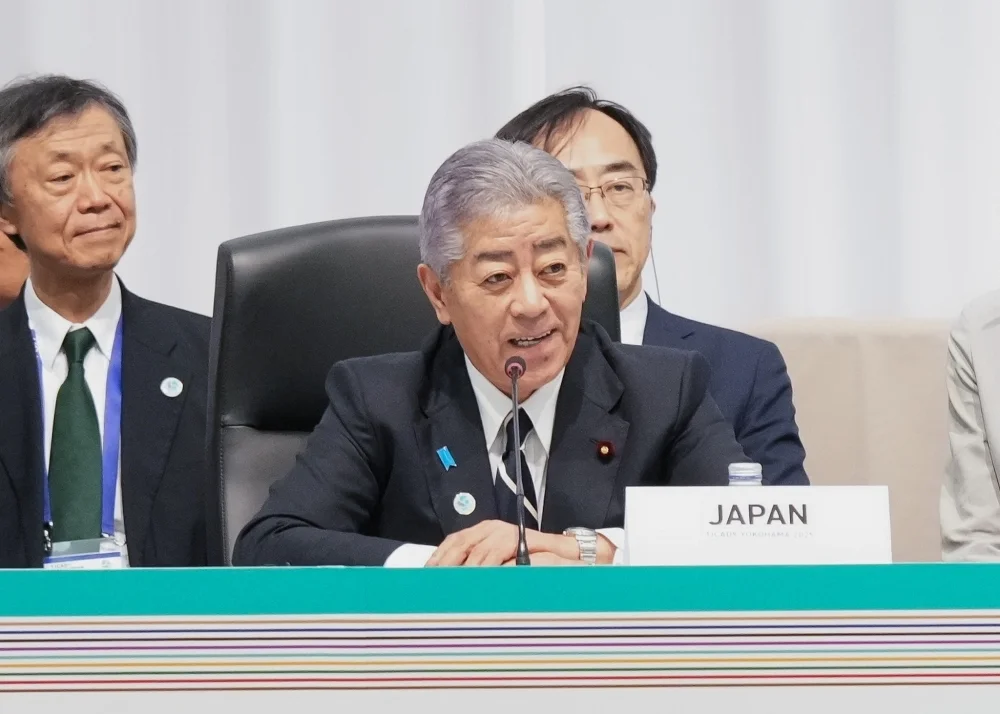
Marrakech – Japan has delivered an unequivocal message to Africa and the international community by reiterating, for the third time in just two days, its unwavering position of non-recognition toward the phantom entity.
The strong stance came during the opening of the 9th Tokyo International Conference on African Development (TICAD-9) summit on Wednesday in Yokohama.
Japanese Foreign Minister Takeshi Iwaya made a solemn declaration at the summit’s opening, stating that “the presence of an entity not recognized by Japan as a State cannot affect Japan’s position regarding the status of this entity.”
This clarification was the only substantive point raised in his opening remarks beyond customary pleasantries, sending a clear signal about Japan’s consistent position and rejection of maneuvers aimed at exploiting separatist elements.
The triple reaffirmation follows similar declarations made Tuesday during both the ministerial opening meeting and the preparatory meeting of senior officials.
During the ministerial meeting, Iwaya precisely stated: “I wish to clarify that the presence in this meeting of any entity that Japan does not recognize as a State does not affect Japan’s position concerning the status of this entity.”
Japan’s diplomatic corps further marked its reservation regarding the presence of the self-proclaimed “SADR” by explaining that Tokyo refused to extend an invitation to the paper state and only invited “countries with which Japan maintains diplomatic relations.” Japanese officials clarified that “it is the African Union Commission that invited all its members.”
This year’s firm stance by Japan effectively slams the door on any political maneuvering space that the separatist group attempted to exploit last year when they infiltrated the preparatory meeting for TICAD-9.
In August 2024, an Algerian delegate illicitly placed a makeshift card representing the self-styled “Sahrawi Arab Democratic Republic” during a pre-TICAD meeting, prompting immediate Japanese intervention.
The Sahara dossier has tipped
The center of gravity in the Western Sahara dispute has decisively shifted from a “referendum-or-bust” approach to autonomy-within-sovereignty as the only workable exit ramp. This formula aligns with UN practice focused on realism, pragmatism, and compromise, as well as regional security externalities and where states are actually placing their diplomatic chips.
Three key inflection points mark this algorithm of change. Since the late 2010s, Security Council language hardened around a “realistic, pragmatic, lasting political solution based on compromise” and placed Algeria at the table as a party – not a bystander.
This re-coded the process: no romanticism, no open-ended plebiscite fantasies, just executable politics. The 2020 Guerguerat operation served as an operational shock that restored supply-chain reliability for West Africa and penalized coercive disruption, making the costs of manufactured volatility visible to states and firms.
A diplomatic cascade followed as a widening set of capitals explicitly call the Autonomy Plan “serious, credible, and realistic,” while a consulate wave in Laâyoune and Dakhla “territorializes” recognition through quiet, cumulative state practice.
The Algeria-Polisario alliance functions as a single strategic unit – a rentier-security complex – whose doctrine is maximalist, zero-sum, and structurally dependent on external subsidies, camp exceptionalism, and perpetual stalemate. This model now runs into capability, legitimacy, and opportunity-cost ceilings.
A petro-rentier can fund escalation cycles, but can’t mint legitimacy. Stripped of slogans, what remains is a hydrocarbon-backed stalemate doctrine built on strategic outsourcing: a state-sponsored non-state actor (Polisario) projects deniable pressure, while the state patron (Algeria) maintains formal distance, enabling coercion without accountability.
The Tindouf governance model represents a juridical anomaly – characterized by opaque administration, humanitarian dependence, and political monopolization – that requires the artificial dispute never to end. Stalemate isn’t a failure; it’s the business model.
However, Sahel volatility, youth unemployment, and diversification imperatives make permanent confrontation fiscally irrational, especially as partners increasingly price stability over ideology. Maximalism without means has morphed into performative obstruction – loud, expensive, and strategically unpersuasive.
Morocco has changed facts on the ground through developmental statecraft in the South, an Atlantic geoeconomic vector, minilateral coalitions, and a political offer that satisfies sovereignty norms while granting robust self-government.
What Morocco changed
The 2007 Autonomy Plan provides a granular institutional design with legislative, executive, and judicial organs; own-source revenues and assigned transfers; and locally elected leadership under the umbrella of Moroccan sovereignty.
The country’s New Development Model for the Southern Provinces converts sovereignty into service delivery through ports, energy, logistics, fisheries, agribusiness, tourism, and human capital investments. Capital follows predictability; predictability follows state capacity.
Morocco is constructing an Atlantic geoeconomic corridor with the Dakhla Atlantique port platform, logistics and renewable energy zones, and southbound connectivity for the Sahel – reframing the Sahara from “disputed periphery” to hinge of a trans-Sahel supply chain.
Rather than chase an abstract “international community,” Rabat has built stacked alignments with Gulf partners, West African states, and Mediterranean interlocutors, each with issue-linkage across security, energy, migration, and trade domains. This represents coalitional realism, not bandwagoning.
The law and norms terrain has markedly shifted. International practice now defaults to territorial integrity unless there’s a decolonization rubric or catastrophic rights “remedy” threshold. The Sahara file – after decades of UN stewardship – has settled into a political settlement track, not secession.
The referential frame has shifted from plebiscitary romanticism to constitutional engineering, with sub-state autonomy as the UN-compatible instrument to square self-government with sovereignty. Consulates, trade arrangements applied to the territory, security coordination, and donor programming constitute quiet recognitional acts that are harder to reverse than tweets or communiqués.
The security calculus has shifted as well concerning the Polisario. Arms flows, jihadist franchising, and smuggling economies in the Sahel are rendered worse by “grey-zone warfare.” The market and state system now penalize actors who treat corridors like bargaining chips.
This isn’t only a Sahel-wide pathology; illicit flows traverse Polisario-held spaces east of the berm and the Tindouf camp economy. UN reporting, rights groups, and EU audits document smuggler presence, jihadist proximity, and governance gaps – and episodes like Guerguerat show how the movement has instrumentalized corridors as leverage.
Algeria’s closure/estrangement doctrine produces deadweight loss and reputational drag, while Morocco’s corridor doctrine delivers public goods in trade, transit, and policing, which third parties reward with diplomatic credit.
Map politics matter because they codify de facto understandings. As official profiles, media visuals, and corporate compliance manuals normalize Moroccan administrative geography, the cost of contestation rises for the secessionist narrative. Litigation bursts can slow agreements’ application, but they cannot substitute for coalitions or governance deliverables.
What ‘Autonomy’ actually resolves
The autonomy framework in which elected regional institutions speak for Saharan populations without amputating sovereignty solves critical issues. It’s the classic consociational workaround that international practice prefers.
It brings the territory fully under Morocco’s constitutional rights architecture, with monitorable local governance that beats camp exceptionalism by orders of magnitude. Autonomy is finalizable – allowing treaty-grade commitments on natural resources, cultural protections, and fiscal assignments that investors, donors, and neighbors can price in.
Looking ahead to 2025-2030, three plausible paths emerge: an implementation track with sequenced autonomy roll-out, institutionalization, and deepening Atlantic/West Africa integration; a costly managed stalemate with low-grade provocations and diplomatic trench warfare; or a low-probability but high-cost escalatory miscalculation that would only consolidate external support for the status-quo-plus-autonomy solution.
The Algeria-Polisario alliance faces strategic cornering through a narrative deficit – the autonomy offer is something executable while maximalist secession is not. Coalition fatigue grows as partners tire of subsidizing ideological sunk costs while the Sahel burns and energy transitions accelerate.
Time asymmetry works against them as Morocco’s trajectory follows compound-growth through institutions and infrastructure, while the other side faces compound-risk through rent dependence and legitimacy decay.
TICAD-9, which runs from August 19-23 under the theme “Co-creating Innovative Solutions with Africa,” aims to align the African Union’s development objectives with the United Nations’ 2030 Agenda.
The conference also seeks to strengthen technological innovation collaborations between Japan and Africa while exploring new markets in digital transition, sustainable development, and social inclusion.
Morocco is represented at the TICAD-9 Summit by the Ambassador to Japan, Mohamed Rachad Bouhlal.
Read also: Interpreting TICAD Through Japanese Political Culture