
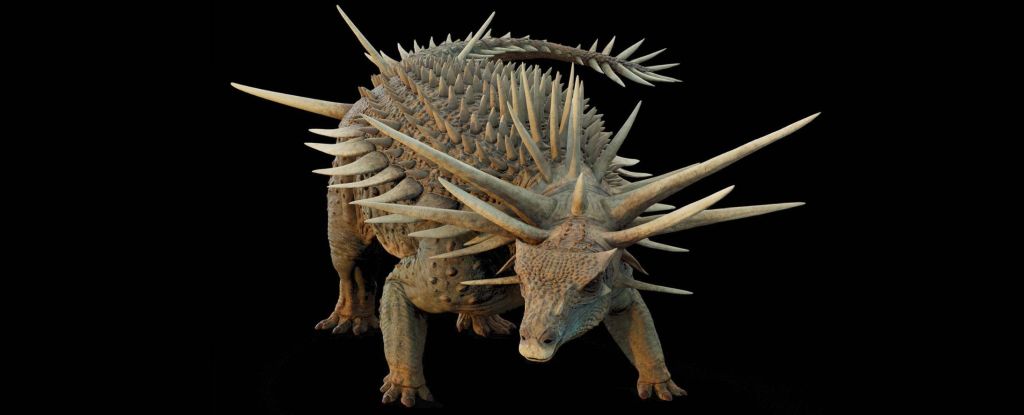
Rabat – A recent remarkable archaeological discovery in Morocco has uncovered a fossil of one of the most unusual dinosaurs ever identified.
“Spicomellus afer” lived over 165 million years ago, during the Middle Jurassic, near today’s Boulemane.
This heavily armored herbivore stands out not only for its extraordinary appearance but also as the oldest ankylosaur discovered to date and the first of its kind found in Africa, according to a study published on Wednesday in Nature.
Scientists first described the species in 2021 based on a single rib. New fossil evidence has allowed researchers to reconstruct its form more completely, uncovering features that astonish even seasoned paleontologists.
A creature like no other
Spicomellus carries spikes fused directly to its ribs, a trait unseen in any other vertebrate, past or present. Some spikes form a collar around its neck, reaching up to 87 centimeters. Its body likely bore a mix of plates and spikes, including massive projections above the hips and blade-shaped armor along the shoulders.
“Spicomellus had neck spikes over a meter long, enormous spikes above the hips, and an array of long, blade-like structures along its shoulders. Nothing like this exists in any other animal,” said Susannah C.R. Maidment of London’s Natural History Museum, who co-led the study with the University of Birmingham.
The complexity of its armor puzzles researchers. Later ankylosaurs evolved simpler protective plating, suggesting that Spicomellus’ spikes served to display dominance, attract mates, or intimidate rivals, rather than solely to defend itself.
A tail weapon ahead of its time
Fossils also show signs of a tail weapon: certain vertebrae fused in a defensive pattern previously seen only in ankylosaurs with tail clubs, which lived tens of millions of years later in the Cretaceous. This discovery pushes back the evolution of tail weapons by at least 30 million years.
“Examining the Spicomellus fossils gave us chills. This discovery challenges long-held assumptions about ankylosaur evolution,” said Richard Butler of the University of Birmingham.
Driss Ouarhache of Sidi Mohamed Ben Abdellah University in Fez, who co-led the Moroccan team, emphasized the find’s importance: “We have never encountered a dinosaur like this, and this region still holds many secrets.”
The fossils were carefully prepared at the Department of Geology at Dhar El Mahraz Faculty of Sciences in Fez, with support from the University of Birmingham. They now await further study and cataloging.