
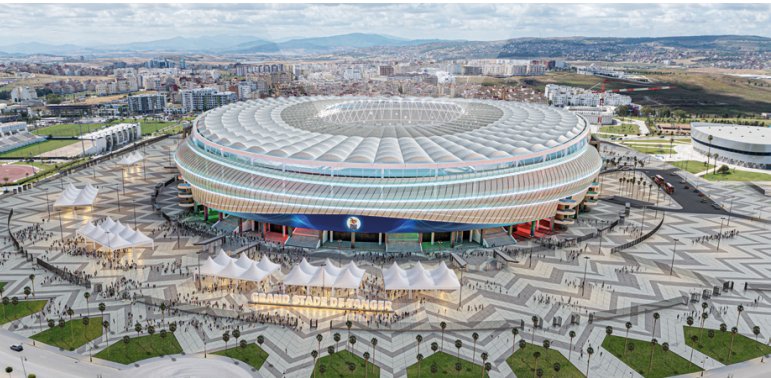
Rabat – The Tangier Grand Stadium, currently undergoing major renovations, will be ready by the end of September, according to Anouar El Amrouai, the project’s lead architect.
The renovation aims to bring the stadium up to FIFA standards, preparing it not just for the fast-approaching 2025 Africa Cup of Nations (AFCON) but also the 2030 World Cup, which Morocco will co-host with Spain and Portugal.
El Amrouai told MAP that all interior spaces have been redesigned to meet international requirements. The revamped stadium, with a capacity of 75,000 seats, now features natural grass, removed athletics track to bring fans closer to the field, and a new full-cover roof.
The mixed structure, which is part metal, part cable, is second only to Brazil’s Maracana Stadium. Local contractors, with technical support from Germany, handled the work at a cost of approximately 360 million USD.
“Back in May 2024, we were still in the design phase; now,” he stated, “the stadium is almost complete, and we are proud of the result.”
Omar El Khiari, advisor to the president of the Moroccan Football Federation (FRMF), described the stadium as a major asset to Morocco’s sporting infrastructure. He stated that it will strengthen the nation’s position as a football hub in Africa and worldwide.
Tangier’s renovation is just one thread in a broader national strategy of upgrades ahead of AFCON 2025. Morocco has selected nine stadiums across six cities, including Rabat, Casablanca, Tangier, Fez, Agadir, and Marrakech, to host the tournament, which runs from December 21, 2025, to January 18, 2026.
Beyond stadiums, the government has launched more than 120 projects to improve roads, transport, and urban infrastructure, while airports and high-speed rail are being expanded.
In addition, Morocco plans to build the 115,000-seat Grand Stade Hassan II near Casablanca by 2028, which is one of the contenders to host the 2030 World Cup final.
Fouzi Lekja, FRMF head who also serves as Morocco’s minister in charge of the budget, has pledged that the stadium will be completed by December 2027, in time for the 2030 World Cup.