Rabat – South Africa’s government continues to grumble over former President Jacob Zuma’s remarkable visit to Morocco, where he announced support for Morocco’s Autonomy Plan for the Western Sahara dispute.
Ronald Lamola, South Africa’s Minister of International Relations, had initially attempted to distance Pretoria from Zuma’s visit, notably by desperately suggesting that the South African government had nothing to do with Zuma’s visit to Morocco.
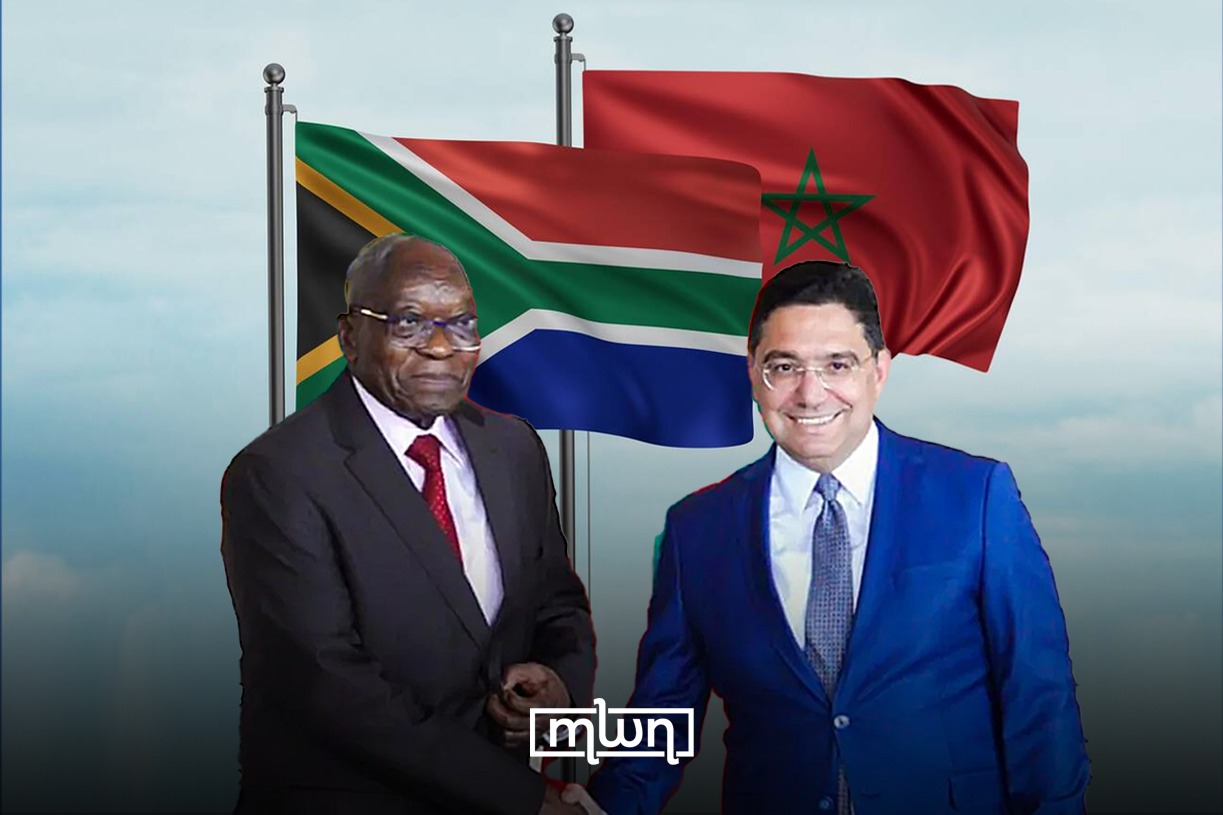
Yet, as part of its desperate campaign against Zuma’s support for Morocco’s territorial integrity, South Africa has now announced that it plans to “demarche” Morocco’s ambassador in Pretoria over the displaying of the South African flag during Zuma’s meeting with Morocco’s Foreign Minister.
A demarche is a diplomatic formal initiative, where a message is delivered from one state to another to either express a view or protest a move or action.
Desperate campaign
“The plans are underway to demarche the Charge d’affaires of the Embassy of the Kingdom of Morocco in Pretoria to register South Africa’s strong objection to the abuse of South Africa’s national flag,” a South African website quoted Lamola as saying in a recent written note to parliamentary questions by an opposition MP.
He suggested that the demarche also seeks to object to the display of the flag as a “platform wherein a position contrary to South Africa’s official foreign policy position on Western Sahara was articulated.”
Despite the recent unearthing of evidence suggesting that the South African embassy in Rabat had requested that Morocco grant Zuma an honorable reception during his visit, Lamola claimed in his written note that the government had no hand in the former president’s trip to Rabat.
South Africa’s continued frustration stems from the fact that, during his significant visit to Morocco, Zuma boldly and historically broke free from Pretoria’s long-standing hostility towards Rabat’s sovereignty over its southern provinces in Western Sahara.
As he met with Morocco’s top diplomat, Nasser Bourita, the former South African president declared his recently established political party’s recognition of Morocco’s sovereignty over the Western Sahara region.
Since its establishment in late 2023, Zuma’s new party, UMKhonto weSizwe (MK), has become a fierce voice of opposition to the ruling ANC (his former party) and the third-largest political party in the South African parliament by number of seats.
Following Zuma’s Rabat visit, a statement jointly issued by the MK party and the Moroccan Foreign Ministry stressed the party’s belief that Morocco’s autonomy proposal is the most viable and optimal path to a future of stability and prosperity for the Western Sahara region.
“This approach offers a balanced path forward that promotes both stability, peace, and development in the region,” it said.
Zuma’s visit to Rabat signaled the former South African president’s readiness to mend ties between Pretoria and Rabat while forging a common vision for African interests on the global stage, something that the ANC views as starkly contrasting with its stance on both the Sahara dispute and Morocco’s growing role in continental affairs.
While a recently revealed note from the South African embassy in Rabat shows that it was involved in arranging Zuma’s trip to Morocco, the South African government’s main concern has been to downplay the significance of displaying the South African flag during Zuma’s visit.
Meanwhile, Zuma himself has delivered a strong response to Pretoria. He has firmly reminded the government that the South African flag does not belong to them but to the country and its citizens.
Yet South Africa’s ruling party has continued to fume over Zuma’s visit.
It has notably demanded that Morocco issue an apology for displaying the country’s flag during the visit, and it accused the former president of betraying Preotira’s “principles.
Morocco’s position momentum
This vague invocation of principles is a thinly veiled reference to South Africa’s support for the Polisario Front, the separatist group seeking an independent state in southern Morocco.
In addition to undermining Morocco’s territorial integrity, the separatist group has in recent months carried out terrorist attacks targeting civilian infrastructure and residential areas in southern Moroccan cities.
Many countries have, in recent years, disowned or distanced themselves from the Polisario to support Morocco’s plan for the Sahara, prompting observers to argue that this Moroccan momentum is irreversible.
Still, the Algerian regime and South Africa’s ruling party have dismissed this momentum, rejected the UN’s repeated calls for a feasible and compromise-based political solution, and signaled their determination to support Polisario’s desperate push for a self-determination referendum.
However, while Algeria’s support for the Polisario is part and parcel of the identity and sense of purpose of the Algerian establishment, Zuma’s ideological split with the ANC suggests that South Africa’s support for the Polisario’s separatism is not as firmly established and may change over time.