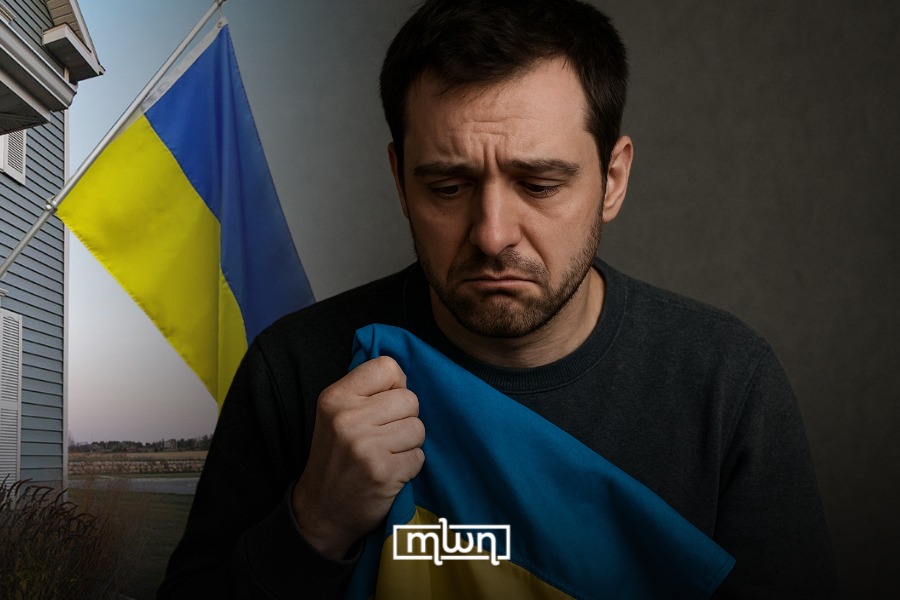
August 24 of last month marked the declaration of independence of the war-torn country of Ukraine. This year, the celebration came after the false hopes raised by the Trump-Putin summit in Alaska, followed by the meeting between European leaders and the American president in Washington to dissuade the US from selling Ukraine to Putin. Ukrainian officials declare that they have no intention of giving up the territories acquired by force by Russia. Trump, for his part, has his eye on Ukraine’s mineral resources and is desperately seeking to conclude a peace agreement with Russia, even at the expense of Kiev.
Shortly after the Alaska summit, European leaders travelled to Washington to try to bring all their weight to bear on the Trump administration. They sought to persuade Washington to rebalance its position with a view to containing and pushing back Russian troops from Ukraine. But each of the major European powers – Germany, France and Britain – is mired in intractable crises that are hampering their foreign policy. Moscow’s response was not long in coming. A few days after these two summits, Russian attacks against Ukraine intensified dangerously, signaling that Putin is determined to defend his territorial gains to the end.
The Russian president did not want to calm things down after his talks with Trump. He left his European counterparts in no doubt that he would comply with American demands. For years, Putin watched placidly as NATO expanded towards Russia’s borders, and Westerners barely listened to his complaints, which were too often dismissed as lamentations. Since his return from Alaska, and to everyone’s surprise, the Russian army has deliberately stepped up its attacks on Ukraine. On the night of 27 to 28 August alone, at least 600 drones attacked Ukrainian territory, killing more than 20 people and injuring dozens more. One of the attacks even targeted the EU Mission in Kiev.
More than the Americans, Europeans were stunned by the scale of Russia’s military response. But what more can they do to contain Putin’s ambitions and deter him from taking more Ukrainian territory? They are aware that without American military support, they are unable to contain the voracity of a Putin who is still eager to take revenge for the disdain his country suffered after the break-up of the former USSR. As Russia continues to deliberately attack Ukraine, Europeans are thinking about how to organize their defense.
There is no doubt that the Trump administration has come to the conclusion that Moscow will not relinquish Crimea, which it seized in 2014, or any of the territories it has conquered since the outbreak of war in 2022, which now account for 20% of Ukrainian territory. But how can this reality be accepted by Europeans who firmly believe that peace can only be achieved through Moscow’s defeat? They are convinced that any victory for Putin will push him further towards conquering other European countries, starting with Moldova, or another European country.
We recall that in February 2022, Putin himself justified the attack on Ukraine by the need to stop the genocide committed in Ukraine against Russian speakers, particularly in the Donbass region. He said he had taken the decision to conduct a special military operation. Its aim is to protect people who have been subjected to abuse and genocide by the Kiev regime for eight years. Putin then openly declared his ultimate goal: we seek to demilitarize and denazify Ukraine. In other words, to change the political nature of the system in Ukraine, which is encouraged and desired by the West. End of quote.
To understand the current tumultuous relations between Russia and Ukraine, it is necessary to look back at the history that has sometimes united and sometimes separated the two countries. From the 9th to the 13th century, the Kievan Rus’ was founded in this region, encompassing present-day Ukraine, Belarus and Russia, which is a source of pride for Ukrainians. It was a great civilization that played a leading role in Europe but fell to the Mongols in the 13th century, creating these three countries. After the Bolshevik Revolution, Ukraine became a Soviet socialist republic following its defeat by the Red Army in 1922. A decade later, the country experienced the worst famine in its history, despite being a major grain producer. It is estimated that between 3 and 5 million Ukrainians died.
A few years after its separation from the Soviet Empire, Kiev described this famine as genocide in 2006, holding Russia responsible. It was followed in this by the European Parliament in 2008, which in turn described it as a crime against humanity. The French National Assembly also condemned this genocide in April 2023. All this selective exposure and accusation was in fact aimed solely at condemning Russia and holding it responsible for past crimes, while absolving the European powers of their historical responsibilities. The West, as always, is amnesiac when it comes to the suffering it itself inflicted on humanity in Africa, Latin America and Asia.
It was therefore the Europeans themselves who pushed Russians into a corner. In Ukraine, popular uprisings were encouraged and fueled in part to overthrow the pro-Russian government. The Maiden revolution of February 2014, or the revolution of dignity as it was called in the West, was a prime example. The decision by pro-Russian President Viktor Yanukovych to suspend the agreement with the European Union and replace it with a partnership with Russia proved fatal for him. The anti-protest laws he subsequently enacted fueled the anger of the population, which pushed parliament to remove him from office in February 2014. Moscow saw the hand of the West in this, and considered his removal from office as a putsch. A month later, Russian troops were already taking possession of Crimea.
Since then, there has been a downward spiral between Ukraine, supported by the West, and Russia, which feels threatened by NATO’s successive expansion towards its borders. Russia’s invasion of Ukrainian territory in 2022 created a new reality in Europe, with the military annexation of entire regions of Ukraine bordering Russia, thereby flouting international law. The main issue at stake in this war, which was political at the outset, has thus become territorial. This is why Trump, who loves deals, supports Russia’s position on Donbass, which encompasses the regions of Donetsk and Luhansk, in exchange for a freeze on the southern front in Kherson and Zaporozhe to satisfy Ukraine.
President Trump, who liked to repeat during his campaign that he would resolve the war in Ukraine in twenty-four hours, encountered the tenacity of an uncompromising Putin. Disappointed by the rigidity of the Russian leader, he was distressed by criticism from his own country and his European allies. On social media, he boasted, by way of consolation, that he had resolved six conflicts around the world in six months. He also admitted, albeit indirectly, the partial failure of his meeting with Putin, suggesting that peace was still a long way off.