
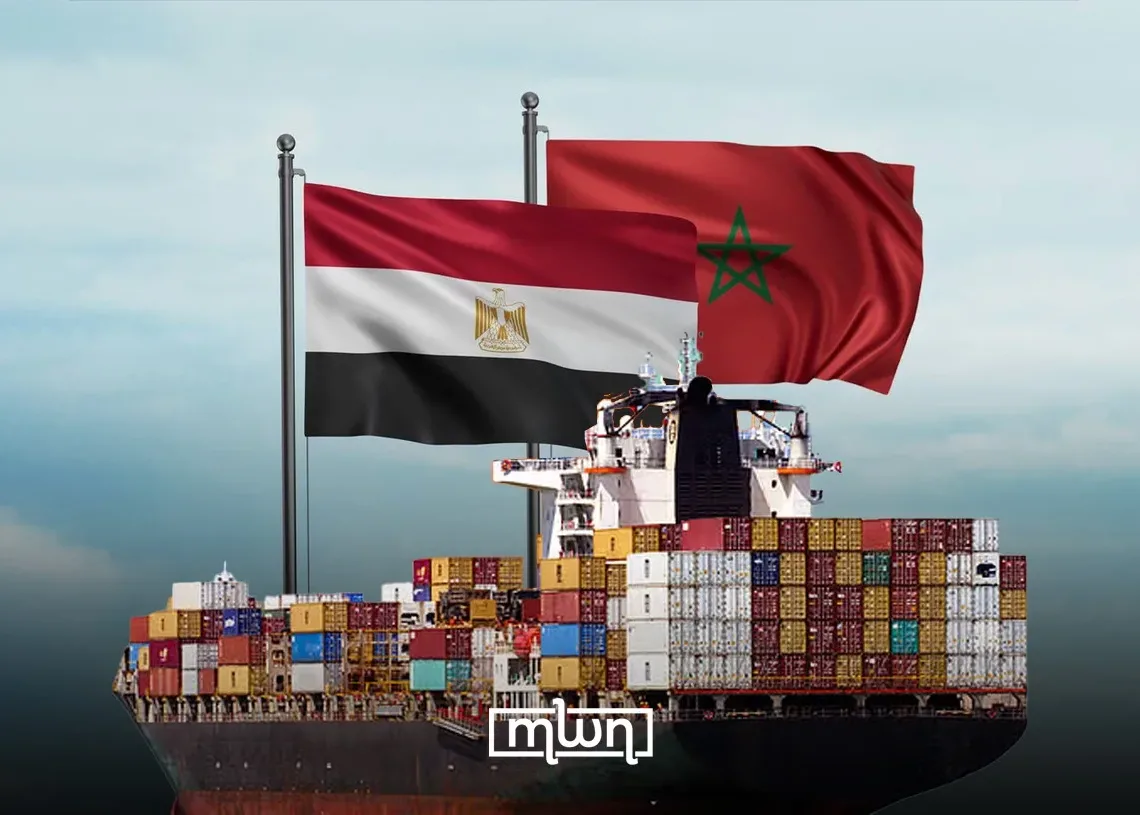
Rabat – Egyptian Minister of Investment and Foreign Trade Hassan Al-Khatib has reiterated the importance of achieving a more balanced trade relationship between Egypt and Morocco.
Speaking on the sidelines of the 17th Ministerial Meeting of the African Continental Free Trade Area (AfCFTA) in Cairo, held on Monday and Tuesday, Al-Khatib noted that Morocco and Egypt are entering “a new chapter” in their bilateral relations.
He pointed to the alignment between the two countries’ governments in their drive to boost trade flows, expand investment, and dismantle barriers hindering the free movement of goods and services.
“New Chapter” in bilateral relations
Al-Khatib noted that he had met with Moroccan Secretary of State for Foreign Trade Omar Hejira to discuss ways of facilitating investment and easing access to each other’s markets.
The talks, he said, also laid the groundwork for the upcoming Joint Trade Committee meeting in Marrakech, which is expected to set concrete steps for improving trade flows.
“We are entering a new chapter in trade relations between the two countries, thanks to the distinguished relations between President Abdel Fattah el-Sisi and King Mohammed VI,” Al-Khatib said.
Morocco’s perspective
For his part, Hejira stressed that Morocco sees Egypt as a key partner in advancing South-South cooperation. He said the discussions focused on practical mechanisms to support Moroccan exports to Egypt to narrow the trade imbalance that has long characterized bilateral exchanges.
Hejira underlined that both countries recognize the need for sustainable trade partnerships that go beyond short-term deals. “This meeting provided an opportunity to follow up on efforts to enhance trade exchange between the two countries and facilitate access for Moroccan goods and exports to Egyptian markets,” he said.
Broader African context
The Cairo meeting comes as African countries push forward with the implementation of the AfCFTA, a landmark agreement designed to create a single continental market of more than 1.3 billion people. Egypt and Morocco have been strong advocates of the pact, seeing it as a tool not only to diversify their economies but also to build stronger inter-regional value chains.
The two governments have voiced determination to scale up their cooperation. The emphasis on a “balanced” trade relationship reflects longstanding concerns about asymmetries in imports and exports, with Morocco often recording deficits in its trade with Egypt.
In May, Morocco announced plans to sharply boost its exports to Egypt, with targets set to rise from MAD 755 million ($75 million) to MAD 5 billion ($500 million) over the next three years. The initiative came on the heels of a visit to Cairo by a Moroccan trade mission of 40 representatives, during which business leaders and exporters held more than 200 meetings with their Egyptian counterparts.
The mission was launched by Hejira and led by Hassan Sentissi El Idrissi, president of the Moroccan Confederation of Exporters (ASMEX), with the clear objective of strengthening the presence of the “Made in Morocco” brand.
South-South partnerships
For Morocco, the renewed dialogue with Egypt aligns with its broader policy of reinforcing South-South economic partnerships, particularly in Africa. This strategy has been central to Rabat’s diplomacy over the past two decades, with Morocco investing in infrastructure, banking, and energy projects across the continent.
Egypt, for its part, has sought to position itself as a gateway to African markets, leveraging its industrial base and geographic location. By reinforcing bilateral trade, both countries are aiming to strengthen their roles as regional hubs within the framework of the AfCFTA.
Recently, King Mohammed VI reaffirmed Morocco’s commitment to South-South cooperation as a cornerstone of Africa’s sustainable development in a message to the 2025 Ibrahim Governance Weekend in Marrakech.
Delivered by Advisor André Azoulay, the message urged African countries to take charge of their development agendas through shared initiatives, stressing Morocco’s role in fostering regional partnerships.
“Morocco has managed to strengthen its role as a strategic catalyst for South-South partnerships, and to serve as a natural bridge between the continent’s various regions and the countries of the South,” the King declared.
He cited flagship projects such as the African Atlantic Gas Pipeline, which he described as “a concrete example of integrated economic development,” and the Atlantic Initiative, designed to give Sahel countries access to the ocean and lay “a solid foundation for a new model of regional cooperation.”