
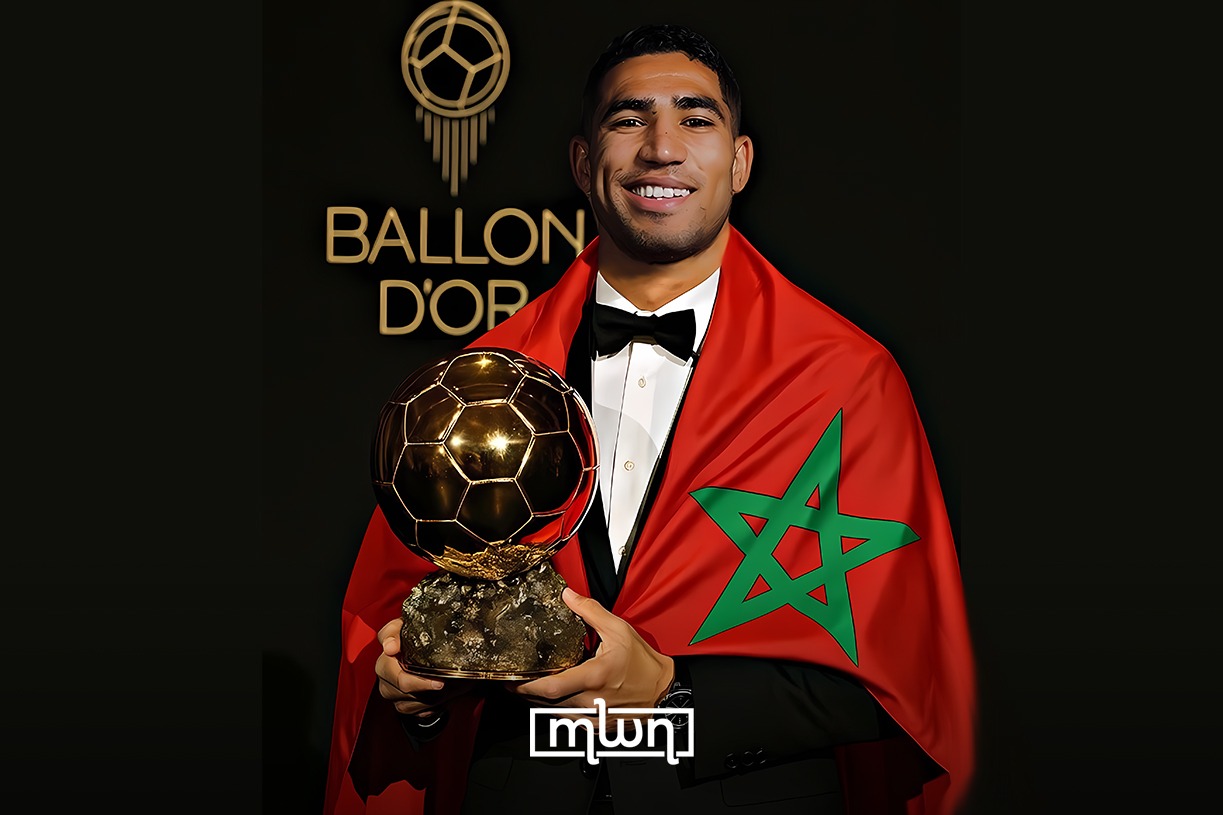
Tomorrow in Paris, when the Ballon d’Or winner will be announced, Achraf Hakimi will almost certainly not be holding it, not because of footballing merit, but because of narrative. France wants its man, and its media have sharpened the knives accordingly.
The French pride is a fragile creature. The prospect of a Moroccan lifting football’s most hallowed trophy on French soil is apparently intolerable. Better to drag him through the mud and install a compatriot by default.
Still, by any footballing measure, Hakimi has just had the season of his life. A right-back in name only, the Moroccan has been Paris Saint-Germain’s most devastating forward weapon. Eleven goals, sixteen assists, four trophies – including PSG’s first Champions League – and the kind of reliability that would make a Toyota Land Cruiser blush.
The Ballon d’Or, football’s most gilded bauble, is within touching distance. Or was, until French justice staged a curious comeback of its own. Last month, prosecutors in Nanterre revived a rape case that had been wheezing on life support for two and a half years. No new evidence. No breakthrough revelations.
A Case That Wouldn’t Die
The accusation itself is riddled with contradictions. WhatsApp messages between the accuser – dubbed “Amélie” – and her friend Nadia tell a less-than-heroic tale. Hours before arriving at Hakimi’s flat, Amélie texted: “J’ai le démon mdrr.” Nadia egged her on to go “mode femme fatale” and “dépouiller” him – a slangy call to rob him for money. She also added: “We’re going to strip him.”
Hakimi, for his part, said the encounter was limited to kisses. He denied penetration. He denied coercion. He denied everything beyond flirtation.
Mbappé backed his former teammate unequivocally. “Achraf Hakimi is respectful toward women. Even when drinking, I’ve never seen him behave inappropriately.”
Meanwhile, Amélie twice refused a medical examination. She also refused to hand over her phone. She changed her account of events between hearings. Her psychological evaluations found “contradictions” and “lack of clarity.” Yet the prosecutor ploughed on.
Fast forward to August this year, and the prosecutor suddenly deemed there were “sufficient charges” to seek a criminal trial – just journalists around the world cast their votes for the Ballon d’Or winner.
Hakimi told Canal+: “Everything is false. I have never raped anyone. I think I fell into a trap, to be used, as blackmail, to extort money from me,” he said. His lawyer, Me Fanny Colin, dismissed the prosecution’s demand as “insane.”
The Club des Avocats au Maroc has waded in, accusing French justice of “character assassination.”
The Inconvenient Messages
Le Monde published Emma’s version of events in detail, complete with the timestamp of WhatsApp exchanges (“At 1:27 am: ‘He grabbed me… I’m gonna leave.’ At 1:50 am: ‘It’s really bad.’ At 2:19 am: ‘On my mother’s life, he raped me.’”). L’Equipe splashed “sufficient charges” across its pages. Le Parisien followed dutifully with reminders of possible 15-year prison terms.
What they did not splash quite so enthusiastically were the incriminating messages about “dépouiller” him. Nor the fact that the accuser initially filed nothing more than a main courante – a kind of diary note at the police station that carries no legal weight.
It all reeks of orchestration. The timing, the leaks, the selective framing – one could almost mistake it for a campaign briefing from the Élysée.
The inconsistencies are not minor footnotes; they are the case. Hours before the alleged assault, Amélie texted her friend that she was “keen” for intimacy. She later purged her phone of those messages. Only when her friend was interrogated did police discover texts urging Amélie to “strip him” and seize his bank codes.
The “victim” refused to hand over her phone, declined medical proof, and changed her version of events repeatedly — at one point admitting her memory was “blurry” and “vague.” Psychological evaluations admitted her account lacked clarity. And yet, the prosecutor insists his file is watertight.
Hakimi is not yet on trial in a court of law. But in the court of public opinion, French media has already written the verdict. “The investigation and the judicial inquiry made it possible to establish the crime of rape,” declared Rachel-Flore Pardo, lawyer for the accuser.
To which Hakimi responded on Canal+: “I have done nothing wrong. I know the truth will come out. This is horrible and unfair, but I am calm because I know my innocence will be proven.”
Why Now?
The question hardly needs asking. Hakimi has the statistics, the trophies, the narrative. He carried PSG in Europe, topped performance ratings, and bagged the Marc-Vivien Foé Award for Africa’s best. He also captained Morocco to win the bronze medal in the Paris Olympics – beating Argentina, Iraq, USA, before losing narrowly 2-1 to Spain. They pummelled Egypt 6-0 to win third place.
Dembélé, by contrast, had also a fine season – six goals, fourteen assists – but is hardly the transformative figure. Yet, France’s press machine has been humming a one-note chorus: “Vote Dembélé.”
A talented player, yes. But a Ballon d’Or contender on par with Hakimi? Only in a parallel universe where pulling a hamstring counts as a goal contribution.