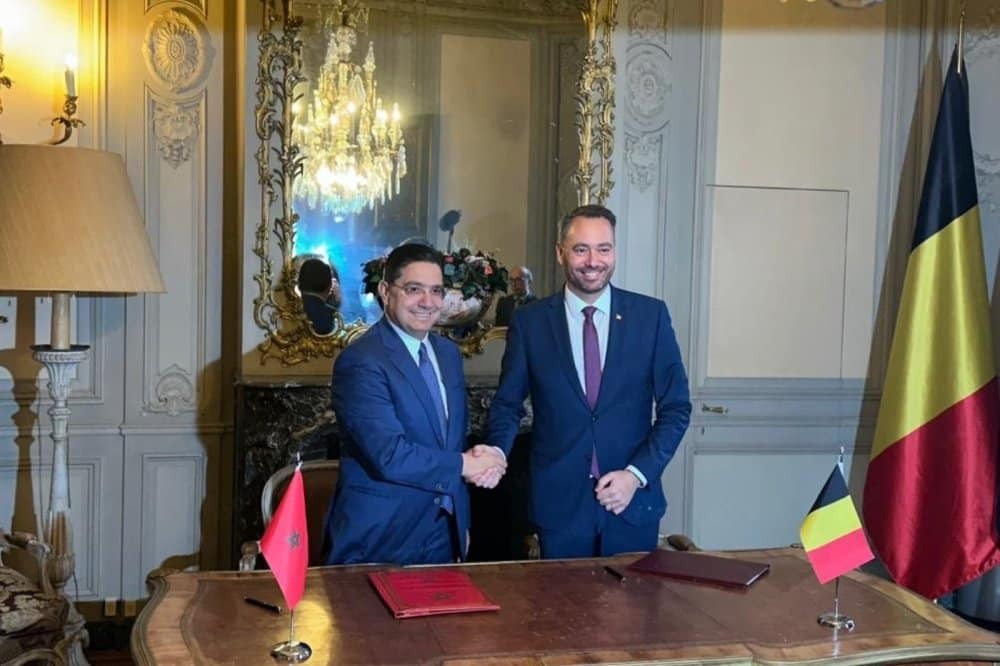
Rabat – Belgium has expressed its support for the Moroccan Autonomy Plan, placing the region within the framework of Morocco’s sovereignty and national unity.
Morocco’s Foreign Affairs, Nasser Bourita, signed a joint declaration with his counterpart, Maxime Prevot today, in which Belgium affirmed that it will act “from now on, on diplomatic and economic levels, in line with this position.”
Belgium has previously expressed support for Morocco’s Autonomy initiative as a serious and credible political solution for Western Sahara.
The recently signed joint declaration, however, marks a major shift in favor of Morocco’s Western Sahara momentum as the European country now adopts a more specific and explicit backing for Rabat’s sovereignty over its southern provinces and territorial integrity.
In the joint declaration, Belgium asserted that it is aware of the “existential importance of the Sahara issue” for Morocco, and considers that the autonomy initiative constitutes the “most appropriate, serious, credible, and realistic basis to achieve a political solution.”
For his part, Bourita welcomed Belgium’s position, describing it as a “clear recognition of the realism and legitimacy of the vision led by His Majesty King Mohammed VI, may God assist him, for the definitive settlement of this regional dispute.”
Belgium’s position aligns with a stance adopted by over 120 countries, including powerhouses like France and the US.
On Tuesday, Poland also expressed its official backing of the Autonomy Plan, describing it as a “serious, realistic, and pragmatic basis for a lasting solution.”
A joint statement was issued following a phone call between Poland’s Deputy Prime Minister Radoslaw Sikorski, announcing the new position Poland endorses, emphasizing the importance of bilateral ties between the two countries.
On Wednesday, France also reiterated its support for Morocco’s territorial integrity along with a group of other countries that also backed the autonomy initiative as the only viable political solution able to end the dispute over Western Sahara.
The growing support comes as the UN seeks a closure to the dispute, which has been ongoing for 50 years. A definite solution, however, requires the engagement of all parties – a situation that poses a challenge to the UN-led political process as Algeria’s regime continues to orchestrate a hostile campaign targeting Morocco’s sovereignty over its southern provinces.
Algeria’s regime refuses its role as a political party in the dispute, describing itself as merely an observer. Its claims come as it harbors, finances, finances, and supports Polisario’s independence claims and referendum, an outdated narrative that the international community disregarded for decades.
The UN Security Council is set to vote on a new resolution on Western Sahara later this month, and a draft resolution shared with Morocco World News suggests that the renewal of MINURSO’s mandate will be set at six months instead of one year.
The UN Security Council took a similar approach in April 2018 until October 2018, and again in October 2019 until April 2019, renewing the MINURSO mandate to only six months, a departure from the usual one-year term.
The decision was mainly driven by former US National Security Advisor John Bolton’s policy, which was critical of the UN peacekeeping mission MINURSO, deeming it unproductive.
This year’s proposal for a six-month mandate for MINURSO – if confirmed – is primarily driven by the US, which seeks to push for a final settlement of the Sahara dispute.
The US, which is the penholder of the draft resolution, has supported recognizing Morocco’s autonomy initiative as the only solution to end the dispute, fully recognizing Moroccan sovereignty since December 2020.
Morocco’s strong backing from global powerhouses further puts pressure on Algeria’s regime to engage seriously in the UN-led political process without delay.