
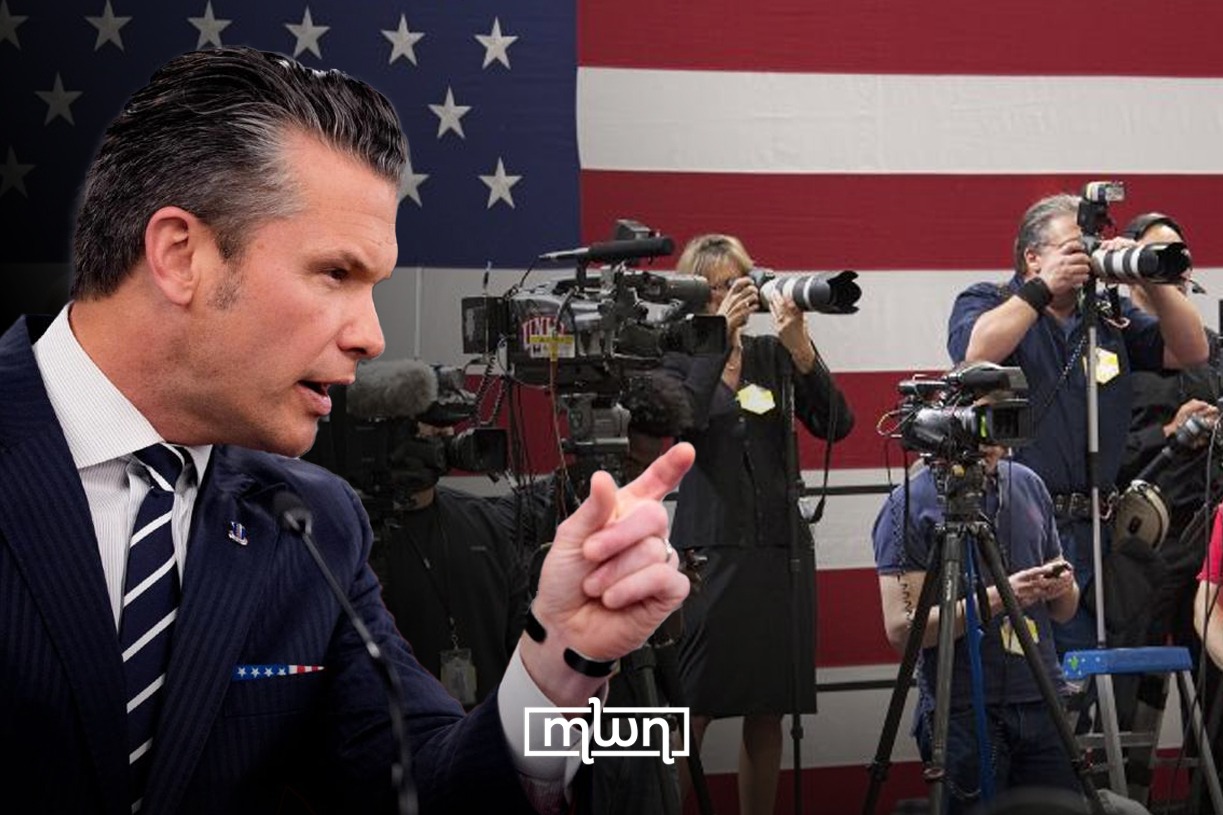
Rabat – Since his appointment, US Secretary of Defense Pete Hegseth has been clamping down on some of the nation’s most renowned and credentialed media outlets’ presence in the Pentagon, the Department of Defense (DoD) headquarters in Arlington, Virginia.
Earlier this year in May, Hegseth announced new restrictions on journalists covering the Pentagon, including physically blocking off specific offices and floors and official government escorts required for journalists in some circumstances.
Again in September, Hegseth issued a memo that restricted journalists from reporting any information — even unclassified — unless approved by the DoD.
Finally, on October 15, major outlets and journalists surrendered their Pentagon credentials rather than adhere to the new restrictions, packing up office and essentially concluding years of in-house coverage of the Pentagon.
More than 30 outlets walked out of the Pentagon, now only 15 reporters remain.
Last week, replacement of the Pentagon press began, with pro-Trump media at its core.
The press responds: fear for free speech
Long-standing and respected outlets like CNN, AP News, The Washington Post, and Reuters say they will continue to report on defense and military news from outside the Pentagon.
A joint statement in response from ABC, CNN, CBS, NBC, and even Fox News — a favorite of U.S. President Donald Trump — reads:
“The policy is without precedent and threatens core journalistic protections. We will continue to cover the U.S. military as each of our organizations has done for many decades, upholding the principles of a free and independent press.”
In an interview with CNN, renowned former Pentagon correspondent Barbara Starr
rejected the overhaul: “There is plenty of room for new media out there, new credible media emerging in this country. There’s plenty of room to discuss the question of the lack of public trust in some media… and that is what many news organizations are already doing.”
Trump’s agenda flourishes with new Pentagon press
Last week, a new type of media flocked to the Pentagon to replace the press vacuum.
MAGA and pro-Trump influencers like Gateway Pundit, The National Pulse, Just the News, TurningPoint USA media (founded by conservative political commentator Charlie Kirk who was assassinated in September), RedState, and Lindell TV will act as the new press corps.
Alongside multiple defamation lawsuits against several of these outlets involving 2020 election lies, these media are known more for their colorful political commentary rather than actual news coverage.
These outlets are outspoken and overt on their conservative-leaning stances and their adamant support of Trump — much of their coverage resorts to sensationalist stories with hoax-ish, unprofessional, conspiracy-like themes and trollish headlines. (A recent headline from Gateway Pundit reads: “WTH?! AOC Goes on Unhinged Screaming Rant at Mamdani Rally.”)
This new media comes alongside Trump’s defunding of PBS and NPR, his ban on AP News from the White House, and continued promotion of AI-generated ‘slop’ on social media.
What this means in the long-run
Unprecedented indeed, the physical absence of independent media in the Pentagon will change the game of military and Pentagon coverage that has been so crucial to a free American press since the 1940s — when the press first began reporting out of the Pentagon.
In 1971, The U.S. Supreme Court affirmed the press’s right to publish information that the government sought to censor in the Pentagon Papers case, establishing a norm of uncompromising transparency between the American people and the Pentagon.
National security must indeed be a priority, but Hegseth’s idea that sensitive information is simply being leaked out of the DoD, is challenged by a decades-long understanding and expectation of radical openness from the Pentagon. (The irony is not lost given Hegseth’s infamous war plan leak in a group chat in April of this year).
Former Pentagon correspondents shared stories of regular interactions and solid rapport with four-star generals in the halls of the Pentagon, who were once enthusiastic to share information with the American public via journalists and media.
“Four-star generals would come up to me and say… ‘here’s some information that the American people need to know.’ They would share some sensitive information with me… I would report it. You can’t do that now.’”
Starr shared a similar experience during her time at the Pentagon: “Every defense secretary that I ever covered walked the hallways themselves. They liked to run into reporters… ‘We want to talk to the American public,’ and that often goes through the news media. That’s just a fact in this country.”
Independent press presence in one of the world’s top-tier, robustly secure military institutions is an incredible show of democracy and perhaps one of the strongest practices of freedom of speech. For Hegseth and the Trump administration to now spoon-feed the press, sedates true investigative reporting and puts one of America’s founding principals to shame.
To deter serious and unbiased journalism in the Pentagon is a dangerous step forward in snipping the increasingly fragile fabric of trust between the American public and the government — a trust that is facilitated by media, journalists, and absolute free speech.