

Rabat – Archaeologists have made new discoveries at Bizmoun Cave near Essaouira, Morocco. These findings provide a better understanding of how early humans lived and how life was in the Stone Age.
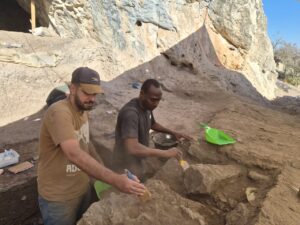
The National Institute of Archaeology and Heritage, part of the Ministry of Youth, Culture, and Communication, began new excavations at Bizmoun Cave. The goal is to learn more about early humans in Morocco and the different stages of their development.
The researchers found stone tools and jewelry that are more than 150,000 years old, according to SNRT News. These discoveries make Bizmoun Cave very important for studying human history in North Africa.
Excavations started on November 3 and will continue until December 3. The project is a collaboration between Morocco, the United States, and France. Scientists are focusing on layers from the Middle Stone Age, where some of the oldest jewelry in the world was found.
Abdeljalil Bouzocar, director of the National Institute of Archaeology and Heritage, told SNRT News that the new research continues earlier work at the cave. The team also found new sites in the surrounding mountains, including Jbel El Hadid and Jbel Korati. So far, over 300 archaeological sites are known in the Essaouira region.
The team discovered fossils of extinct animals, showing that Essaouira used to be a link between the Mediterranean and the Sahara. They found bones of the Atlas lion, which lived about 110,000 years ago, as well as rhinoceroses, ancient cattle, horses, antelopes, gazelles, and ostrich eggs over 150,000 years old. They also found ancient plants that early humans consumed.
Stone tools found nearby were used for hunting, and they are also more than 150,000 years old. These finds help scientists understand how early humans lived, hunted, and survived.
The research team includes Professor Abdeljalil Bouzocar from Morocco, Professor Steven Kuhn from the University of Arizona, and Dr. Philippe Fernandez from Aix-Marseille University.
Bizmoun Cave and its surroundings are key places for learning about the history of early humans in North Africa, concluded the report.