
 Join on WhatsApp
 Join on Telegram
Mohammedia – Morocco is entering one of the most challenging water chapters in its modern history, as years of drought and critically low dam reserves push the country to rethink how every drop is managed.
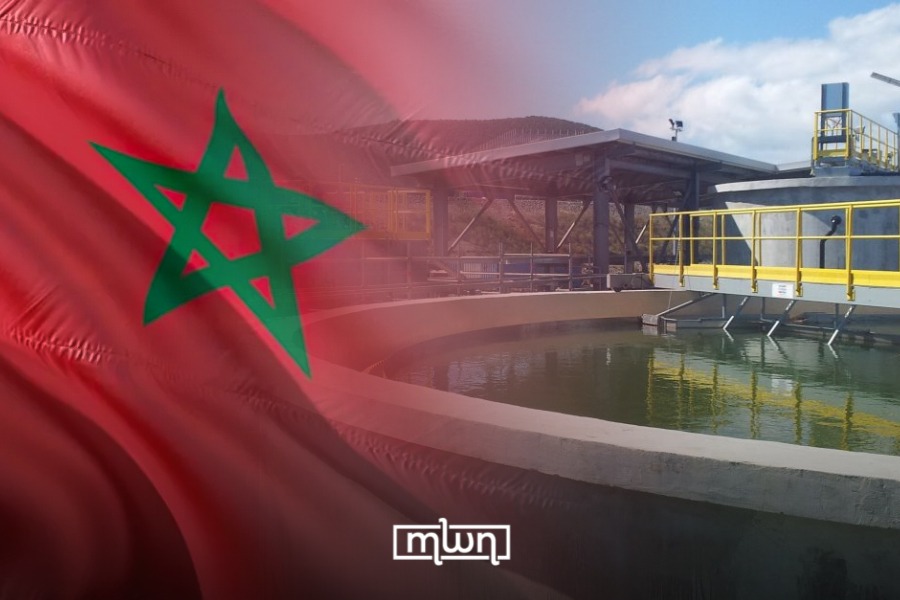
What was once an environmental concern has now become a structural issue touching agriculture, industry and daily life. In this context, wastewater treatment and reuse have moved from a niche technical subject to a central pillar of Morocco’s long-term water resilience.
Meanwhile, renewable water availability has fallen to around 600 cubic meters per person per year, far below the scarcity threshold of 1,000.
Some reservoirs, such as Al Massira, the country’s second-largest, are hovering around 1% of capacity. Meanwhile, population growth, expanding cities and rising agricultural needs continue to increase pressure on a resource that is becoming more irregular with every passing season.
Wastewater reuse moves to the center of water policy
This shift in priorities explains why the National Shared Liquid Sanitation and Reuse Program has become one of Morocco’s most strategic initiatives.
The plan sets a long-term goal of mobilizing up to 573 million cubic meters of treated wastewater annually.
The first milestone is far more immediate, as it aims to reach 100 million cubic meters per year by 2027. Today, reuse stands at 52.6 million cubic meters — double the figure from 2019 — but still only halfway to what authorities expect in less than two years.
On the ground, major projects are already reshaping the country’s water landscape. Between 2019 and 2024, nearly MAD 6 billion dirhams were invested in reuse infrastructure, from treatment upgrades to new distribution systems.
Marrakech offers one of the clearest illustrations of this trend. The city’s wastewater treatment plant processes 33 million cubic meters annually, supplying irrigation water to golf courses and the Palmeraie. Similar projects are expanding in Agadir, Tangier and the Tétouan–Martil corridor.
Private industry has also become a key actor. The OCP Group channels over 20 million cubic meters each year for industrial use and aims to rely entirely on non-conventional water sources.
This model where industries work directly with sanitation operators and help finance needed infrastructure is increasingly seen as a template for future expansion.
A water system under strain
These advances are happening against a backdrop of deeply stressed natural resources. The period from 2018 to 2024 has been the driest since records began in 1945, with dam inflows falling from more than 40 billion cubic meters in wet years to less than 10 billion in recent seasons.
The vulnerabilities are not evenly distributed, as some basins face severe shortages, while only a small portion of the country concentrates most renewable water.
To keep pace with declining water availability, Morocco has massively expanded its sanitation network.
The number of wastewater treatment plants has grown from just seven in 2006 to 216 in 2024. Tertiary treatment is now available in dozens of facilities, enabling safe use in green spaces, agriculture or industry.
National wastewater depollution improved from 7% in 2006 to nearly 58% by 2024, a transformation driven by both investment and new technology.
Yet technical progress is only part of the equation. Experts point to persistent challenges in water quality monitoring, regulatory frameworks, storage capacity and the need to formalize agricultural reuse.
Despite its potential, much of the water suitable for irrigation remains underused due to a lack of planning, distribution pipelines or legal clarity.
Governance, partnerships and the road ahead
These issues were at the center of a workshop held in Rabat on November 19, bringing together the Policy Center for the New South, the Ministry of the Interior, the European Union and the French Development Agency.
Specialists emphasized that wastewater reuse can only succeed through integrated governance, linking planning, financing and environmental oversight.
They called on authorities to ensure that expanding reuse capacity aligns with national priorities in agriculture, urban development and industrial growth.
International partners note that Morocco has the foundations to scale up quickly, especially under the National Program for Water Supply and Irrigation 2020–2027.
With desalination expanding nationwide, irrigation shifting toward more efficient techniques and wastewater reuse accelerating, the country is gradually diversifying its water sources to build long-term resilience.
Read Also: New Data Shows Morocco at High Climate Risk as Water Resources Fall Sharply