
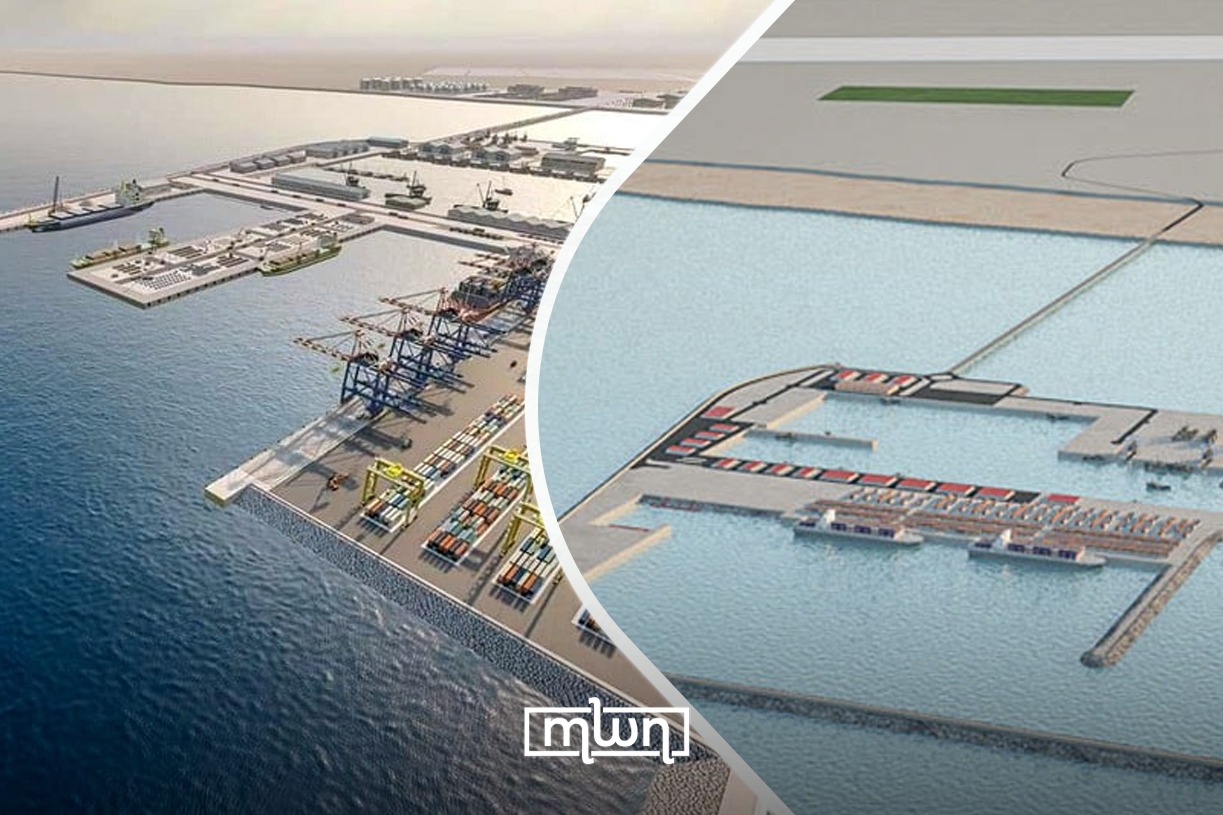
Mohammedia – Port Dakhla Atlantique enters a pivotal new phase as engineers push ahead on one of Morocco’s most ambitious infrastructure projects.
During the first panel of the Dakhla Africa Logistics Forum held last week, Abid Mrayzig, chief of works at the port’s development directorate, offered fresh insights as to how the megaproject is structured and how far construction has advanced, according to H24.
His update comes at a time when the port continues to be viewed as a strategic lever for the economic emergence of the southern provinces and a key element in the Kingdom’s wider Atlantic vision.
The project takes shape within the national port strategy for 2030 and the new development model for the southern provinces, while also responding to regional needs in fisheries, logistics, and cross-border trade.
It aims to transform Dakhla-Oued Eddahab into a central interface for African economic integration, echoing the vision shared by King Mohammed VI during the 45th anniversary of the Green March.
Beyond its continental ambition, the port is designed to serve as a modern, high-capacity platform to unlock new investment and strengthen Morocco’s industrial and logistical position across the Atlantic corridor.
Midway through the forum, Mrayzig emphasized the port’s potential to reinforce South-South cooperation, particularly in the context of the Royal Initiative for Sahel countries.
Alongside the deep-water port itself, the plans include a 1,600-hectare industrial and logistics zone organized around four key priorities: making the area attractive to operators through a multimodal platform, improving access to serviced industrial land, fostering industrial synergies for higher value creation and developing a logistics and economic space serving West African and Sahel markets.
The site, located roughly 50 kilometers from Dakhla’s urban center, will also benefit from strong maritime connectivity toward the American, European, and African continents.
A strategic hub taking shape
Beyond its geopolitical outlook, the port boasts technical and operational advantages that place it among the country’s most advanced infrastructure projects.
Its total projected capacity reaches 35 million tons per year, covering container traffic, liquid and solid bulk, fisheries, mining products and renewable energy components.
Mrayzig highlighted the concept of multimodality as a defining feature, noting that the link with the Tiznit-Dakhla expressway will help streamline the circulation of goods.
The port also fits into the region’s aviation development program, reinforcing transport interconnectivity.
The logistics zone adjoining the port is expected to evolve progressively as operators arrive. It will be structured into several poles, including seafood competitiveness, shared services, a general industrial zone, a commercial zone, a logistics hub and a 650-hectare dedicated port space.
On the engineering side, the project is conceived as an island port connected by a land corridor and equipped with two main basins – one with a twelve-meter draft and the second varying between 12 and 14 meters.
Several specialized quays are planned, including a deep berth at minus 14 meters for heavy cargo linked to renewable energy, and three commercial quays for petroleum products, containers and Ro-Ro traffic, all reaching minus 16 meters.
The complex will extend over 2.7 kilometres of quays, with an overall width of 1.3 kilometres and more than 7.5 kilometres of protective breakwater.
The total cost of the project is estimated at MAD 15 billion ($1.65 billion). Current works have reached 46% completion, with the maritime bridge nearing finalization and active construction ongoing across the second and third basins.
According to Mrayzig, the port is designed for future expansion, ensuring that its role within Morocco’s Atlantic strategy will continue to grow in the years ahead.
Read Also: CIRPES in Dakhla Signs Four African MoUs to Combat Child Soldiers