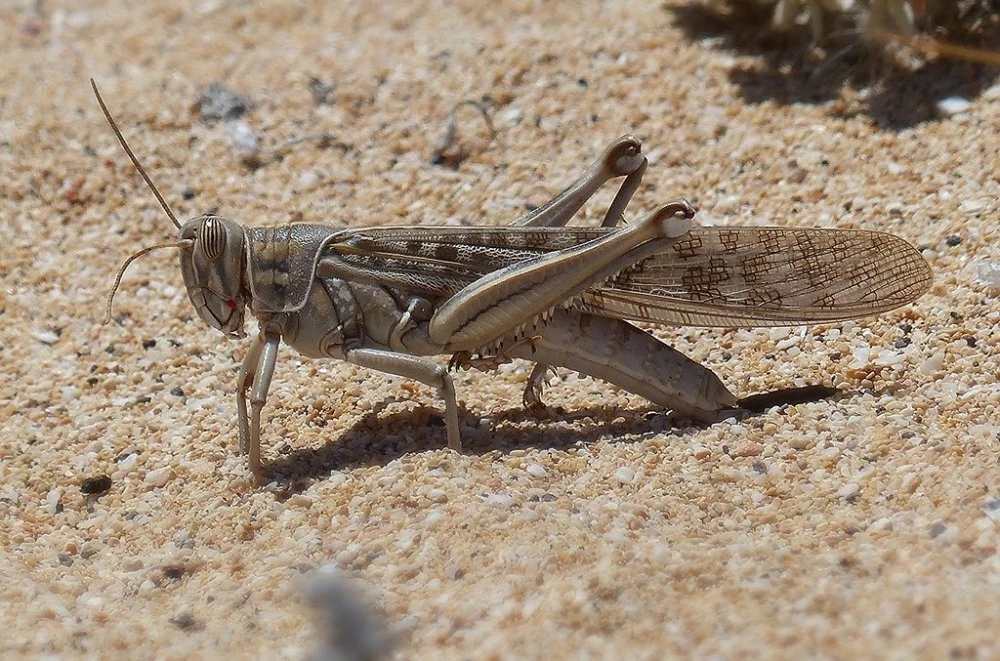
Marrakech – Morocco handed over 100,000 liters of pesticides to Mauritanian authorities on Monday in Nouakchott’s outskirts to support the country’s fight against desert locust swarms threatening agricultural and pastoral resources.
The donation reflects the depth of fraternal relations and cooperation between Morocco and Mauritania across various sectors.
It continues the close and permanent cooperation between national specialized centers combating this pest in both Morocco and Mauritania through technical support and experience exchange at the bilateral level or in coordination with the Food and Agriculture Organization (FAO) through the Commission for Controlling the Desert Locust in the Western Region (CLCPRO).
The handover took place at the facilities of the Mauritanian Center for Locust Control in the presence of representatives from the Moroccan Embassy in Nouakchott, officials from the Mauritanian Ministry of Agriculture, a FAO representative, and the director of the National Center for Desert Locust Control in Mauritania.
CLCPRO Executive Secretary Mohamed Lamine Hamouni hailed Morocco’s “rapid and qualitative response” to the aid request from concerned Mauritanian authorities in a statement to the Moroccan news agency MAP. He noted that “a cargo of pesticides was sent in a timely manner and in sufficient quantity.”
This generous support and notable efforts by Morocco will allow Mauritania to eradicate this pest or at least reduce its impact, Hamouni remarked. He stressed that desert locusts represent a cross-border threat requiring cooperation and strengthened efforts in eliminating their breeding sites.
Acting Secretary-General of the Mauritanian Ministry of Agriculture, Mohamed Yahya Mohamed Mahmoud, lauded the extremely important support provided by Morocco contributing to Mauritanian efforts against the desert locust pest threatening the environment and food security.
He added that this aid demonstrates cooperation uniting both bordering countries at all levels, serving integrated development and deeper coordination.
Fighting locusts requires redoubled efforts and coordination between countries, which prompted FAO to create a specialized body for combating this pest grouping regional countries, he observed.
Current anti-locust efforts concentrate in Mauritania’s Inchiri region in the west, Dakhlet Nouadhibou in the north, and Trarza in the southwest, according to Mauritanian officials.
Morocco now leads regional locust-control preparedness
Morocco maintains recognition from FAO and the World Bank as one of the reference countries in desert locust control in the western region. At the heart of this system stands the National Anti-Locust Center (CNLAA) based in Aït Melloul, which coordinates surveillance, early warning, preventive treatment, and crisis response.
The center manages field prospection in breeding areas, maintains detailed situation maps, oversees pesticide and equipment stocks, and evaluates environmental and health impacts in close coordination with FAO regional commissions such as CLCPRO.
Morocco has evolved from the “spray everything” approach of the 1980s-1990s to a more restrictive and sophisticated regime.
Only four products are now registered specifically for locust control: the pyrethroids deltamethrin and lambda-cyhalothrin, the insect growth regulator diflubenzuron, and the biopesticide Metarhizium acridum.
This narrow list anticipates stricter EU residue standards on exported crops and pushes operators toward less persistent and more targeted molecules, particularly biopesticides.
Institutionally, Morocco has built a comprehensive infrastructure around pesticide management. National plans for locust risk assign to CNLAA and regional posts not just usage but also stock management, analysis, and safe disposal of locust-control pesticides, with over 200 dedicated storage sites across the country.
Under a FAO/GEF program on obsolete pesticides, Morocco inventoried about 850 tons of obsolete stocks and established systems for tracking and eliminating them, plus infrastructure for handling empty containers from locust campaigns.
This technical base gives Morocco the capacity to hold and mobilize large volumes of anti-locust pesticides, enabling support for neighbors during crises. International documents on emergency locust response cite CNLAA-Morocco as a training and expertise hub where other African states can send staff for capacity building in environmental and health monitoring of pesticide use.
Morocco serves as one of the pilot countries for FAO’s Locust Pesticide Management System (Locust-PMS/LPMS), a digital platform tracking pesticide stocks, batches, application sites, equipment, and exposure indicators from warehouse to field.
Key components in Morocco’s success include national research conducted by institutions such as the Hassan II Institute and CRTS on ecotoxicology and environmental impact, alongside partnerships with CIRAD and other laboratories to reduce broad-spectrum spraying.
This has positioned Morocco toward a model where anti-locust campaigns remain pesticide-based but are embedded in sophisticated systems of regulation, traceability, biopesticide integration, and regional solidarity rather than brute-force chemical control.