Marrakech – With Algeria now eviscerated of its diplomatic veneer and standing naked before international scrutiny, the United Nations has finally published Resolution 2797, delivering a devastating blow to Algiers’ mendacious campaign to manipulate the official text and obfuscate its role as the malevolent architect of the Western Sahara dispute.
The UN Secretariat’s publication of this historic resolution came after an unprecedented 24-day delay, orchestrated entirely by Algeria’s pernicious interference with the translation process, revealing the depths of this regime’s duplicity and its pathological obsession with distorting reality to serve its hegemonistic ambitions.
Algerian officials conducted a relentless campaign of intimidation against UN staff, desperately pressuring them to replace the term “parties” with “two parties” in the Arabic version, seeking to expunge their country’s culpability in perpetuating this manufactured conflict.
This grotesque manipulation attempt represents the nadir of diplomatic conduct, transforming Algeria from a putative state actor into a rogue entity that operates through subterfuge and coercion.
The regime’s intrusive behind-the-scenes maneuvering provoked widespread condemnation from Security Council members who witnessed firsthand Algeria’s metamorphosis into a diplomatic pariah willing to corrupt international institutions to salvage its crumbling narrative.
Algeria’s machinations aimed to eviscerate accurate interpretations of Resolution 2797’s terms and recommendations, reducing the political process to a bilateral confrontation between Morocco and the Polisario while absolving Algeria of its primary role as the malicious puppeteer orchestrating this artificial dispute.
This calculated deception reflects the regime’s fundamental dishonesty and its inability to confront the inexorable tide of international opinion that has exposed its duplicitous game.
After more than three weeks of being held hostage by Algeria’s Byzantine machinations, the Security Council demonstrated its institutional integrity by publishing the resolution in all six official languages with the original reference to “parties” intact, delivering an unequivocal rebuke to Algeria’s contemptible attempts at textual vandalism.
This transparency definitively eviscerates Algeria’s attempts to alter the framework established by the Security Council for the political process, exposing the regime’s desperation as it watches its half-century investment in regional destabilization crumble before its eyes.
The published text confirms unequivocally that Algeria remains the principal malefactor in this regional dispute, the prime mover whose intransigence has condemned an entire generation to limbo in desert camps. No amount of linguistic legerdemain or translation chicanery can mask this incontrovertible reality consecrated by the Security Council’s collective wisdom.
Autonomy dominates every clause, obliterating Algerian fantasies
Concrete statistics from the resolution reveal Morocco’s absolute hegemony over the text, with autonomy mentioned six times while no other proposal receives even a cursory reference, demonstrating the complete intellectual bankruptcy of Algeria’s position.
The term “parties” appears thirteen times without ever mentioning “two parties,” each occurrence representing another nail in the coffin of Algeria’s obfuscation strategy.
The resolution explicitly references Moroccan sovereignty, incorporating it within the autonomy framework as an immutable fact rather than a negotiable aspiration. And the Security Council welcomes the United States as mediator, specifically naming the parties as Morocco, Algeria, Mauritania, and Polisario in a formulation that strips away Algeria’s fraudulent pretense of neutrality.
Conspicuously absent from the resolution are any mentions of referendum, independence, or human rights monitoring, concepts that exist only in the fevered imaginations of Algerian propagandists and the incendiary rhetoric of their exposed and clueless diplomatic apparatus.
Terms like “referendum” persist solely in statements by Algerian officials who continue peddling their obsolete narrative to an increasingly incredulous international community, while the actual UN text consigns these chimeras to the dustbin of history where they belong.
Attaf invents ‘two parties’ to erase Algeria’s culpability
Algerian Foreign Minister Ahmed Attaf’s response to this diplomatic catastrophe has been characterized by systematic prevarication and pathological denial that would make Orwell’s Ministry of Truth blush with embarrassment.
Attaf appeared visibly traumatized during his November 2 interview with AL24 News. His language trembled with the desperate cadence of a man who recognizes that his words carry no weight, given the historic magnitude of the diplomatic annihilation his country has suffered.
His physiognomy betrayed the internal turmoil of a seasoned diplomat confronting the wreckage of decades of failed policy, while his demeanor oscillated between bewilderment and barely contained panic as he attempted to spin an unspinnable disaster.
Attaf’s cascade of falsehoods began with his preposterous claim that the resolution calls for a referendum on self-determination, a blatant fabrication that he later contradicted by admitting the text “does not include the word referendum,” inadvertently exposing his own mendacity in real-time.
This spectacular self-contradiction encapsulates the intellectual chaos that has consumed Algeria’s diplomatic establishment as they grapple with their comprehensive defeat.
He then compounded his credibility deficit by insisting Morocco had not achieved its objectives because “sovereignty” does not appear in the resolution, despite the text’s explicit statement that “genuine autonomy under Moroccan sovereignty could represent the most realistic solution.” Such blatant, brazen fabrication reveals either Attaf’s illiteracy or his willful disregard for factual accuracy.
The minister’s most egregious deception involved his repeated insistence that the resolution calls upon “the two parties, Morocco and Polisario” to negotiate, when the Security Council specifically employs “parties” and explicitly mentions Algeria, definitively dismantling the myth of its “observer” role that this regime has fraudulently maintained for decades.
This linguistic sleight-of-hand represents the epitome of Algeria’s intellectual dishonesty, attempting to airbrush itself out of a conflict it has nurtured, financed, and weaponized for half a century. Attaf’s inability to acknowledge basic textual evidence demonstrates the complete moral and intellectual bankruptcy of Algeria’s position, downgrading him from a diplomatic interlocutor into a purveyor of alternative facts.
Algeria slid from regional power into diplomatic leprosy
Algeria’s abortive last-minute gambit to introduce an “expanded proposal” attributed to Polisario encountered universal rejection from Security Council members who recognized this transparent attempt at diplomatic sabotage for what it was.
Ambassador Amar Benjama’s improvised initiative, hastily concocted as a counterweight to Morocco’s Autonomy Plan, possessed neither official backing nor international credibility, representing instead the death throes of a dying diplomatic strategy.
This pathetic maneuver revealed Algeria’s complete isolation within the international community, dragging the country from a regional power into a diplomatic leper whose proposals are reflexively dismissed as the products of desperation rather than serious policy formulation.
The manipulation attempt illuminated Algeria’s metamorphosis into a rogue state that operates outside accepted diplomatic norms, employing tactics more suited to criminal enterprises than sovereign nations.
After being systematically marginalized from negotiations due to its pathological rigidity and delusional maximalism, Algeria’s only remaining option was to boycott the vote on Resolution 2797. Whatever self-serving interpretation Algiers may come up with to account for this desperate gesture, the overall context and already discernible, far-reaching significance of the UN resolution suggest it was an act of impotent defiance that further underscored its irrelevance to any constructive resolution of the dispute it helped create.
Attaf’s recent theatrical offer to mediate between Morocco and Polisario during a November 18 press conference represents the apotheosis of cynicism, converting the primary instigator of regional discord into a self-appointed peacemaker.
This farcical role reversal epitomizes Algeria’s shameless opportunism and its willingness to exploit any opening to rehabilitate its tattered reputation, even if it requires abandoning decades of ideological positioning.
By attempting to masquerade as a neutral actor while simultaneously spreading venom about Morocco’s sovereignty claims, Algeria demonstrates the schizophrenic nature of its diplomatic personality, simultaneously playing arsonist and firefighter in a conflict of its own making.
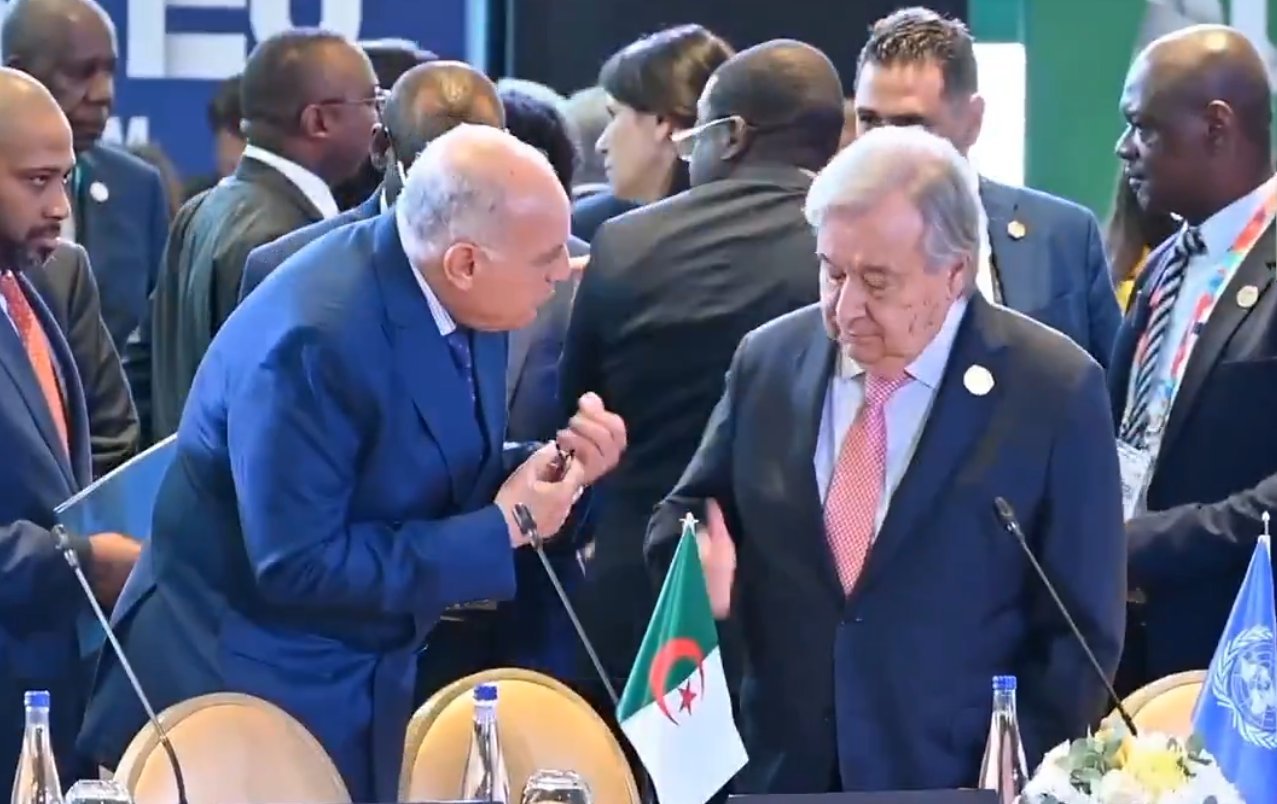
A recent video circulating on social media captured the nadir of Algeria’s diplomatic humiliation when Attaf desperately approached UN Secretary-General António Guterres, only to be summarily dismissed as Guterres turned away and continued walking, leaving the minister mid-sentence like a supplicant whose petition has been rejected.
This public snub illustrates Algeria’s precipitous fall from regional heavyweight to international pariah, a transformation that reflects the cumulative weight of decades of destructive policies and diplomatic malpractice.
Indeed, the footage serves as a metaphor for Algeria’s broader isolation. It shows a once-influential regime reduced to chasing after international leaders who no longer consider it worthy of serious engagement.
Half a century of juntas produced today’s catastrophe
This diplomatic catastrophe represents the inevitable culmination of half a century of mismanagement by successive military juntas that have squandered Algeria’s natural wealth on regional destabilization rather than national development.
Over $600 billion in hydrocarbon revenues, resources that should have transformed Algeria into a regional powerhouse, were instead diverted into a black hole of support for the anti-Morocco separatist cause. This has created a convoluted inversion of national priorities that prioritized external meddling over internal prosperity.
Such massive hemorrhaging of national wealth represents one of the most spectacular cases of resource misallocation in modern history, mutating Algeria from a potential regional leader into a cautionary tale about the perils of ideological extremism.
President Abdelmadjid Tebboune’s inadvertent confession in July encapsulated this tragic reality when, in a rare moment of honesty that pierced through decades of official dissimulation, he admitted: “We have wasted fortunes and billions of dollars for Polisario.”
Former FLN Secretary-General Ammar Saadani’s 2019 estimate that Algeria spent over $500 billion supporting Polisario since 1975 provides a staggering quantification of this systematic pillaging of national resources. This stupendous wealth could have funded education, healthcare, infrastructure, and economic diversification. But it was instead consumed by the insatiable appetite of a phantom state that exists only in refugee camps and diplomatic fiction.
While Algeria pours hundreds of billions into sustaining its artificial creation, ordinary Algerians endure the consequences of this criminal neglect through endemic youth unemployment, recurring shortages of basic goods, and systemic underdevelopment that has transformed the country into an exporter of human misery.
This perverse prioritization of external adventurism over domestic welfare has created the perverse situation where Algeria, despite possessing vast natural resources, has become one of the rare oil-producing nations whose citizens emigrate daily by the hundreds, risking their lives in desperate attempts to reach Europe in search of the opportunities their own government has denied them.
The timeline pressures Algeria’s failing artificial separatist project
The resolution’s passage with eleven votes in favor, zero against, and three abstentions delivered another crushing blow to Algeria’s diplomatic credibility while exposing the hollowness of its threats and bluster.
The Russian veto that Algeria’s proxies had long threatened failed to materialize, revealing the emptiness of Algeria’s supposed strategic alliances and the transactional nature of relationships based on shared opposition to Western influence rather than genuine partnership. Even China’s abstention, despite Algeria’s courtship efforts, demonstrated the limits of ideological solidarity when confronted with the reality of international consensus around Morocco’s position.
Resolution 2797 establishes autonomy under Moroccan sovereignty as the most realistic solution while explicitly requiring negotiations to be conducted based on Morocco’s Autonomy Plan, definitively consigning the referendum option to the historical dustbin where it belongs.
In this sense, the resolution represents the international community’s collective rejection of Algeria’s maximalist position and its embrace of pragmatic compromise as the only viable path forward.
Its requirement that all parties engage in discussions without preconditions based on Morocco’s Autonomy Plan delivers a fatal blow to Algeria’s strategy of endless procedural obstruction and precondition-setting that has characterized its approach for decades.
The Secretary-General’s mandate to provide a strategic review of MINURSO’s mandate within six months, considering future negotiation results, signals the beginning of the end for a mission that has outlived its usefulness and become a costly monument to international inaction.
This timeline creates pressure on all parties to engage constructively or face the prospect of fundamental changes to the international framework that has sustained the status quo for three decades. For Algeria, this represents an existential threat to the artificial life-support system that has kept its phantom state viable despite its lack of genuine popular support or international recognition.
Algeria’s counter-attacks have proven not merely ineffective but counterproductive, further exposing its isolation and desperation to an international community increasingly impatient with its obstructionist tactics.
Despite frantic lobbying in UN corridors and desperate attempts to break the silence procedure launched by the United States, no Security Council member demonstrated willingness to sacrifice their credibility by supporting Algeria’s transparent manipulation attempt.
This universal rejection shows Algeria’s slide from a respected member of the international community into a diplomatic outcast whose proposals are automatically suspect.
The regime’s current predicament represents the inevitable consequence of decades of diplomatic malpractice, regional destabilization, and systematic deception that has finally collapsed under the weight of its own contradictions.
Algeria’s inability to adapt to changing regional dynamics, its pathological attachment to obsolete Cold War-era posturing, and its refusal to acknowledge the fundamental shifts in international opinion have conspired to create this moment of reckoning where all its chickens have come home to roost simultaneously.
Cornered, the regime retreats into pure denialism
Today, Algeria’s regime stands completely exposed before its own people, stripped of the elaborate mythology that has sustained its legitimacy for half a century and forced to confront the consequences of its systematic misgovernment and criminal neglect of national priorities.
Unable to justify this comprehensive diplomatic catastrophe or explain how hundreds of billions of dollars were illegally diverted from national development to fund foreign adventurism, the regime has retreated into the last refuge of failed governments: systematic lying and categorical denial of observable reality.
Hence Ahmed Attaf, supposedly a state minister and the head of Algerian diplomacy, has been reduced to peddling fabrications so transparent that they insult the intelligence of his own citizens, twisting himself from a diplomatic representative into a carnival barker hawking fantasies to an increasingly skeptical audience.
His performance represents the intellectual and moral bankruptcy of a system that has lost all connection to truth, decency, and the legitimate interests of the people it supposedly serves.
This debacle represents the final act in Algeria’s Security Council tenure, as the country’s non-permanent membership expires on December 31, 2025, ensuring it will miss the crucial April 2026 meeting where UN Personal Envoy Staffan de Mistura will brief Council members on negotiation progress between Morocco, Algeria, Polisario, and Mauritania based on autonomy as the definitive solution to the Sahara dispute.
Algeria’s absence from this pivotal moment will serve as a fitting metaphor for its broader irrelevance to constructive conflict resolution, having transformed itself from an essential party into an obstructionist bystander.
There is now nothing Algeria can do to reverse the trend that has seen Morocco’s Autonomy Plan emerge as the internationally recognized pathway to regional peace and stability, vindicated by decades of patient diplomacy and principled engagement with the international community’s evolving consensus.
As for the Algerian regime itself, while it may still be needed to convince its Polisario puppets to accept the inevitable and be offered a dignified exit from the Western Sahara stage, its diplomacy has not been merely defeated but thoroughly humiliated.
By the time the fabricated “Western Sahara conflict” is definitively settled, what will be left of Algeria’s once prestigious reputation will be a trail of broken diplomatic relationships, squandered resources, and missed opportunities that will take generations to repair.