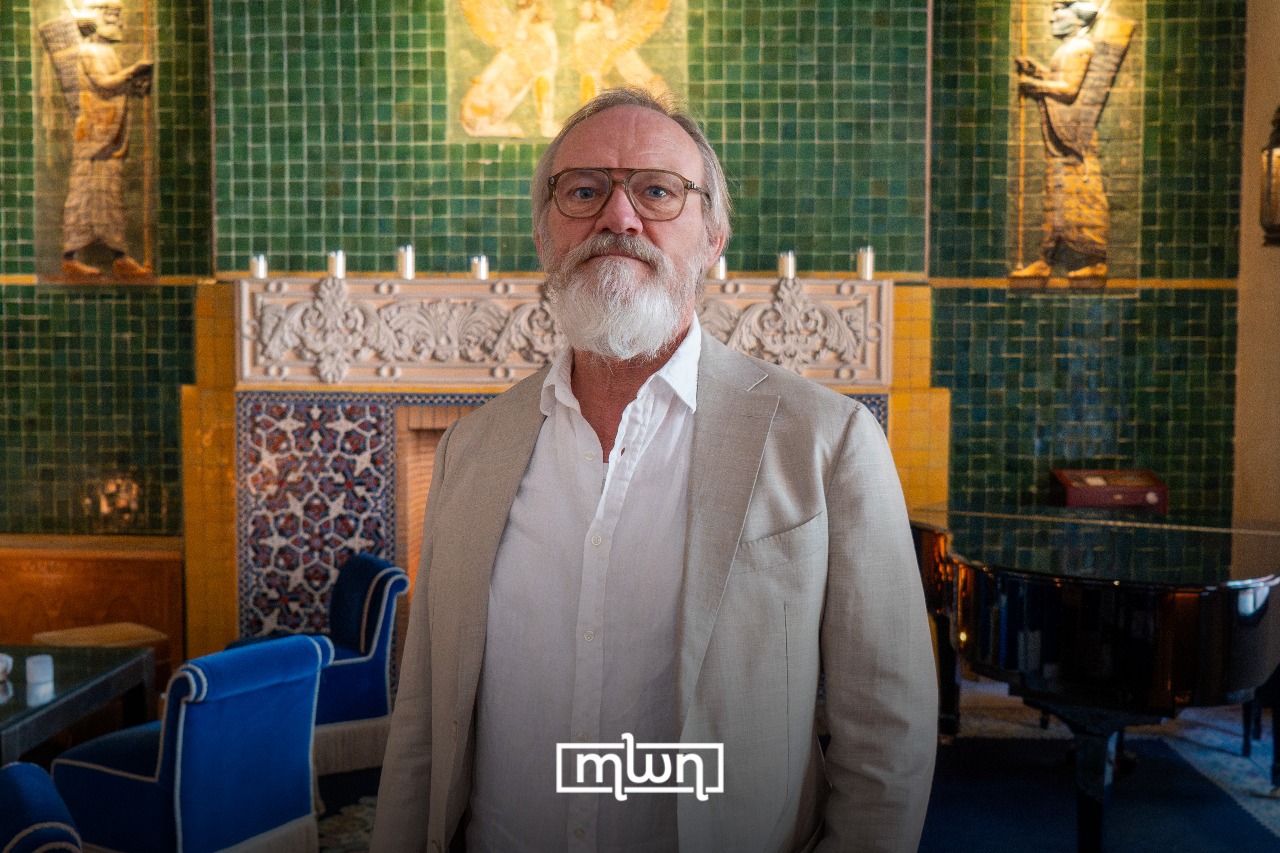
Marrakech – Veteran Icelandic actor Ingvar Sigurdsson brought director Hlynur Pálmason’s “The Love That Remains” to the 22nd Marrakech International Film Festival, representing a filmmaker who has carved a distinctive niche in contemporary Nordic cinema.
The film marks Pálmason’s fourth feature following his acclaimed works “Winter Brothers,” “A White, White Day,” and “Godland.”
“The Love That Remains” premiered at the Cannes Film Festival in May, where it earned the Palm Dog Award for its canine performer Panda. The 109-minute Icelandic production has since been selected as Iceland’s entry for the 98th Academy Awards’ Best International Feature Film category.
View this post on Instagram
Speaking to Morocco World News (MWN) at the Marrakech festival, Sigurdsson described the film as “very different from his other films.” He noted that Pálmason originally intended it as “a little film before he is going to do his next big film, but it kind of grew, and it is bigger than he expected.”
The narrative follows a year in the life of a family navigating parental separation, functioning as a meditation on the liminal spaces between togetherness and dissolution. This marks a significant departure from Pálmason’s previous works, particularly “Godland,” which are known for their grandeur, historical weight, and often bleak, dramatic tone.
“The Love That Remains” is very intimate, focusing on a modern family, separation, memory, and ordinary life over a year. This move from sweeping narratives to such a personal, close-to-home story represents an evolution in the director’s cinematic approach.
Saga Garðarsdóttir plays Anna, an artist losing her studio to developers, while Sverrir Guðnason portrays Magnus, a seafaring husband who refuses to fully acknowledge their marital dissolution. The domestic sphere becomes a contested terrain where traditional familial hierarchies undergo renegotiation.
Realism merges with fantasy
Sigurdsson, who plays the grandfather and has collaborated with Pálmason since his 2012 film school graduation project “The Painter,” explained the director’s unique approach to storytelling.
“I’m always fighting with the narrative in my films,” he quoted Pálmason saying. “I’m always trying to make a film that is pure cinema, with a story that is told, you cannot tell it as a radio play, or a stage play, or you cannot even write it as a book.”
This resistance to conventional narrative structures positions the work within broader discussions of medium specificity and cinematic language. The film blends domestic realism with surreal elements, creating what Sigurdsson described as a work that “becomes like a dream and a fantasy, with a lot of profound and deep signs in it, or metaphors.”
He noted that while the script initially appeared “small and cute,” the cinematic execution transforms seemingly innocent moments into revelations about underlying familial tensions.
The cast includes Pálmason’s own children in central roles. The decision reflects broader questions about authenticity and performance within documentary realism traditions. “It’s just because it’s easy,” Sigurdsson explained.
“He always keeps his camera in the back seat so that when an opportunity comes, even if his kids are with him, he’ll say: ‘Look, the weather is perfect – let’s go out and film now.’” The children, having worked with their father “since they were very, very young,” function as “professional actors” who “know the work, they know the camera.”
Universality emerges through specificity
The film employs 35mm cinematography, with Pálmason serving as his own cinematographer. This technological choice signals resistance to digital uniformity while invoking tactile qualities associated with analog film cultures. Editor Julius Krebs Damsbo and sound designer Björn Viktorsson, both regular collaborators, contribute to the film’s distinctive aesthetic approach.
Addressing the work’s cultural specificity within transnational cinema contexts, Sigurdsson stressed its universal resonance. “Even though we are both Scandinavian, it affects similarly in Scandinavia, or in Morocco, or North Africa, or wherever, because it’s uniquely told,” he said. “It’s very universal.”
This assertion speaks to cinema’s capacity to transcend geographic boundaries while maintaining culturally specific visual languages.
The actor described experiencing different interpretations during multiple viewings. “I’ve seen it twice in a row, and it has a different hit on me, both times, very different,” he noted. Such multiplicity of meaning reflects Pálmason’s resistance to singular narrative readings, inviting spectatorial participation in meaning-making processes.
Sigurdsson observed Moroccan audience reactions during the festival screening, noting their engagement with the film’s complex emotional terrain.
The cross-cultural reception demonstrates cinema’s potential for creating shared affective experiences across diverse cultural contexts. “Sometimes you struggle to put everything together and you just ask yourself: why?” he acknowledged.
His advice to viewers reveals an aesthetic philosophy prioritizing emotional over rational comprehension: “Just relax, take it in, you don’t have to understand everything, but you can feel it, and it stays within you for a week, or more.”
Morocco enriches creative encounter
The production involved collaboration between multiple European countries, including Iceland, Denmark, France, Finland, and Sweden. Production companies included STILL VIVID, Snowglobe, Aamu Film Company, HOBAB, Film i Väst, and Arte France Cinéma, reflecting contemporary European co-production models.
Critical reception has been notably positive, with Rotten Tomatoes reporting 100% approval from 17 critics. The film received additional recognition at Film Fest Gent, where it earned a Special Mention award.
Sigurdsson’s presence at the Marrakech festival represents his first visit to Morocco, fulfilling what he described as a long-held travel aspiration. His representation of Pálmason’s work continues a creative partnership spanning over a decade, encompassing the director’s evolution from film school graduate to internationally recognized auteur.
“The Love That Remains” challenges conventional divorce narratives through its integration of quotidian family dynamics with increasingly surreal psychological landscapes, positioning Pálmason among contemporary cinema’s most distinctive voices in exploring domestic dissolution through experimental storytelling techniques that resist easy categorization within genre conventions.