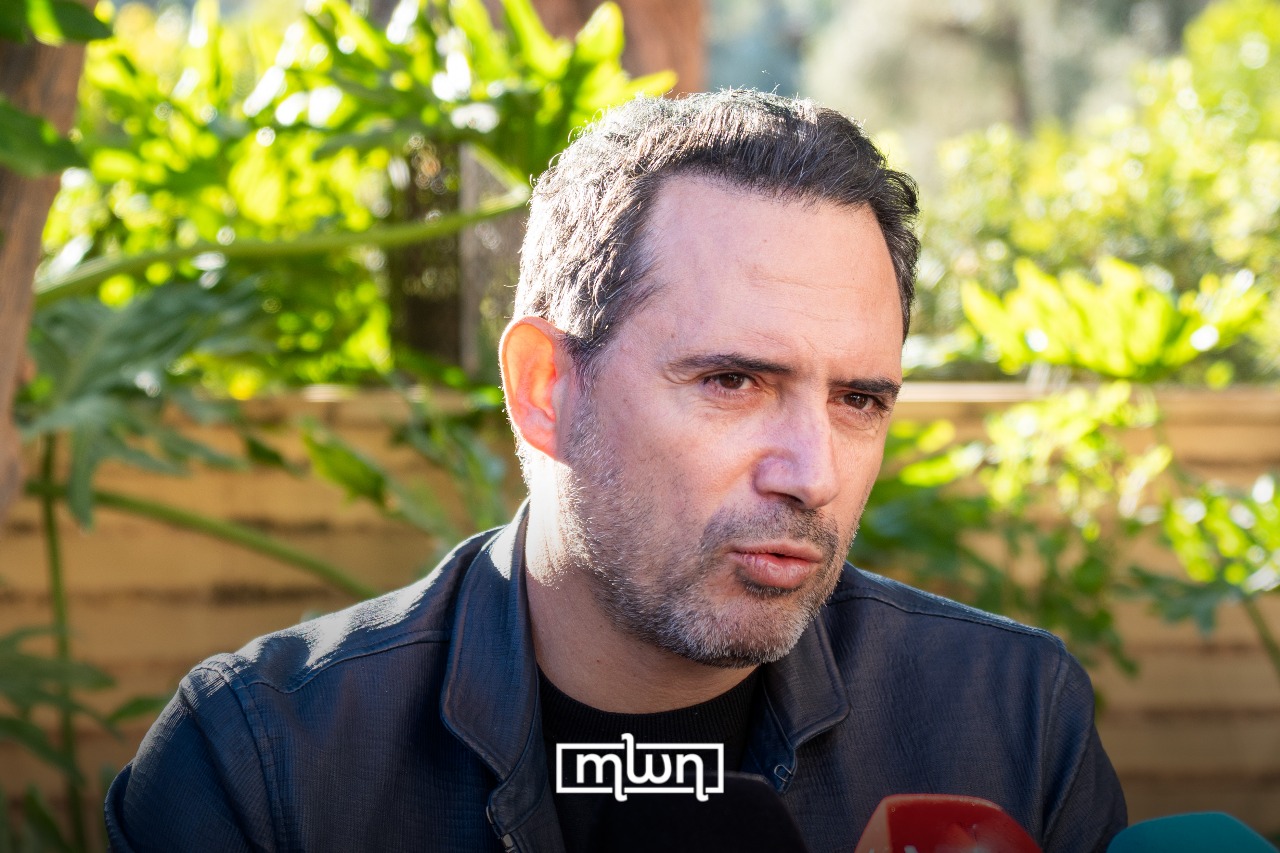
Marrakech – Tunisian actor-turned-filmmaker Dhafer L’Abidine premiered his latest directorial effort “Sophia” at the 22nd Marrakech International Film Festival Tuesday evening, marking the worldwide debut of a cross-cultural thriller that tackles contemporary themes of identity, exile, and family separation.
The 117-minute film follows Emily, a British mother who defies her father’s authority and travels from London to Tunis with her daughter Sophia, hoping to reconnect the child with her estranged Tunisian father Hicham. The fragile reunion transforms into a nightmare when Sophia mysteriously disappears, unraveling family secrets and launching a desperate search for truth.
L’Abidine, who wrote the script thirteen years ago, told Morocco World News (MWN) that global divisions and polarizing narratives about different communities prompted him to revive the project now.
“Because of what’s happening around the world, with all the division you see and all the narratives about ‘bad people’ and ‘good people’ – talking about Arabs, Muslims, Christians, Jews, and separating people,” he said during the festival interview.
The filmmaker positioned his narrative around an interfaith, intercultural relationship that challenges binary constructions of cultural difference. “In the film, the mother is British and a devout Christian, while the father is Tunisian and Muslim,” L’Abidine noted.
For him, “it was important to tell a story that shows we are all the same. It doesn’t matter what nationality or country we come from – what matters is that we are human beings who care about one another.”
L’Abidine’s approach directly confronts hegemonic Western cinematic representations that often reduce Arab subjectivity to orientalist tropes and deficit narratives. “You see a lot of films made about Arabs in the West, but you see it from a different point of view,” he observed. “For me, it was very important that we tell our story, that we are part of these stories, and that we have our own point of view as well.”
The director described his narrative strategy as deliberately balanced and non-partisan. “I wanted to tell the story that way – not biased, not taking one side or the other, but simply being fair and telling the story the right way,” he explained.
Rather than creating region-specific content, L’Abidine aimed for cross-cultural accessibility that transcends geographical and cultural boundaries. “I wanted to write a film that could be seen in Morocco, in Tunisia, in Britain, in France, or in the Gulf countries,” he said. “I didn’t want the film to be just made for one particular country or just a culture. I wanted something that unifies us.”
‘A thriller with a heart’
The filmmaker characterized his work as entertainment with deeper cultural significance that operates within what scholars might term the liminal space between commercial appeal and social commentary.
“I wanted to write something that’s entertaining, but at the same time it’s got something else. It’s got a certain message or value that makes it different,” he stated. “For me, it is a thriller with a heart, I would say. A thriller with something else emotional to offer. And brings two cultures together.”
L’Abidine’s personal background informed the project’s intercultural dimensions without directly mirroring his experiences. The director’s transnational biography reflects broader patterns of contemporary diaspora identity formation.
“I lived in the UK for 26 years. My family is there. I’ve worked in the Middle East and spent a long time there as well. I’m Tunisian, and my wife is English,” he revealed. “So there are common points, but the film is different. It’s not my personal life or my personal experience.”
The production represents a collaborative effort between L’Abidine’s Double A Productions and British company New Sparta Productions. Jessica Brown Findlay leads the cast alongside L’Abidine, Jonathan Hyde, and Kaïs Setti. MAD World handles international sales for the project.
L’Abidine’s filmmaking trajectory includes previous successes with “Ghodwa” (2021), which received Golden Globe consideration and won the FIPRESCI prize at Cairo International Film Festival, and “To My Son,” which earned Best Film honors at the Hollywood Arab Film Festival.
The director expressed particular satisfaction with Marrakech as his premiere venue, noting his longstanding connection to Morocco dating to 2012 when he filmed scenes for the series “Hunted” in Tangier.
The festival selection positions “Sophia” within ongoing conversations about transnational Arab cinema and cross-cultural storytelling that challenge essentialist notions of cultural authenticity.
L’Abidine concluded by addressing the universal applicability of his narrative approach. “I think the idea is also that it doesn’t matter where you’re from or who you are – you can find yourself in the story,” he said. “And that’s what’s most important, really.”