
 Join on WhatsApp
 Join on Telegram
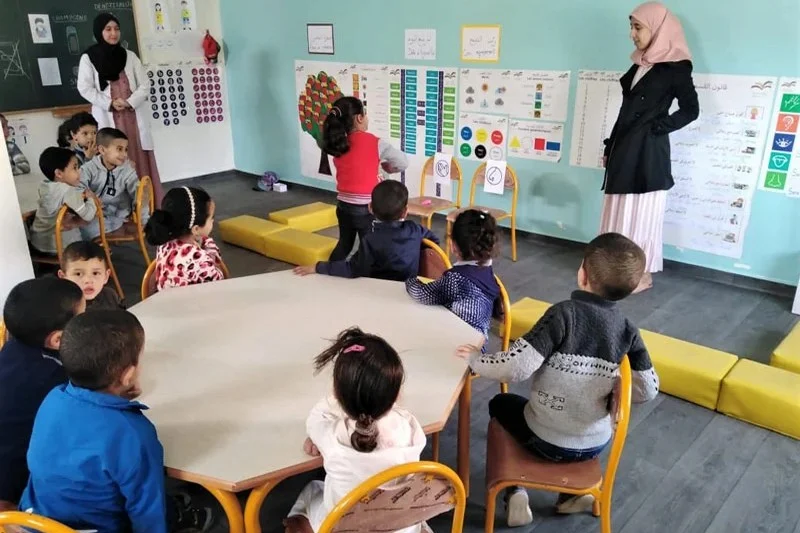
Marrakech – Morocco’s rural areas have achieved an 81% preschool enrollment rate, significantly outpacing urban regions, Education Minister Mohamed Saad Berrada announced Monday at the House of Representatives.
The increase in early childhood education from 35% in 2018 represents substantial progress over seven years.
Berrada attributed this success to the absence of land ownership issues in rural areas and support from the National Human Development Initiative (INDH) since 2018, particularly in school construction and preschool program development.
The ministry aims to achieve complete preschool generalization by 2028. This year alone, approximately 42,000 additional students enrolled, and 1,500 new classes were created, pushing the overall preschool enrollment rate to an expected 85% by year-end.
Just last week, the National Evaluation Authority confirmed nationwide progress, with preschool enrollment for children aged four to five increasing from just over half in 2015 to more than 70% in 2025.
Director Hicham Ait Mansour noted that rural areas have experienced the most notable shifts, with enrollment rates more than doubling and now exceeding urban centers.
In September, officials revealed that over 268,000 children aged four and five in rural Morocco benefited from preschool enrollment through an early childhood development program co-financed by the World Bank and INDH.
The program created over 9,500 jobs for preschool educators and referred more than 500,000 women and children to health services.
Berrada outlined the adoption of an innovative technical approach based on “local planning” that integrates the “Massar” database for preschool education with primary education data.
This system allows the ministry to accurately identify children who have not benefited from preschool education and pinpoint regions with shortages for targeted intervention.
The preschool education system currently employs 50,000 educators, with 20,000 working in rural areas. Each educator receives approximately 950 hours of initial training, and the ministry has mandated the transition from fixed-term to permanent contracts (CDI) for all educators.
Regional academies now transfer contributions to associations on schedule – September 1 and January 1 – to prevent salary payment delays for educators. The ministry directly monitors this procedure to ensure compliance.
Read also: Over 268,000 Children Benefited from Morocco’s Rural Early Childhood Program
However, this preschool progress exists alongside broader educational challenges. In April, Berrada revealed that nearly 280,000 students abandon school annually, with 160,000 dropping out at the middle school level.
The ministry plans to redirect at least 80,000 at-risk middle school students toward “second chance schools” offering vocational training for job market preparation or educational reintegration.
“Riyada” (leadership) schools now monitor students and provide educational support alongside confidence-building activities, including music, sports, and theater.
Psychological and educational monitoring units use the “Massar” platform data to identify vulnerable students, who automatically receive parallel activities and personalized support.
Social support programs in rural areas include school transportation, canteens, and accommodation facilities to address socioeconomic barriers to education.
The government’s employment roadmap targets reducing annual school departures from 295,000 in 2024 to 200,000 by 2026. Official statistics for 2022/2023 showed 294,458 students abandoned education – 58,819 from primary schools, 156,998 from middle schools, and 78,651 from high schools.
Ministry documents disclosed 62% of those leaving were over 16 years old, despite mandatory education at this age.
Most concerning, 230,904 students never re-enrolled, while 63,554 left after expulsion. The ministry reintegrated 50,448 students during the same year through various intervention measures.