Washington – The world woke up yesterday to a scene that seemed torn from a different era, yet unmistakably shaped by our own. In the pre-dawn dark over Caracas, whispers spread that US special operations forces had struck deep inside Venezuela’s capital. Before sunrise, Washington confirmed that Nicolás Maduro and his wife, Cilia Flores, were in US custody and en route to New York to face federal charges.
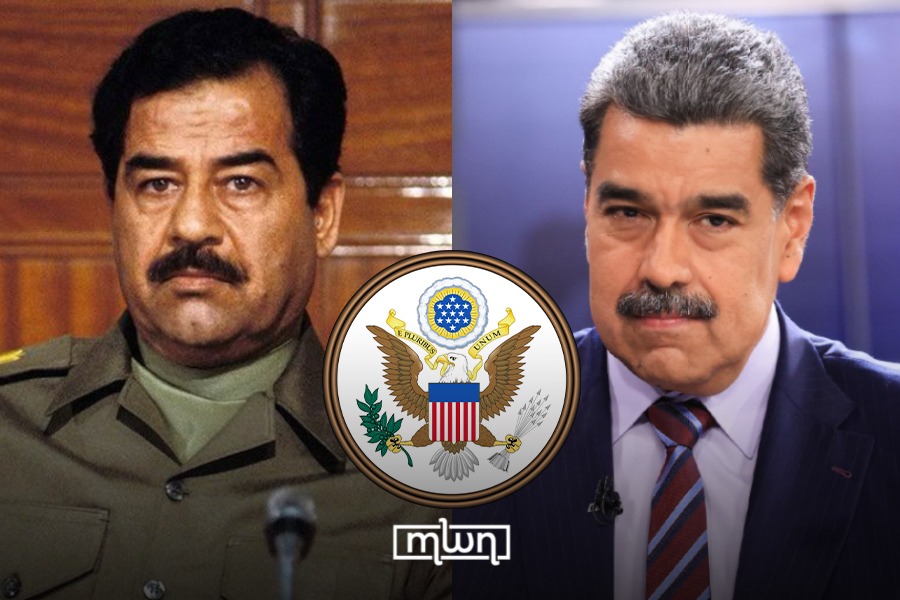
For those of us who remember Baghdad in 2003, the echoes are impossible to ignore. But it’s in the contrasts, not the similarities, that this moment finds its deeper meaning.
From Saddam’s hideout to Maduro’s safe room
When Saddam Hussein was captured near Tikrit 23 years ago, the world witnessed the end of a ground war that had flattened cities and fractured an entire country. It took months of fighting and the loss of tens of thousands of lives to bring him before a tribunal. This time, regime change came without an invasion or, technically, a war.
The US government framed the Caracas operation as a law enforcement action, not a military one — a precision strike rather than a sweeping campaign. Instead of “Shock and Awe,” it was a door blown open in the dark, an arrest warrant delivered by men in body armor rather than tanks. The language has changed, but the implications may be just as profound.
Supporters of the move will argue that this distinction matters: no armored columns, no occupation, far fewer civilian casualties than Iraq. They will say this is accountability through courts, not conquest through armies. But changing the mechanics of regime change does not automatically resolve the deeper questions about sovereignty, precedent, and who gets to decide when a foreign leader is brought before a judge.
The legal ghost of Iraq
Back in 2003, the justification rested on the specter of weapons of mass destruction. It was a narrative built on threat perception, a pretext that unraveled over time. In 2026, the framework is narcotics and terrorism. By labeling Maduro less as a political leader and more as an alleged criminal conspirator, US officials are expanding the reach of domestic law into the realm of foreign sovereignty.
That shift raises difficult questions. Can a nation unilaterally apprehend a sitting head of state beyond its borders under the banner of criminal justice? What does it mean for international law if regime change can now occur through an indictment rather than a declaration of war?
The United States once prided itself on upholding the architecture of international norms built after 1945. Yet with this action, Washington continues to risk rewriting the rules casting itself as global prosecutor and bailiff in one.
The day after
History’s gravest mistakes often unfold in the silence that follows victory. In 2003, Iraq was liberated from dictatorship but left without a functioning state. Two decades later, policymakers again face a morning after.
Caracas, still in shock, faces a power vacuum. While US officials describe their operation as a “necessary enforcement action,” the immediate uncertainty invites a familiar anxiety: Who governs now? And under what legitimacy? Removing a ruler is easy. Rebuilding a nation’s institutions, its confidence, and its sovereignty is not.
The weight of precedent
Few dispute Maduro’s authoritarian rule or the suffering it inflicted on Venezuela’s people. But the deeper concern is the precedent this sets. If international norms can be sidestepped when convenient, what stops future powers, friendly or otherwise, from claiming the same authority?
America’s moral authority abroad has always rested not just on its strength, but on its restraint. The test ahead will be whether today’s capture becomes a new template for projecting power, or a moment of reckoning that forces reflection on how far justice can reach before sovereignty collapses under its weight.
Those who defend the raid will say the old rules have failed that international institutions are too slow, too weak, or too politicized to deal with leaders accused of grave crimes. They will argue that doing nothing in the face of alleged narco‑terrorism is its own kind of abdication. Yet if each powerful state now reserves the right to decide which foreign leaders are criminals and to snatch them at will, the entire system of protections that smaller countries rely on begins to erode.
In the pursuit of accountability, the US has crossed into new territory. The question is no longer whether Maduro was a dictator. It is whether, in proving that it can deliver justice, America has once again redrawn the lines of the global order and blurred them in the process.