 Join on WhatsApp
 Join on Telegram
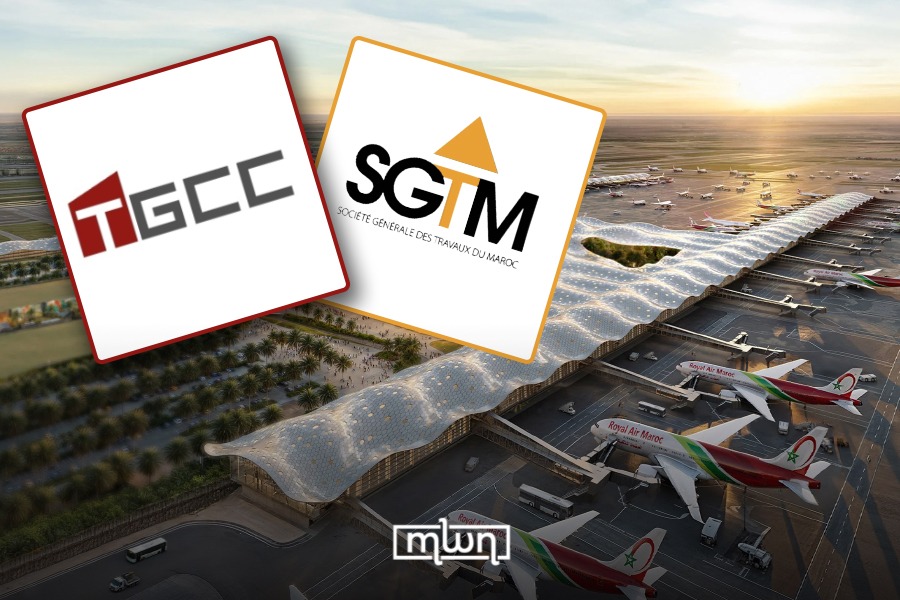
Marrakech – After weeks of anticipation following converging reports in mid-December, it is now officially confirmed that the National Airports Office (ONDA) has awarded the construction contract for the new terminal at Casablanca Mohammed V Airport to a 100% Moroccan consortium led by SGTM (Société Générale des Travaux du Maroc) and TGCC (Travaux Généraux de Construction de Casablanca).
Valued at MAD 12.8 billion ($1.28 billion), the contract marks “the largest airport construction site ever undertaken in Morocco,” as described by ONDA in its official statement.
The office stressed that the project “marks a historic turning point in the evolution of the kingdom’s main airport and reflects the ambition to provide Casablanca with infrastructure worthy of its role as a regional and international hub.”
The announcement follows a highly competitive international tender that drew strong global interest from leading construction firms worldwide.
Twenty-eight companies initially submitted expressions of interest in May 2025, with nearly half being Chinese firms, including Sinohydro Corporation and China Civil Engineering Construction. Spanish, Turkish, Egyptian, French, Indian, Swiss, and Canadian companies also participated in the preliminary phase.
The bid opening, held in mid-December following an international tender launched in early November, ultimately left the SGTM-TGCC consortium as the sole remaining contender. Turkish firm Kalyon Insaat was eliminated during the administrative and technical evaluation phases.
Among domestic rivals, only Sogea-Maroc and Jet Contractors had initially joined the SGTM-TGCC groupement in the early stages
The project is set to be delivered over a 40-month construction period, with completion targeted for mid-2029. From initial programming to architectural design and technical evaluations, the entire process was completed in a notably compressed 18-month timeframe.
The tender phase itself moved swiftly, spanning just eight months from the launch of the expression of interest in April 2025 to the final contract award, a timeline that stands out for a project of this scale and complexity.
Inspired by Morocco’s Atlantic Ocean heritage
The new terminal will span 600,000 square meters and accommodate 20 million passengers annually in its first phase, with expansion capacity to 30 million passengers. The H-shaped configuration features a central processor and two jetties, designed to handle up to 45 aircraft simultaneously with direct contact gates.
Advanced operational features include automated baggage handling systems, optimized passenger flow management, and intelligent traffic management systems. The terminal will connect directly to the future Tangier-Marrakech high-speed rail line, enhancing intermodal transportation access.
The project forms a cornerstone of ONDA’s “Airports 2030” strategy, which aims to elevate Moroccan airports to the highest levels of performance, efficiency, and international connectivity. The development also supports preparations for the 2030 FIFA World Cup, co-hosted by Morocco, Spain, and Portugal.
The project is expected to create thousands of direct and indirect jobs, providing a significant boost to Morocco’s construction and public works sector. It also constitutes a major test of project management and multi-trade coordination, mobilizing advanced national expertise across multiple disciplines.
The partnership between SGTM and TGCC will split the contract equally, marking their second major collaboration following the MAD 3.2 billion ($320 million) Hassan II stadium project in Benslimane.
The contract award coincides with SGTM’s December stock market debut on the Casablanca Stock Exchange, following a landmark IPO that raised up to MAD 5.04 billion ($504 million) through the sale of 12 million shares at MAD 420 each – an offering that drew over 171 000 investors and demand about 34 times the shares available, making it one of the most heavily subscribed and significant listings in Moroccan market history.
The new terminal incorporates three main levels and includes green oasis zones, commercial areas, a large duty-free section, VIP lounges, and a hotel, all offering runway views.
The architectural design draws inspiration from Morocco’s Atlantic Ocean heritage, featuring curved lines that evoke water movement and traditional Moroccan elements, including Andalusian geometric patterns and Atlas mountain Amazigh (Berber) carpets.
Additional infrastructure includes a new parallel runway measuring 3,700 meters by 45 meters with associated circulation paths, aircraft parking areas, and a new control tower approximately 42 meters high.
The terminal’s roof design references traditional Moroccan “bejmat” with hexagonal patterns and ochre coating, paying homage to the southern provinces’ architecture.
ONDA concluded that the terminal “will establish itself as a structuring lever for competitiveness, attractiveness, and international influence, positioning Casablanca Mohammed V Airport as an international reference airport.”
Extensions planned for 2040 and 2050 will accommodate future growth demands as part of the kingdom’s long-term aviation development strategy.