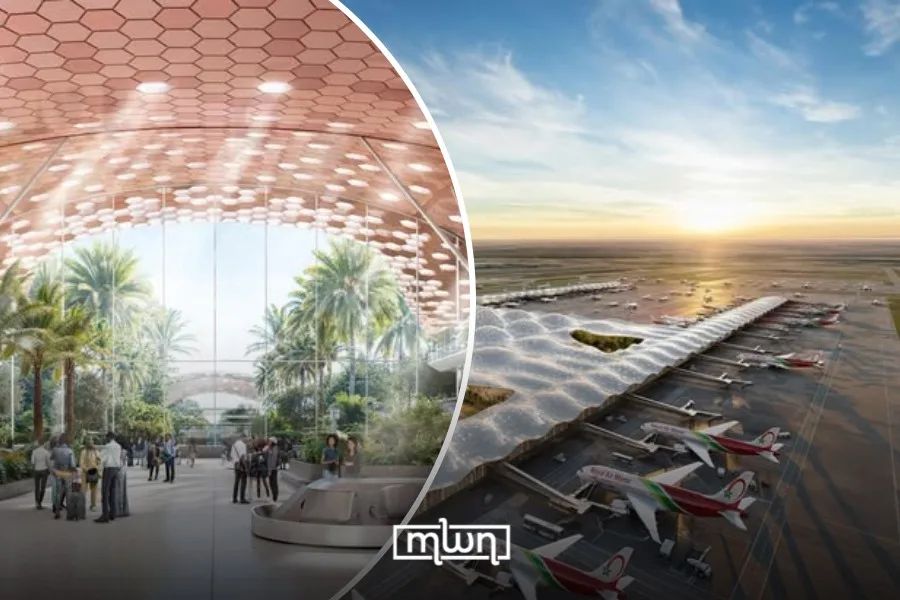
Doha – The Office National des Aéroports (ONDA) has officially announced the construction of a new terminal at Casablanca’s Mohammed V Airport. The ambitious project, with an estimated investment of MAD 15 billion ($1.5 billion), will feature a hub-style terminal designed to accommodate 20 million passengers annually when completed in 2029.
This major infrastructure development is part of Morocco’s “Airports 2030” strategy, which aims to strengthen the country’s position as a strategic aviation hub for global exchanges. The terminal is being designed as a technical marvel and architectural masterpiece, representing an unprecedented infrastructural revolution in Morocco’s airport sector.
The H-shaped terminal will comply with international hub standards, particularly in terms of connection times, baggage handling, and utilization rates of boarding bridges. It will also address anticipated air traffic growth needs, especially those linked to Royal Air Maroc’s development program.
Connectivity will be a key feature of the new terminal, with direct access to the Kenitra-Marrakech high-speed rail line (LGV), offering travelers quick and smooth connections to major Moroccan cities.
Following the model of major international airports such as Paris-Charles de Gaulle, London-Heathrow, and Hong Kong International, this modern infrastructure aims to strengthen transportation intermodality and enhance passenger experience.
The rail connection will significantly reduce travel times between Casablanca and other strategic centers while supporting air traffic growth by facilitating airport access for both domestic and international travelers.
Comprehensive infrastructure development
The new terminal project extends beyond the main building to include a parallel runway measuring 3,700 meters by 45 meters with associated taxiways and aeronautical infrastructure. The development will also feature aircraft parking areas and a new 42-meter-high control tower.
Designed with passenger comfort in mind, the terminal will be arranged across three main levels and will integrate green spaces in the form of oases, commercial zones, a large duty-free area, VIP lounges, and a hotel, all offering views of the runways.
The various components are intended to deliver an entirely reinvented qualitative experience for travelers, optimizing mobility, comfort, and hospitality. ONDA has already launched the earthworks tender, with additional construction tenders to follow in the coming months.
This iconic project reinforces ONDA’s ambitions to meet the country’s new challenges, particularly in preparation for the 2030 FIFA World Cup.
Architectural design inspired by Atlantic waves
Conceived as an architectural manifesto, the new Casablanca terminal draws inspiration from the natural forces of the Atlantic Ocean. The curved, fluid lines of its architecture evoke the power and delicacy of water movement, symbolizing the balance between strength and serenity.
The terminal embodies the vision of “Morocco, gateway to the Atlantic,” ONDA says, where the fluidity of forms resonates with the energy of waves. The vast open spaces, inspired by the limitless Atlantic horizon, reflect Morocco’s aspiration to establish itself as a strategic crossroads for global exchanges.
The design goes beyond its role as a transportation infrastructure to serve as Morocco’s gateway, a contemporary representation of Moroccan cultural identity in all its diversity.
The architecture draws from forms, colors, and materials that reflect the North African country’s diversity: geometric patterns of Andalusian inspiration, Amazigh carpets from the Atlas Mountains, and elegant arches from medinas blend into a harmonious and avant-garde vision.
Gardens play a central role in the terminal design. By integrating two tree-lined and vegetated areas in the form of oases within the airport, ONDA aims to offer travelers an immersive, modern experience that shows off Morocco’s natural heritage.
These oases provide a soothing contrast to the terminal’s contemporary architecture and create a space for calm and decompression before or after flights.
The roof covering the terminal represents an architectural masterpiece. The pattern of the “soffite” (overhanging parts) refers to the “bejmat” with a hexagonal grid covered in ochre, as a tribute to traditional Moroccan architecture and homage to the southern provinces.
This reference to terracotta zellige also brings a warm and welcoming touch to the airport, with a subtle and natural texture, contrasting with the contemporary architectural gesture.
Read also: Tangier Airport’s $327 Million Extension to Triple Passenger Capacity