 Join on WhatsApp
 Join on Telegram
Rabat – Morocco’s infrastructure, soft power, investments, and alliances have certainly shaped the country’s international and regional position – and this is precisely what a report commissioned and published by the Choiseul Institute outlines.
The report, authored by a research associate at Princeton University, Yasmina Asrarguis, portrayed Morocco and its achievements as a rising “middle power.”
“The kingdom of Morocco has progressively established itself, over the last decades, as one of these emerging regional ‘middle powers,’ whose vocation lies in mediation, circulation, and connectivity.”
The report recalls King Mohammed VI’s efforts since ascending the throne, outlining the country’s project, which relies on modernized infrastructure serving as a matrix for continental integration.
Tanger Med Port and maritime growth
It cited all of Morocco’s mega projects, including the Tangier Med Port, which has been operational since 2007, to compete with strong and renowned competitors, including those in neighboring Spain.
Tanger Med and other key investment hubs have been key to strengthening Morocco’s appeal to international players, attracting renowned companies active in different sectors, including the automotive and aeronautic sectors.
Tanger Med Port finished the 2024 fiscal year with a revenue of MAD 11.23 billion ($1.22 billion), marking an increase of 12.3% compared to 2023.
The port reached a historic milestone in 2024 as it handled 10.24 million 20-foot equivalent units (TEUs).
The port has been so successful throughout the past few years that several news outlets in neighboring countries, including Spain, have shared concerns about the port’s achievements outperforming major international hubs in Spain.
In 2021, Spanish newspaper El País stressed the importance of Tanger Med Port, noting that its performance reflected a “negative” impact on Spanish ports.
A zooming automotive sector
The report authored by Asrarguis also cited the booming automotive sector, which continues to undergo major upward transformation.
Notably, it mentioned the emergence of the battery and electric mobility industry, enabling the country to “anticipate major energy transitions and adapt to new European standards, especially regarding carbon taxation.”
The North African country is working to create a full electric vehicle battery value chain to attract investors and produce batteries for over one million cars, with plans to raise capacity to 1.45 million, and eventually two million.
Sky-high ambitions
Morocco is also strengthening its aeronautic sector.
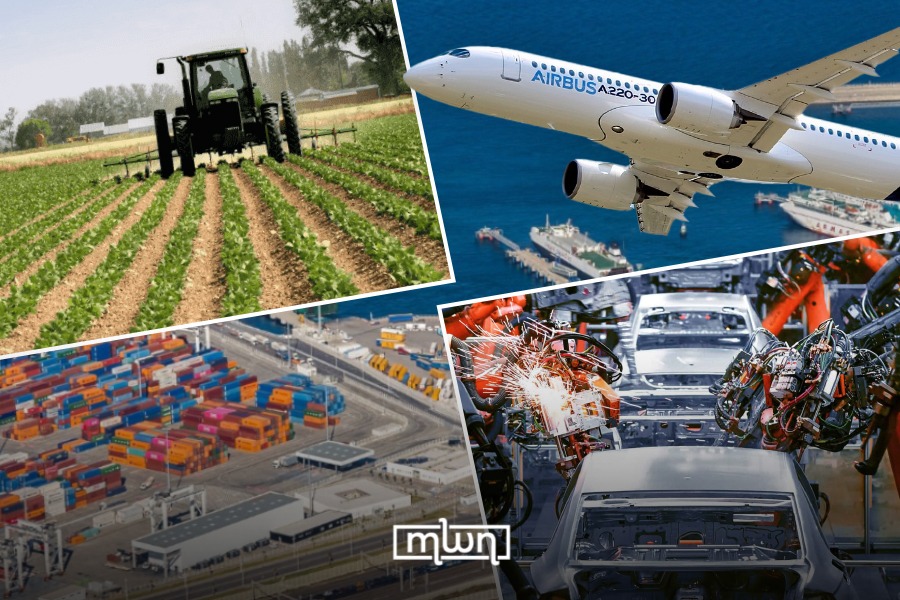
“Two sectors particularly structure this growth: the automotive and aeronautics industries, Morocco’s showcases in global value chains, as well as agriculture and agri-food, anchored in a centuries-old tradition but now increasingly affected by climate constraints,” the report said.
Morocco’s aerospace sector generated export revenues that amounted to over $2.54 billion in 2024.
Over 150 companies are currently operating in Morocco, with the country offering 0% corporate tax for the first five years and around 8% for the following 20 years.
Morocco is now seeking to strengthen the sector with plans to produce its first aircraft engine by 2027 or 2028.
Sustaining food security through drought
In terms of food security, the North African country has long worked in favor of boosting the local food sector not only to strengthen its own food sovereignty but also the continent’s.
The recent heavy rainfall, which started in mid-November last year, is also set to contribute to the agriculture sector, which has suffered from years of drought.
The recent rainfall also boosted Morocco’s national reserves, with dams across the country accumulating over 24 million cubic meters of water in just 24 hours during January 5-6.
During this period, the overall filling rate rose from 42.5% to 43.9%.
A dynamic tourism boom
The report also cited other booming sectors like tourism, recalling that 2025 first half alone was marked by 8.9 million tourist arrivals.
The number represents a 19% increase compared to 2024.
“The majority come from the major source markets of the European continent, particularly France and Spain,” the report said.
In 2025, Morocco welcomed 19.8 million tourists – representing a 14% increase compared to the number recorded in the previous year.
The tourism revenue reached MAD 124 billion by the end of November 2025, reflecting an increase of 19% compared to 2024.
Despite a bright future, challenges remain
While the Choiseul Institute report outlines Morocco’s leadership across these key sectors, it also explores persistent domestic challenges, including unemployment.
Specifically, the report highlights how unemployment remains high, particularly among youth.
“Although [economic] growth is projected at 4.4% for 2025, it has not succeeded in curbing unemployment, which stood at 13.3% in the first half of 2025 and is expected tor each 13% in 2026,” the report said, recalling the government employment roadmap that aims to reduce this rate to 9% through the creation of 1.45 million jobs.
For the report’s commissioner, the goal remains fragile in a context of “ongoing sectoral restructuring,” especially as the informal sector still represented a third of non-agricultural employment in 2023.