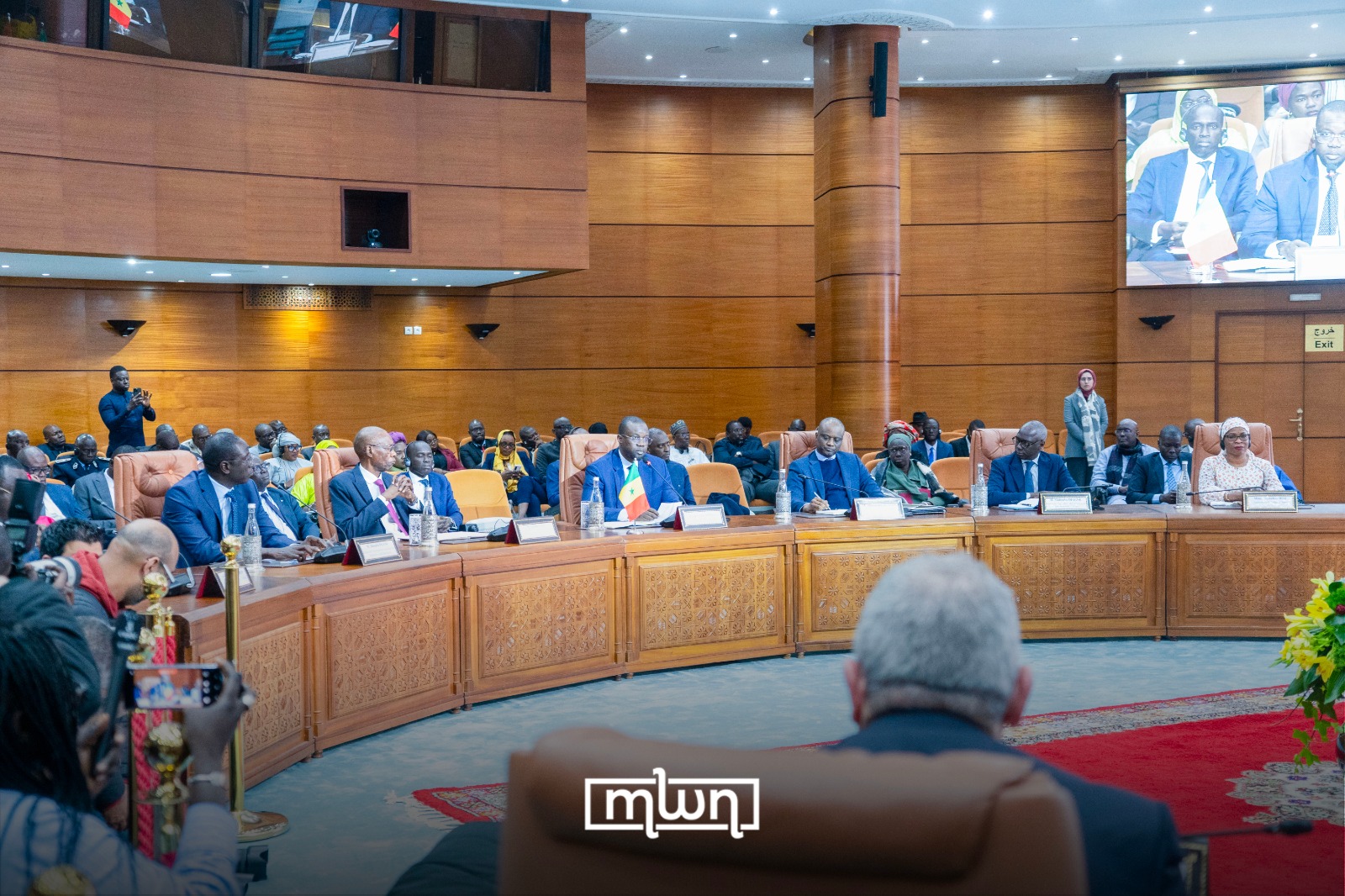
Rabat – During the opening of the 15th session of the Morocco–Senegal Joint Commission, Senegalese Prime Minister Ousmane Sonko said his official visit to Morocco is “a major political moment,” acknowledging that the visit comes amid strong sporting emotions and regrettable incidents that affected both peoples.
The commission kicked off today in Rabat, convening high-level officials from both countries, including Head of Government Aziz Akhannouch and Foreign Affairs Minister Nasser Bourita.
Referencing the chaotic events at the AFCON final, Sonko emphasized that neither the incidents nor the emotions surrounding them have weakened the centuries-old ties between Morocco and Senegal.
Rather, he said, they have “tested their bond, not divided them.” Sonko stressed that this trip is not meant to soothe tensions but to affirm and reaffirm that sports cannot define or distort the profound historical, spiritual, human, and economic relationship tying the two nations.
The final moments of the AFCON were marred by tensions when the Senegalese team decided to temporarily withdraw from the game after a VAR-verified penalty was awarded to Morocco. Senegalese fans committed acts of hooliganism and violence and attempted to storm the pitch while using stadium facilities as weapons against security guards.
Sonko acknowledged his delegation’s visit comes in a context charged with “sporting emotions, regrettable excesses, and at times painful images for two peoples deeply connected.”
He stressed the importance of not letting emotion dictate the meaning of events, adding that the trip is not intended to soothe the situation but rather “affirm and reaffirm that sports have not divided our peoples.”
“They [sports] have tested their bond,” he added. “They have not opposed Senegal and Morocco. They have put to the test the intensity of two national passions within a shared space.”
For Sonko, the situation marking the AFCON final must “neither be denied nor dramatized. They must be reframed as emotional overflows produced by fervor and not as political or cultural fracturing.”
He described the foundation between the two countries as built on the depth of human, spiritual, economic, and cultural ties, as well as knowledge, religious brotherhood, and a rooted shared history.
Akhannouch, in his opening speech at the 15th joint commission, remarked on the importance of the meeting in continuing to shape the bonds between the two countries.
“There is no need to reiterate here the deep civilizational and human bonds that have long characterized the historic relations between our two nations – relations that stretch back centuries and are the fruit of a long history of brotherhood and friendship,” Akhannouch said.
Akhannouch also spoke about Morocco’s AFCON journey, stating that the event will be a milestone in the history of the tournament.
“We believe that the true victory is not measured solely by results, but by our collective ability to use sports as a tool for human and economic development and to elevate our position on the global stage,” Akhannouch stated.
He added that Morocco is determined to continue this momentum into preparations for the World Cup 2030.
“We are now preparing alongside our partners, Spain and Portugal to host the 2030 FIFA World Cup. Our aim through this global event is to elevate the image of our entire African continent, which today demonstrates its capability to host the world’s largest events,” Akhannouch said.