 Join on WhatsApp
 Join on Telegram
Vienna – Fifty years after the Madrid Accords handed the Western Sahara its unresolved fate, the same city served as the venue for a meeting that may mark the beginning of its resolution. The United States Embassy in the Spanish capital hosted on Sunday, February 8, closed-door consultations that brought together high-level delegations from Morocco, Algeria, Mauritania, and the Polisario Front.
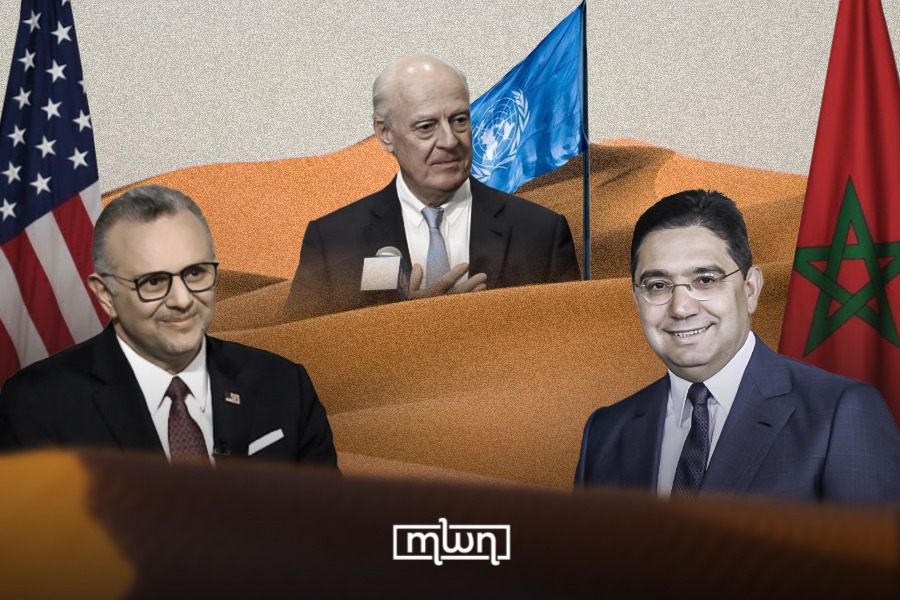
The session was organized and supervised by Massad Boulos, President Donald Trump’s special advisor for Africa, Michael Waltz, the US Ambassador to the United Nations, and Staffan de Mistura, the UN Secretary-General’s personal envoy for the Western Sahara. Its stated purpose was to advance the implementation of UN Security Council Resolution 2797, which was adopted last October and recognizes Morocco’s autonomy plan as the primary basis for resolving the half-century-old Sahara conflict.
The meeting was held in total secrecy, without Spanish participation in the negotiations, and was extended to Monday after failing to conclude on schedule. It ended with only a brief statement from the US Mission to the United Nations acknowledging that talks had taken place, with no joint communiqué, no group photograph, and no announcement of concrete results. Yet the absence of an immediate breakthrough should not obscure the deeper significance of what happened in Madrid.
From managing the conflict to engineering a settlement
For decades, the international approach to the Western Sahara dispute operated under a logic of conflict management. The primary concern of the major powers was to prevent escalation and contain regional fallout, while accepting a frozen conflict as a tolerable status quo. The various rounds of negotiations that unfolded over the years were often more about process than substance, and the dispute was left to linger in the corridors of the United Nations without any serious prospect of resolution.
What the Madrid meeting signals is a departure from that approach. Washington’s direct and active involvement in organizing and supervising face-to-face talks between all parties, under the framework of a Security Council resolution that explicitly centers Morocco’s autonomy initiative, indicates a shift toward what international relations literature describes as settlement engineering. It speaks, in other words, to the deliberate narrowing of available options and the steering of parties toward a specific, implementable outcome. In this sense, the United States is no longer simply managing the conflict; it is actively working to resolve it.
Driving this shift is a fundamental recalibration of strategic priorities. Cross-border security threats, the instability engulfing the Sahel, energy supply concerns, and migration pressures have made regional stability in North Africa a core interest for the major powers. Having persisted for nearly fifty years with no resolution in sight, the Western Sahara dispute is increasingly viewed as a structural liability. For Washington, the cost of continued inaction has begun to outweigh the political risks of pushing for a definitive settlement. According to El Confidencial, US diplomacy now considers this issue an “absolute priority” and aims to have the parties sign a framework agreement in Washington within three months.
The momentum of international recognition
The Madrid meeting did not emerge from a diplomatic vacuum. It is the latest step in a trajectory that has been building steadily since December 10, 2020, when the United States, under the first Trump administration, formally recognized Moroccan sovereignty over the Western Sahara as part of the trilateral agreement linked to the Abraham Accords. That recognition was initially dismissed by some as a transactional gesture, but it proved to be a turning point. The Biden administration chose not to reverse it, and the second Trump administration has not only upheld it but escalated it into an active settlement push, with Secretary of State Marco Rubio describing Morocco’s autonomy plan as the “only feasible political solution.”
The American recognition triggered a cascade of diplomatic shifts. In March 2022, Spain, the former colonial power, officially endorsed Morocco’s autonomy plan. In a letter to King Mohammed VI, Prime Minister Pedro Sánchez described the Moroccan proposal as “the most serious, realistic and credible” basis for resolving the dispute. This newfound Spanish position was formalized in a joint declaration on April 7, 2022. Then, on July 30, 2024, France dealt what was arguably the most consequential blow to the separatist thesis when President Emmanuel Macron declared in a letter to King Mohammed VI that “the present and future of Western Sahara fall within the framework of Moroccan sovereignty.” More significantly, Macron called Morocco’s autonomy plan “the only basis” for a just and lasting political solution to the Sahara dispute. As a permanent member of the Security Council, France’s shift carried enormous weight and effectively closed the door on Algeria’s hopes that Paris might serve as a counterbalance to the growing pro-Morocco consensus.
These successive recognitions by three of the most consequential Western capitals, combined with the growing number of African and other states that have opened consulates in the Sahara or expressed support for Morocco’s territorial integrity, have fundamentally altered the diplomatic environment. The separatist option has lost the international traction it once enjoyed, and the political landscape in which the Madrid talks took place is one in which Morocco’s position is stronger than at any point in the history of this conflict.
Resolution 2797 and the narrowing of options
The legal and political backbone of the Madrid process is Security Council Resolution 2797. Adopted in October 2025 with strong US backing, this resolution represents a qualitative leap in the international framework governing the dispute. For the first time, the Security Council recognized Morocco’s autonomy proposal not as one option among several, but as the primary and most feasible basis for a political solution. This language effectively marginalizes the referendum option that Algeria and the Polisario have championed for decades.
The idea of a referendum on self-determination, which was the cornerstone of earlier UN plans, had already lost its practical viability long before Resolution 2797 formalized its abandonment. The demographic and logistical complexities of defining a voter base, the absence of any credible mechanism for implementation, and the fundamental disagreement between the parties over who would be eligible to vote had rendered the approach unworkable. The resolution formalized what had been an implicit shift within the Security Council for over a decade: the recognition that theoretical solutions disconnected from the realities of power, geography, and demographic change cannot serve as the basis for a workable settlement.
The resolution also consecrated a reality that Moroccan diplomacy had worked for years to establish: the identification of Algeria as a main and direct party in this dispute, not the mere observer it long claimed to be. For decades, Algiers maintained the fiction that it was a concerned neighbor with no direct stake in the outcome, while in practice it served as the principal political, financial, and logistical backer of the Polisario. The refugee camps in Tindouf are on Algerian soil. The Polisario’s leadership operates from Algerian territory. Algeria’s diplomatic apparatus has been mobilized for decades to lobby against Morocco’s territorial claims in every international forum. The Polisario does not possess independent decision-making capacity; it functions as an instrument in Algeria’s broader geopolitical maneuvering against Morocco, a bargaining card used not to serve the interests of any population, but to keep Morocco strategically constrained.
This dynamic traces back to the very origins of the conflict. The late Algerian President Houari Boumediene is widely reported to have declared: “I will make the Sahara a pebble in Morocco’s shoe.” The irony is that before the conflict erupted, Boumediene himself had told Arab leaders at the Rabat Summit in October 1974 that “the problem now concerns Morocco and Mauritania,” and had even privately offered King Hassan II his support in retrieving the territory from Spain. It was only after the Green March of November 1975 that Algeria reversed course and began building the Polisario into the instrument of obstruction it has remained for half a century. By anchoring the negotiations in a roundtable format that includes Algeria as a full participant, Resolution 2797 stripped away the pretense of non-involvement and placed Algiers exactly where it belongs: at the table, as a party whose constructive engagement is now considered structurally necessary for any viable resolution.
Algeria’s resistance despite narrowing options
Algeria’s participation in Madrid, after years of refusing direct negotiations with Morocco, reflects the cumulative effect of this sustained international pressure. Massad Boulos’s earlier visit to Algiers was not a courtesy call. It was a calculated exercise in quiet diplomatic pressure, communicating an unambiguous message: Washington views Algeria’s constructive engagement as a prerequisite for breaking the deadlock, whether by pushing the Polisario toward pragmatism on the autonomy initiative or by creating a regional environment conducive to a lasting settlement.
Algeria, however, did not arrive in Madrid ready to concede. According to El Confidencial, the Algerian Foreign Minister Ahmed Attaf refused to participate in a joint photograph or communiqué, arguing that such gestures were meaningless while relations between Algeria and Morocco remained unnormalized. The Algerian delegation reportedly did not concede on the principle of self-determination, and the meeting concluded without the broader understanding on the proposed technical committee that the American side had sought.
Reports also indicate that Algeria undertook escalatory steps while the negotiations were taking place, including the operationalization of the Gara Djebilet iron ore mine and military deployments near the Moroccan border village of Ich. The logic is transparent: by engineering border friction, Algiers seeks to bait Morocco into skirmishes that can then be spun into propaganda about Moroccan aggression, expansionist ambitions, and designs on the so-called Eastern Sahara. This manufactured narrative would then be presented to Washington as grounds for Algeria to withdraw from a negotiation process it never wanted but could not refuse under American pressure. Yet these are the thrashings of a headless chicken — the erratic, undirected convulsions of a party that has had the rug pulled from under its feet.
Because Algeria’s room for maneuver is narrowing rapidly. The strategic calculation that sustained its position for decades, the assumption that time was on its side, that the conflict could be kept frozen indefinitely, that international attention would shift elsewhere, is no longer operative. The energy and security dynamics in North Africa and the Sahel have made stability a priority for the major powers, and the continuation of the Western Sahara conflict is increasingly viewed as incompatible with that objective. The increasing pressure on Algeria reflects the closure of a phase in which time could be used as a tool for political maneuvering, and the opening of a phase in which a realistic political settlement is the only path available.
The Polisario’s diminishing leverage
The Polisario Front’s position has weakened considerably in recent years, and the Madrid meeting provided further evidence of this trend. The movement’s earlier encounter with a Trump administration official produced no shift in the American position and no concessions to its demands. The message conveyed was consistent with the broader international approach: the political horizon is no longer open to all scenarios, and the autonomy initiative has been widely accepted as representing the only viable framework for a realistic and lasting settlement.
The Polisario’s departure from Madrid without any political gains reflects the growing marginalization of the separatist movement within international decision-making circles. Its traditional discourse, centered on the right to self-determination and the demand for a referendum, has lost what might be called functional legitimacy, meaning the capacity to influence decision-makers and shape policy outcomes. The international community’s increasing prioritization of stability as a strategic value that takes precedence over ideological considerations has further eroded the Polisario’s standing. The separatist thesis no longer commands the international audience it once did, and the movement’s inability to offer any constructive alternative to the autonomy framework has left it politically isolated.
Bachir Mustafa Sayed, an advisor to the Polisario’s leader and brother of the movement’s founder, wrote on social media before the Madrid meeting that the gathering aimed to add the Sahara cause, “already pre-cooked,” to Trump’s tally of diplomatic points. While intended as criticism, Sayed’s statement inadvertently captures a reality that the Polisario has been unable to counter: the terms of settlement are being set by actors with far greater political weight, and the Polisario’s ability to shape the outcome is diminishing with each passing round.
The expanded Autonomy Plan and the road ahead
One of the key developments around the Madrid discussions was the presentation of Morocco’s expanded autonomy plan. According to El Confidencial, the new document runs to some forty pages. A substantial elaboration of the original three-page outline submitted in 2007, it was treated as the only working paper on the negotiating table in Madrid. The discussions also explored the creation of a permanent technical committee tasked with refining the plan. It would comprise representatives of all four parties, who would be assisted by legal experts and working under US and UN supervision. If established, this committee would institutionalize the autonomy plan as the sole negotiating framework, transforming it from a political proposal into an operational blueprint subject to technical elaboration. However, the two sides hold different conceptions of the committee’s mandate: Morocco views it as a mechanism for refining the autonomy plan, while the opposing camp, according to El Confidencial, attributes a broader role that would also explore alternative pathways. This disagreement was reportedly a main reason the meeting ended without a broader consensus.
Washington’s broader agenda extends beyond the territorial dispute itself. The US diplomatic objective includes promoting full reconciliation between Algeria and Morocco, the reopening of their land border closed since 1994, the resumption of diplomatic relations, and the reactivation of the Maghreb-Europe gas pipeline. Shut down by Algeria in October 2021, the pipeline had been a significant conduit for gas supplies to the European market, particularly Spain. This situates the Western Sahara settlement within a larger framework of regional stabilization and economic integration, and it suggests that Washington views the resolution of this conflict as a strategic investment in a stable, interconnected North Africa.
Spain’s peripheral role and the larger meaning of the Madrid meeting
It is worth noting that Spain, the former colonial power, was not a participant in the Madrid negotiations. While Spanish Foreign Minister José Manuel Albares received several of the visiting delegations separately, including the Algerian and Mauritanian foreign ministers on Saturday, and later the Moroccan Foreign Minister Nasser Bourita on Monday, Spain’s role was limited to that of an informed observer obtaining first-hand accounts of the negotiations without having a seat at the table.
The selective nature of Spain’s diplomatic engagement was also evident in one telling detail: no representative of the Polisario was received at the Spanish Foreign Ministry. This asymmetry reflects the broader realignment of European positions on the Western Sahara, where the trend has moved decisively toward accommodating the political reality of Moroccan sovereignty.
The Madrid meeting did not produce a peace agreement, nor was it expected to. The path ahead will involve further difficult negotiations. But after Madrid, one thing is certain: the Western Sahara conflict has exited the era of ambiguity. For fifty years, the dispute survived precisely because its parameters remained undefined, its parties disputed, and its endgame was deliberately left open.
Resolution 2797 and the American-led process have ended that ambiguity. The parameters are now set, the parties are identified and seated, and the endgame has a name: autonomy under Moroccan sovereignty. Those who refuse to engage with this framework are free to do so, but they will find themselves negotiating with an empty chair across from them, while the future of the Western Sahara is decided in rooms they chose not to enter.