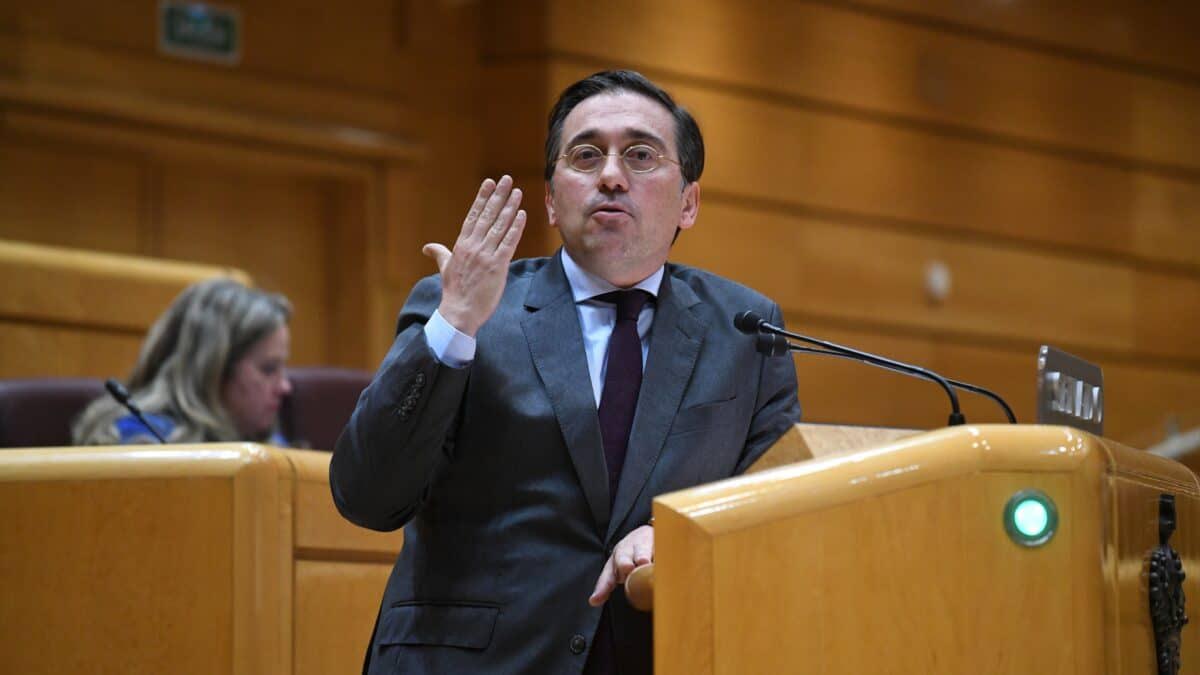
Marrakech – Spanish Foreign Minister José Manuel Albares unleashed a withering verbal assault against the opposition Popular Party (PP), accusing the conservative Christian democratic formation of dispatching secret emissaries to Morocco while publicly criticizing the government’s Western Sahara stance.
During a heated parliamentary exchange on Wednesday, Albares lambasted PP lawmakers for their duplicitous behavior. “Stop being hypocritical and ridiculous,” the minister thundered at the conservative bench, revealing that the party had sent representatives to Morocco to support Pedro Sánchez’s position on Rabat’s autonomy plan “behind the scenes.”
The confrontation erupted when PP deputy Cayetana Álvarez de Toledo questioned the minister about former President José Luis Rodríguez Zapatero’s business dealings. Albares dismissed her inquiries as an “obsession” and refused to make “insinuations” about former government heads.
The minister branded the PP as an unreliable party that attempts to “sabotage” Spain’s foreign policy initiatives. He cited their opposition to European funds distribution and their rejection of official language recognition at the European level.
Albares particularly condemned PP efforts to “boycott” the friendship treaty signed with France. The conservative party challenged the agreement before the Constitutional Court and prevented parliamentary ratification.
The foreign minister declared the PP “a great danger to democracy” under Alberto Núñez Feijóo’s leadership. He noted that party supporters were abandoning the conservatives “massively” in favor of the far-right Vox movement.
Meanwhile, Spain’s diplomatic approach to Western Sahara has sparked fury among Polisario Front separatists in Tindouf camps. Albares met with foreign ministers from Morocco, Algeria, and Mauritania during recent US-UN-sponsored consultations but conspicuously excluded any Polisario representatives.
Polisario no longer figures in serious diplomacy
The Spanish minister held successive meetings with Moroccan Foreign Minister Nasser Bourita, followed by his Algerian counterpart Ahmed Attaf and Mauritanian colleague Mohamed Salem Ould Merzoug. He also met with UN Personal Envoy Staffan de Mistura.
This calculated diplomatic exclusion exposes the Polisario’s terminal irrelevance in contemporary geopolitical calculations. Spain’s deliberate snubbing reduces the separatist movement to its essential nature – a hollow proxy entity devoid of substantive political currency in post-Cold War international relations.
The marginalization crystallizes a brutal geopolitical reality where Algeria emerges as the authentic protagonist in this manufactured conflict. Polisario is widely seen by analysts as a mere appendage – akin to a puppet on a small theater stage, animated not by its own will but by an unseen hand that dictates every movement, gesture, and line from behind the curtain.
Contemporary diplomatic architecture no longer indulges the fiction of Polisario autonomy or the self-styled “SADR” independence narrative, tearing away decades of ideological pretense to expose a movement structurally dependent on external patronage and incapable of sovereign agency.
International power brokers are steadily discarding the separatist façade as a fossil and relic of the era of ideological blocs, its political salience eroded by a shifting global order.
The movement’s slide into diplomatic obsolescence mirrors a wider strategic recalibration in which proxy constructs, once useful in bipolar confrontation, are now liabilities in an increasingly multipolar contest defined by enforceable outcomes rather than ideological symbolism.
This systematic isolation accelerates under intensified American regional engagement designed to reshape North African strategic dynamics. Washington’s interventions target Moroccan-Algerian normalization as essential to broader Sahel stabilization objectives, rendering 1970s Marxist militias counterproductive to evolving security architectures.
‘Spain has never known what it wanted’
Spanish historian Florentino Portero has provided a broader context for these developments. “The Western bloc assumes that Morocco has won the battle for Western Sahara,” Portero declared in a recent interview.
The historian explained that major powers, led by the US and followed by France, have endorsed Morocco’s position. Spain subsequently adopted the framework outlined in recent UN Security Council resolutions supporting autonomy as the most realistic solution.
Portero identified Algeria as the “primary loser” in this realignment, alongside “to a lesser extent, Spain,” describing the military junta as “increasingly isolated” with only ambiguous Russian ties for support. He characterized current US diplomatic initiatives as attempts to reduce tensions and approach Algeria.
The historian painted a grim picture of Spanish-Moroccan relations despite Morocco’s strategic importance. “Relations with Spain are very bad,” Portero stated, criticizing the government’s management of Moroccan policy from Moncloa Palace without proper parliamentary consultation.
He warned that Morocco remains cognizant of Spain’s internal political dynamics and potential policy modifications following government changes. “Morocco has always had clear objectives,” the historian observed, while “Spain, in contrast, has never known what it wanted.”
Morocco’s acute awareness of Spanish political volatility creates additional complications for bilateral relations, he added. The North African country recognizes that electoral changes could potentially reverse current Western Sahara positions, given parliamentary opposition to government policy shifts.
This political uncertainty undermines long-term strategic planning between Madrid and Rabat, forcing Morocco to hedge against potential policy reversals while maintaining pragmatic engagement with existing arrangements.
The historian noted ongoing disputes over exclusive economic zones and airspace control as evidence of deteriorating bilateral ties.
Read also: The Madrid Meeting: A New Diplomatic Breakthrough