 Join on WhatsApp
 Join on Telegram
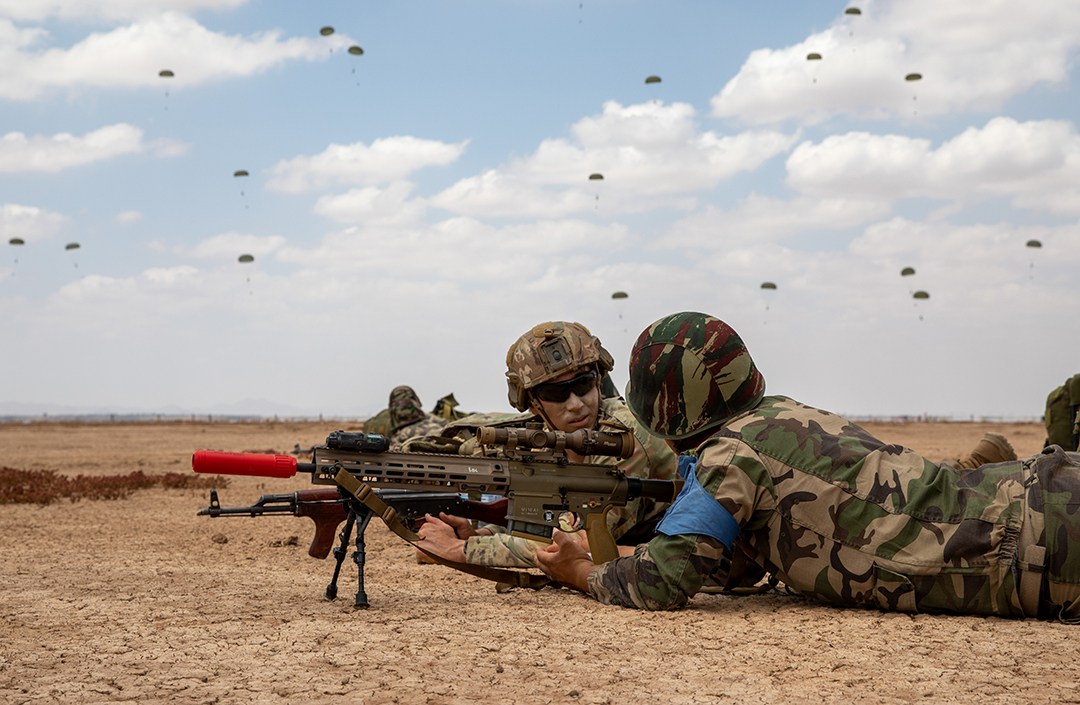
Marrakech – More than 40 technology vendors will embed with US military forces in Morocco from April 20 to May 8 to test cutting-edge battlefield systems during African Lion 26, according to DVIDS.
The initiative is led by the US Army Southern European Task Force, Africa’s (SETAF-AF) Advanced Capabilities Directorate, which serves as the command’s primary interface with the innovation ecosystem. The announcement came on February 9, as final operational preparations for the exercise moved forward.
The vendors will address specific operational gaps, including 10 mission command systems, four deep attack capabilities, 12 defense-in-depth enablers, and 15 counter-attack integrators. Units including the 19th Special Forces Group, the 173rd Airborne Brigade, and the 207th Military Intelligence Brigade will take these tools from industry into the field.
“Our ultimate purpose is to translate the senior leader’s vision for transformation into tangible, battlefield-ready capabilities in the hands of our Soldiers,” said Lt. Col. Ramon Leonguerrero, innovation division project manager for the Advanced Capabilities Directorate, in the press statement.
Morocco’s expansive ranges, unrestricted airspace, and open electromagnetic spectrum were cited as key factors enabling realistic experimentation at scale.
A central priority is transforming how the combined joint task force headquarters processes data and executes strikes – shifting from manual reporting to automated, real-time analytics.
Advanced AI tools, ISR systems, and launched effects from six key vendors are being integrated to shorten the kill chain. Technologies such as the Maven Smart System will help build a common operational picture by bridging operational and tactical sensor data.
“Our goal is to close the gap between emerging technology and the warfighter, using African Lion 26 to rapidly field and validate the tools and technology needed for a decisive edge,” Leonguerrero said. “The shift is most evident in the accelerated speed of decision-making.”
That acceleration is most visible in deep attack operations. “This provides the CJTF headquarters with the ability to detect, track, and engage targets with greater speed and at extended ranges, revolutionizing deep reconnaissance and attack operations,” he stated.
The exercise also serves as a live testing ground. Warfighters will complete digital surveys evaluating each system’s performance, generating real-time scorecards sent directly to vendors and US Army Europe and Africa to guide procurement decisions.
“We need the ability to scale or make changes to technology rapidly,” Leonguerrero added. “This exercise allows us to test, fail, fix, and validate these emerging technologies in an operational environment.”
The groundwork for African Lion 26 was laid during planning meetings held December 8-12, 2025, at the Southern Zone headquarters in Agadir, where Moroccan and American representatives discussed interoperability, logistics, and force integration across air, land, maritime, and special operations domains. The exercise will span Agadir, Tan Tan, Taroudant, Kenitra, and Benguerir.
Morocco’s Royal Armed Forces noted that more than 40,000 troops participated across the last five editions, describing it as “the largest military event in Africa.”
That strategic weight was reinforced during AFRICOM’s first 2026 media briefing on February 3, when Commander General Dagvin Anderson described African Lion 26 as bringing together 19 African countries alongside European and other international partners.
Anderson, who has visited Morocco twice since assuming command in August 2025, stressed that Morocco remains a central pillar of US security strategy on the continent.
“Security leads to stability; that stability creates opportunities for investment; and that investment creates prosperity for both African partners as well as the United States,” Anderson said.
Anderson also pointed to the depth of the bilateral relationship, noting that Morocco was the first country to recognize the United States as a nation. “We are excited this year as the United States approaches its 250th birthday that Morocco has been with us every step of the way as the first country to have recognized us as a nation,” he affirmed.
That recognition dates to December 1777, when Sultan Sidi Mohammed Ben Abdallah (Mohammed III) opened Moroccan ports to American vessels, leading to the 1786 Treaty of Peace and Friendship – widely considered America’s oldest continuously operative treaty relationship.
The general also spotlighted ongoing work to develop joint counterterrorism infrastructure, describing efforts to establish centers of excellence in Morocco and Tunisia that would serve as “force multipliers” across the continent.
He framed Morocco’s role within a broader strategic calculus, foregrounding the importance of working with “willing partners” endowed with distinctive strategic capabilities.
African Lion 26 runs from April 20 to May 8, once again positioning Morocco as the host of the continent’s largest military exercise.