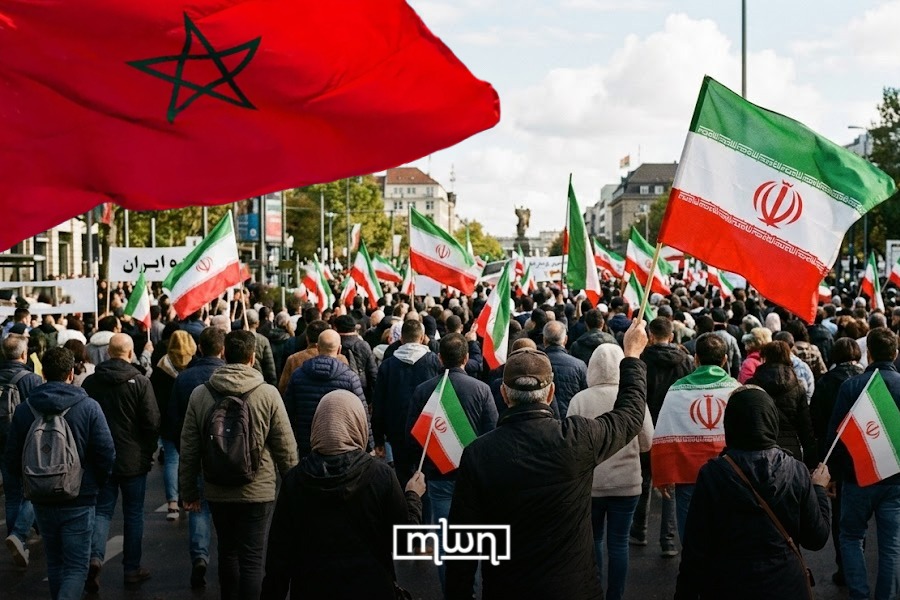
Morocco’s streets have recently witnessed a troubling scene as a small but vocal group has shown “solidarity” with Iran’s regime, chanting for a foreign power thousands of miles away. They claim to support a “revolutionary cause,” yet their stance undermines the very nation they call home. This is not a simple disagreement; it is a direct blow to Moroccan identity.
Is Moroccan memory this short? Have these protesters forgotten our history or do they choose to ignore it? Morocco’s conflict with the Iranian regime dates back to 1979, when King Hassan II recognized the danger behind Khomeini’s so‑called “Islamic revolution.” Morocco’s early stance was not dictated by ideology but by a clear understanding of geopolitical reality. King Hassan II warned that exporting revolutionary dogma under a religious banner would destabilize moderate nations and threaten the social cohesion of the wider Muslim world. His foresight proved accurate as Iran’s interference later extended from Lebanon to Yemen and even to North Africa. Our history shows that vigilance toward Tehran’s designs is not hostility, but self‑preservation.
The ‘distance’ myth and the Polisario connection
Some argue that Morocco is too far from the Middle East to be touched by its conflicts. That assumption is dangerously naive. The regime in Tehran does not respect geography. Through proxies like Hezbollah in Lebanon and the Houthis in Yemen, it exports instability well beyond its borders. Distance from Iran does not mean immunity from its reach in an age where ideological warfare crosses continents.
This is not conjecture but a documented fact. In 2018, Morocco severed diplomatic ties with Iran after presenting evidence that Tehran, via Hezbollah, had provided the Polisario Front with weapons, training, and support. Moroccan officials detailed shipments of surface‑to‑air missiles and the presence of Hezbollah operatives assisting Polisario elements. That was no coincidence. Iran has never forgiven Morocco for standing by the exiled Shah, and it has sought to weaken our country as a form of strategic revenge.
The threat has only deepened. More recent reports, including by leading international media outlets, revealed that Iran, through Hezbollah, trained fighters from the Algeria‑based Polisario Front, including those later detained in Syria. This confirms that Tehran continues to use Polisario as a proxy in its wider regional agenda. When someone waves an Iranian flag in a Moroccan street today, they are not supporting “resistance;” they are endorsing the very network that arms those trying to amputate our Sahara from our map.
This is no freedom cause
While Moroccan forces dedicate their lives to defending our territorial integrity, these activists provide moral and political cover for a foreign power that seeks our fragmentation. Their actions insult every soldier guarding our borders. Marching for a regime that funds separatists is not an exercise of freedom of expression; it is an act of deliberate disloyalty.
Some protesters hide behind “freedom of expression” to justify their stance. But no democracy on earth grants its citizens the right to collaborate morally or politically with an actor that targets its sovereignty. Morocco’s 2011 Constitution guarantees freedom of thought, opinion, and expression in Article 25. Our Constitution guarantees broad freedoms, but it also binds those freedoms to the nation’s unity and sacred institutions. Article 42 emphasizes the King’s role as defender of the realm and the people’s cohesion, while national laws criminalize any act that endangers territorial integrity. True democracy flourishes only when citizens exercise rights within the framework of collective responsibility. To weaponize free speech against national survival is to betray the very system that grants that speech.
The Sectarian and moral illusion
These individuals exploit the safety and liberties guaranteed by the Moroccan state to promote a regime that violently suppresses its own people. Would they dare protest against the Mullahs in Tehran? Would they question Iran’s territorial ambitions or proxy wars without risking prison or worse? To use Moroccan liberty as a shield to defend Iranian repression is not practicing freedom; it is abusing it.
The illusion goes deeper than sectarianism. The Iranian regime not only targets Sunnis or those of other sects; it also brutalizes Shia who reject the authority of the Mullahs. It behaves less like a state and more like a mafia, destroying anyone who dares to oppose its rule regardless of sect, class, or background. To trade a proud, independent Moroccan Sunni‑Maliki identity for the protection racket of such a regime is to surrender both dignity and reason.
Dissent or subversion?
There is a clear line between criticizing a domestic policy and cheering for a foreign power that arms separatist militias. The first is dissent; the second is subversion. Healthy criticism strengthens a nation; it pushes institutions to reform and adapt. But collaboration direct or indirect with a power seeking Morocco’s dismemberment crosses from civic activism into treachery. Those who raise Tehran’s cause in our streets are not participating in democratic debate but echoing propaganda designed to weaken the Moroccan state from within. The line is thin but unmistakable: one corrects the homeland, the other conspires against it.
Moroccan law has long treated incitement against territorial integrity as an offense precisely because the Sahara question is not a mere “policy dispute;” it is a red line of national existence. When you stand with those who train and arm the Polisario, you are not defending democracy; you are standing against the very survival of the Moroccan state.
Loyalty to the fatherland
True loyalty (الولاء للوطن) means standing by Morocco’s land, history, and monarchy before anyforeign agenda. Our independence was built on unity, and our sovereignty depends on vigilance.Every generation of Moroccans inherits both freedom and responsibility. Our ancestors fought colonial powers not only to reclaim land but to secure the dignity of choice, the right to shape our destiny without external manipulation. To honor their sacrifice means defending the unity they achieved. Today’s vigilance ensures that Morocco remains not a pawn in foreign schemes, but a sovereign voice in the Muslim world and Africa alike.
To those chanting for Iran’s regime, the truth is simple: you cannot serve two masters: the nation that gives you a passport, a home, and freedoms, or the foreign regime that seeks to tear that nation apart. In the face of Iran’s hostility and its alliance with the Polisario, the choice is brutally simple: you are either with Morocco’s unity, or with the Mullahs who wish to see it broken.
The views expressed in this article are the author’s own and do not necessarily reflect Morocco World News’ editorial views.