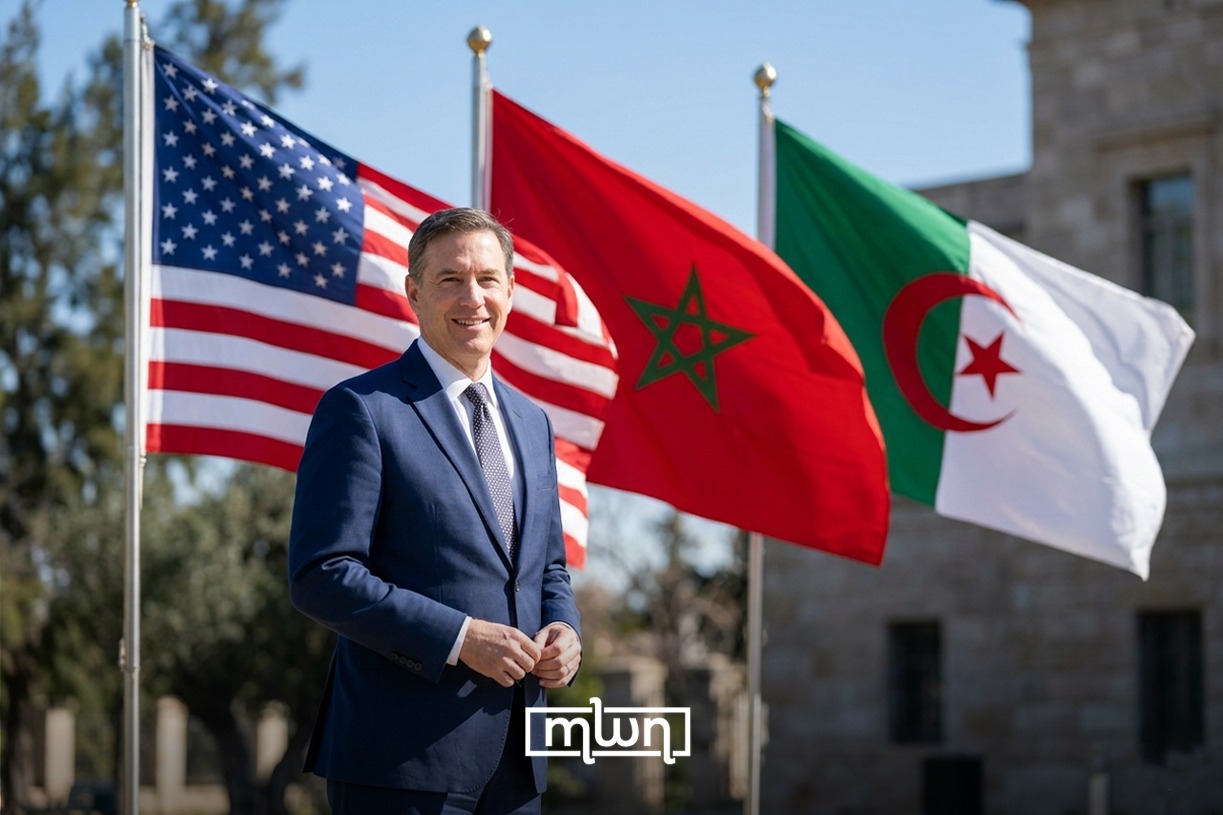
Marrakech – US Deputy Secretary of State Christopher Landau will travel to Algeria and Morocco from April 27 to May 1. The visit comes at a critical juncture in the Western Sahara dispute, with Washington intensifying diplomatic pressure on all fronts to advance a resolution based on Morocco’s Autonomy Plan.
In Algeria, Landau will meet with officials to discuss what the State Department has described as regional security issues and commercial deals with US companies. He will then travel to Morocco for talks on technological and space coordination and the bilateral security partnership.
The trip is not routine. It lands days before UN Secretary-General Antonio Guterres is expected to present a strategic review of MINURSO’s mandate to the Security Council on April 30. The review was mandated under Resolution 2797, adopted in October 2025, which anchored the international framework behind Morocco’s Autonomy Plan as the basis for negotiations.
Washington has made its position on MINURSO clear. US Ambassador to the UN Mike Waltz told Congress in March that Washington is conducting a strategic review of MINURSO, a mission deployed for over 50 years.
He said any renewal of the mission’s mandate must be tied to a genuine political process built around Morocco’s autonomy proposal. Secretary of State Marco Rubio’s strategic plan for 2026-2030 committed the State Department to winding down costly and ineffective peacekeeping operations worldwide.
The pressure on Algeria has been direct. During an April 17 meeting in Antalya between Trump’s special envoy for Arab and African affairs Massad Boulos and Algerian Foreign Minister Ahmed Attaf, Washington reportedly urged Algeria to dismantle the Tindouf “refugee” camps and accept the Autonomy Plan as the foundation for a final settlement.
According to Moroccan media reports, Algeria offered counterproposals including access for US companies to its hydrocarbons and rare minerals. Boulos did not accept.
Guterres is set to meet with his special representative for Western Sahara and MINURSO chief Alexander Ivanko in New York late today to finalize the strategic review ahead of the April 30 presentation. The review will shape the Security Council’s deliberations on the mission’s future scope and mandate.
The diplomatic momentum extends well beyond Washington. Morocco’s Foreign Minister Nasser Bourita has been conducting an intensive European tour timed to precede the Security Council session.
In Vienna on April 22, Austria endorsed Resolution 2797 and stated that genuine autonomy under Moroccan sovereignty could constitute one of the most feasible solutions. The two countries signed a memorandum of understanding on strategic dialogue.
Bourita then traveled to London, where UK Foreign Secretary Yvette Cooper described Morocco’s 2007 Autonomy Plan as the most credible, viable, and pragmatic basis for peace. The backing of a permanent Security Council member carries particular weight ahead of the April 30 review.
Today, Switzerland declared the Autonomy Plan the most serious, credible, and pragmatic basis for resolving the dispute. Bern welcomed Resolution 2797 and affirmed that genuine autonomy under Moroccan sovereignty could represent one of the most viable outcomes.
These reaffirmations followed EU High Representative Kaja Kallas’s visit to Rabat on April 16-17, during which the 27-member bloc’s unified position in favor of the Autonomy Plan was formally restated. The newfound EU position, adopted in January, calls on the parties to engage in negotiations taking Morocco’s proposal as a basis.
The convergence of Landau’s visit, the MINURSO strategic review, and Bourita’s European diplomatic offensive is not a coincidence. It is a coordinated closing act on a five-decade dispute whose outcome is no longer in question.
The Polisario’s own leadership has begun to signal as much. In an interview with Spain’s El Español this month, the separatist front’s pseudo-foreign minister Mohamed Yeslem Beisat admitted that his movement “cannot make independence the only option.”
He went further in remarks to El País, conceding that autonomy under Moroccan sovereignty “can be discussed and accepted.” Such statements would have been doctrinal heresy within the movement a year ago.
At the 50th anniversary of his phantom republic in Tindouf, Polisario chief Brahim Ghali told his dwindling audience that the Sahrawi people would be “not a source of threat but a partner willing to pursue peace and cooperation” with Morocco. Armed struggle, once the doctrinal centerpiece of the separatist project, has quietly disappeared from the talking points.
The diplomatic ground beneath the Polisario continues to give way. Mali withdrew its recognition of the self-proclaimed “SADR” on April 10, calling Morocco’s Autonomy Plan the only serious and credible basis for a settlement.
Honduras followed suit on April 22, suspending recognition it had maintained since 1989. Bolivia cut ties with the entity in February. That makes six withdrawals in two years. No country has extended new recognition to the phantom state since 2011.
And as the Arabic proverb goes, misfortunes never come alone. The US Bureau of Counterterrorism publicly flagged concerns this week over Iran-Polisario collusion, with Senator Ted Cruz warning that Tehran is turning the separatist front into “the Houthis of West Africa.”
Two congressional bills now seek to designate the Polisario as a terrorist organization. For a movement already hemorrhaging diplomatic recognition and abandoning its own founding doctrine, the threat of a formal terror listing may prove to be the final nail.
Washington is driving the timeline. Europe is consolidating behind it. The separatist front’s own leaders are hedging their bets. And the countries that once propped up the fiction of an independent Sahrawi state are walking away – one by one, capital by capital. The space for alternatives has not merely narrowed. It has, for all practical purposes, closed.
Read also: Why the US Must Designate the Polisario Front as a Terrorist Organization