
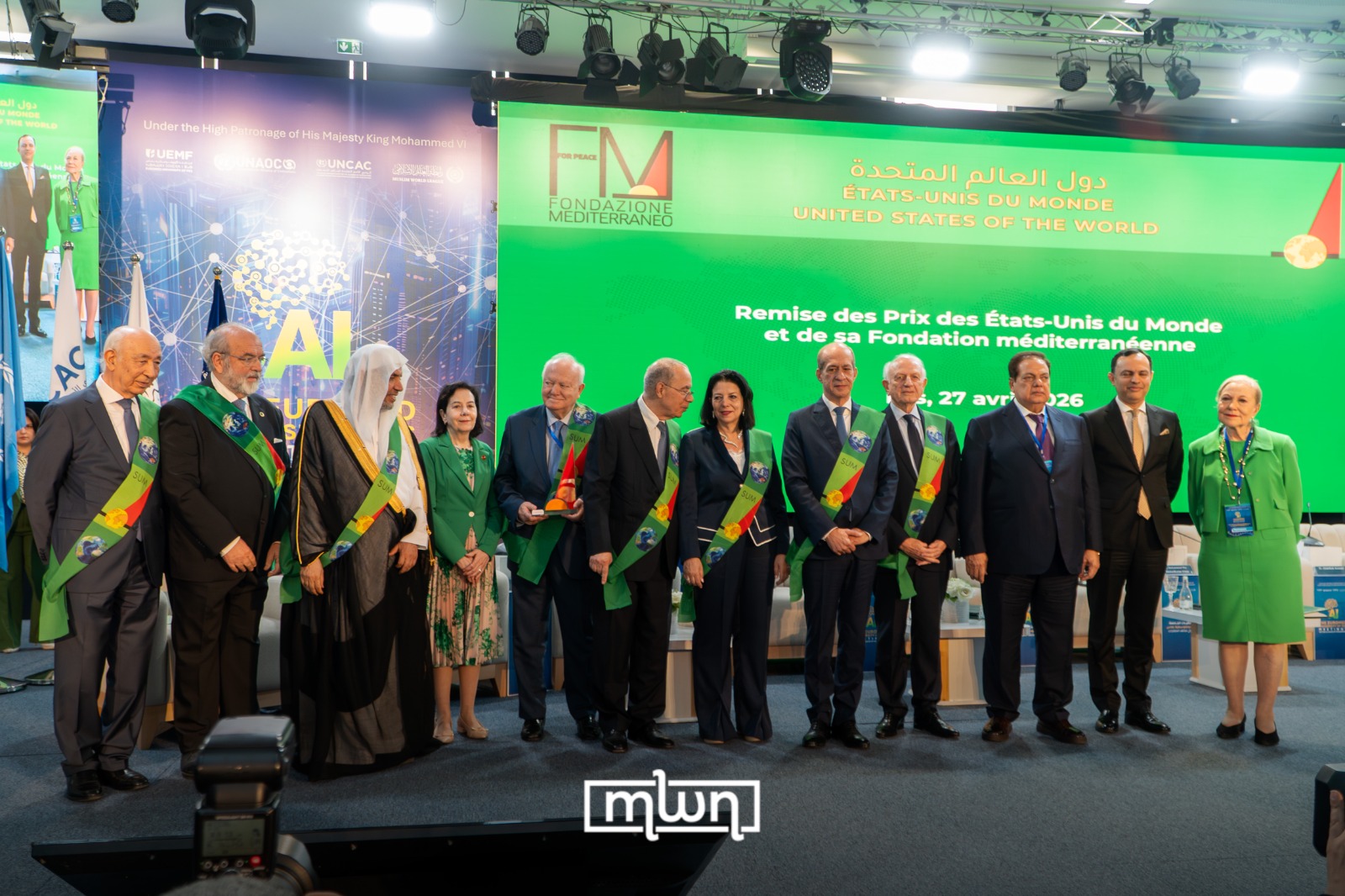
Fez — The “Euromed University of Fez Meetings on the Alliance of Civilizations” opened yesterday, bringing together more than 2,000 participants from over 70 countries to examine how artificial intelligence is reshaping societies, economies, and global governance.
The opening session featured high-level figures including Mostapha Bousmina, André Azoulay, Mohammad bin Abdulkarim Al-Issa, Miguel Ángel Moratinos, Amal El Fallah Seghrouchni, and Mohamed Abou El Enein, all of whom warned that AI represents both a historic opportunity and a profound disruption requiring coordinated global oversight.
A forum grounded in urgency and global stakes
Speakers repeatedly framed AI as a turning point comparable to — or surpassing — previous industrial and scientific revolutions. Bousmina warned that the technology is transforming every sector while introducing new risks, from job loss to cyberwarfare.

“We are not witnessing a clash of civilizations, but a clash between human civilization and artificial intelligence,” he said, stressing the need for ethical and regulatory frameworks.
Technological progress must remain anchored in human values, Azoulay insisted, cautioning against allowing machines to replace human judgment.

“Technology is legitimate only when it serves humanity,” he said, adding that it “is not legitimate to think in place of humans.”
Between innovation and existential risk
International speakers warned that the stakes extend far beyond technology. Moratinos raised concerns about what he described as “technological totalitarianism,” while Al-Issa called for a unified ethical framework to govern AI systems globally.
For his part, Abou El Enein questioned whether humanity is prepared to manage the power it is creating.
“Will AI align with our values, or distance us from our humanity?” he asked, warning of risks ranging from misinformation to autonomous warfare.
Across sessions, the common theme remained the urgency to adapt to the AI age. Artificial intelligence is no longer a distant prospect but an active force reshaping global systems, requiring urgent, collective responses, participants argued.
Ministers and participants reflect on human-centered AI
Speaking to Morocco World News (MWN) on the sidelines of the event, Minister Amal El Fallah Seghrouchni emphasized the need to keep AI grounded in human values after receiving the Mediterranean Prize for Development.

“I am very happy to receive this prize as a Moroccan,” she said, adding that her work aims to make artificial intelligence “something human, deeply human.”
Mostapha Bousmina also told MWN that the forum was designed to bridge technical expertise and broader societal reflection.
“The engineers, the technologists, the researchers will present the recent findings in artificial intelligence,” he said, noting that discussions would also include philosophers, policymakers, and social scientists to address real-world implications.
Michele Capasso, Secretary-General of the “United States of the World” and President of the Fondazione Mediterraneo, echoed similar concerns in remarks to MWN.
“Artificial intelligence is an opportunity for all of us, but also a danger if it is not used in the service of humanity,” he said.
Student voices highlighted the event’s educational dimension. Laajal Anass told MWN that the forum reflects Morocco’s broader commitment to dialogue and cooperation.
“Today’s event shows the fundamental role of our university in opening up to its academic, political, and economic environment,” he said.
Lewisa Dudvyne Jean-Philippe, a PhD student, linked the discussions to global crises.
“Artificial intelligence plays a growing role in both conflict dynamics and humanitarian response,” she told MWN.
A platform for global dialogue
Organized in partnership with international institutions including the United Nations, the forum aims to produce recommendations addressing AI governance, ethics, and international cooperation.

Participants stressed that no single country can tackle these challenges alone, pointing instead to the need for inclusive dialogue across cultures and disciplines.