
 Join on WhatsApp
 Join on Telegram
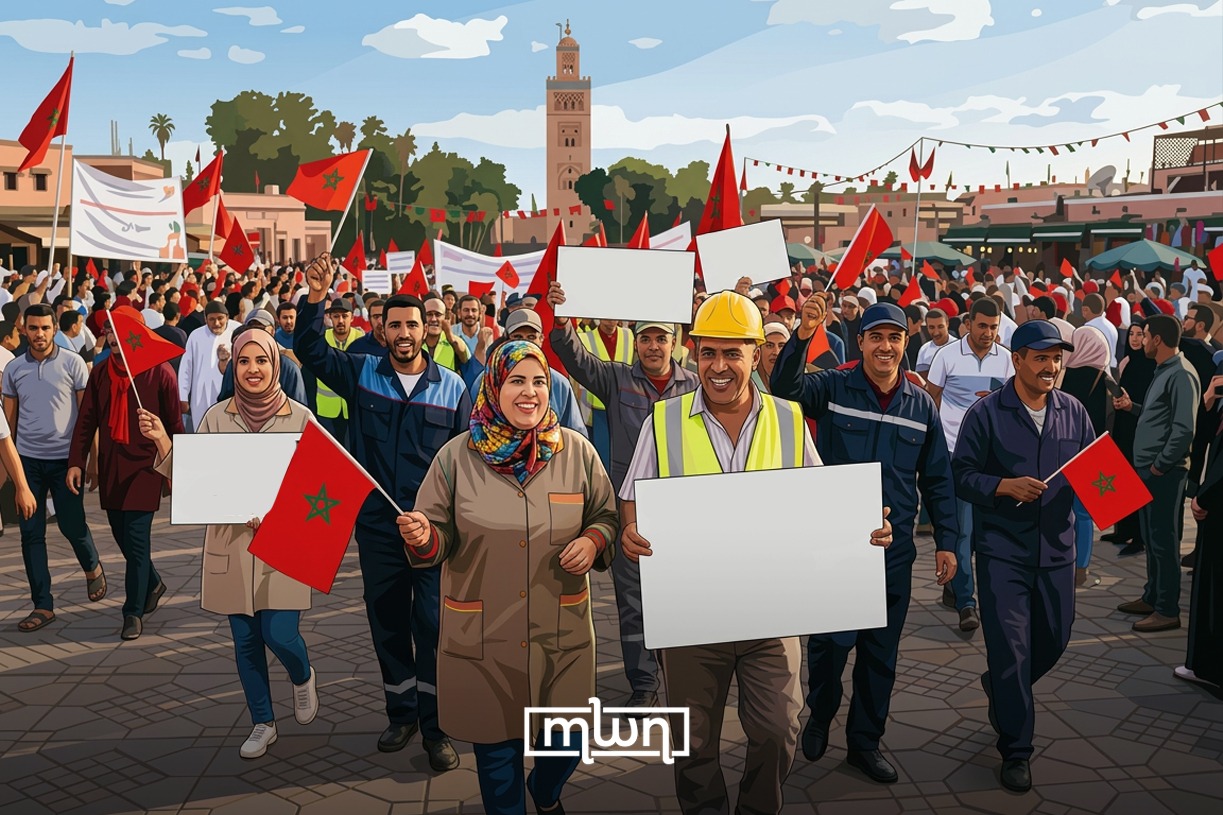
Casablanca — Every May 1st, Morocco’s streets fill with union marchers. Workers, banners in hand, move through Rabat, Casablanca, Marrakech, and other cities demanding better wages, more jobs, and fairer conditions. This year’s Labor Day arrives against a backdrop of recent government moves on wages and labor reform.
Just days before, the government held what it called a landmark round of social dialogue. A new round of meetings in April, chaired by Head of Government Aziz Akhannouch, brought together major trade unions, the General Confederation of Moroccan Enterprises (CGEM), and the Confederation of Moroccan Agriculture and Rural Development, focusing on wage increases, tax adjustments, and reforms to pensions and social protection. The government presented the talks as a win, but unions see it differently.
On paper, some progress is real. The SMIG has risen 20% since 2021, reaching MAD 3,422 ($370.59) per month as of January 2026. The agricultural minimum wage reached MAD 2,533 ($274.32) in April 2026, a 25% rise from before 2021.
Last month, the government council adopted draft law No. 032.26 amending the Labor Code, ending the system of 12-hour workdays for private security workers paid at standard rates and bringing their conditions in line with broader labor protections, part of the implementation of the April 2024 tripartite social agreement.
But numbers on paper and daily reality don’t always match. Morocco’s unemployment rate remained at around 13% in 2025, even as the economy generated 193,000 new jobs — only enough to reduce the number of unemployed people by roughly 17,000, leaving about 1.62 million people still out of work.
More troubling is what’s happening at the margins. Youth unemployment between ages 15 and 24 actually increased, from 36.7% to 37.2%, while women’s unemployment rose from 19.4% to 20.5%.
A generation the numbers keep leaving behind
The youth figure is one that union leaders keep returning to. A joint report by the High Commission for Planning (HCP), the International Labor Organization (ILO), and the European Union estimated that 2.9 million Moroccans aged 15 to 29 were not in employment, education, or training, representing 33.6% of that age group, roughly one in three. Women make up more than 72% of that total.
The agricultural sector adds another layer of tension. Morocco’s agricultural sector has shed 1.7 million jobs since 2000, leaving just one in four Moroccans working in farming, down from one in two a generation ago. And yet this year’s harvest is projected to be exceptional — agricultural output expanded 14.8% year-on-year in the first quarter of 2026, with cereal production expected to top 8 million metric tons, nearly 80% more than last year.
The workers who depend on it are increasingly foreign. Without sub-Saharan labour, farms in regions like Souss-Massa would struggle to survive, according to producers’ associations, a sign of how deep the structural gap between Morocco’s economic ambitions and its domestic workforce has become.
Workers haven’t forgotten the strike law either. In February 2025, five major unions called a general strike to protest the passage of a new strike regulation law and the soaring cost of living, with participation on the first day reaching 84.9% according to unions, effectively paralyzing educational institutions and key public and private sectors alike.
The law, Bill 97.15, remains a sore point. Unions argued it narrowed the legal definition of strikes to labour-specific demands only, excluding protests over living costs or government policy, and imposed penalties on unions for non-compliance.
HCP projections suggest unemployment could fall below 13% in 2026, driven by agricultural recovery and a projected economic growth rate of 5%. Optimistic, if it holds.
But for a young person in Casablanca — where even a minimum wage salary of MAD3,422 ($370.59) falls well short of rent and basic expenses — projections are a difficult thing to live on.
Labor Day in Morocco has always been something between a march and a mirror. Today, what it reflects is a country generating growth, reforming on the margins, but still struggling to make that growth reach the people carrying the banners.
Morocco World News is also on X — check out our latest posts now! Get MWN on iOS and Android for instant access to breaking news.