
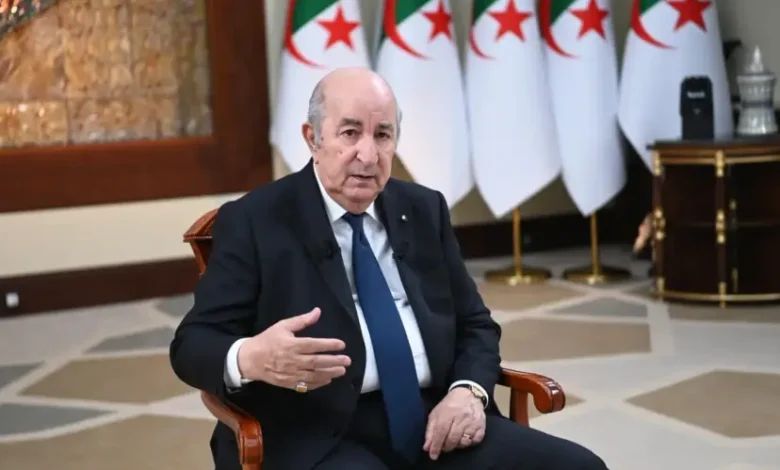
Rabat – Recent remarks by Algerian President Abdelmadjid Tebboune have sparked debate over whether Algeria is beginning to soften its long-standing position on the Western Sahara issue, as global momentum increasingly favors Morocco’s autonomy plan.
During a televised interview on Algeria’s public channel on Saturday, Tebboune referenced UN Security Council Resolution 2797, stating that it is “making its way… without a problem between them and us.” While the comment was short and lacked detail, it could be significant given Algeria’s consistent rejection of UN resolutions that support a political solution based on Moroccan sovereignty.
Adopted on October 31 last year, Resolution 2797 calls for a realistic and lasting political solution to the Western Sahara dispute. It reinforces the Moroccan autonomy initiative, which offers self-governance for the region under Moroccan sovereignty. The resolution also clearly identifies Algeria as a key party in the conflict and urges it to take part in negotiations.
Algeria notably did not vote on the resolution, choosing instead to boycott the session despite holding a non-permanent seat on the Security Council at the time. Its foreign minister, Ahmed Attaf, had strongly criticized the resolution and reaffirmed Algeria’s support for the Polisario Front and its call for self-determination.
A careful recalibration?
Tebboune’s latest remarks appear to mark a shift in tone, as by acknowledging that the resolution is progressing, he may be signaling a reluctant acceptance of the current UN-led process, which aligns with Morocco’s position.
This comes at a time when Morocco has achieved major diplomatic gains on the international stage. A growing number of countries have backed Morocco’s autonomy plan as the most credible solution to the dispute over the past few years. At the same time, several nations have withdrawn or frozen their recognition of the self-proclaimed Sahrawi Arab Democratic Republic, weakening the diplomatic standing of the Polisario.
This trend reflects a broader shift in global opinion. Many countries now favor stability and pragmatic, realistic solutions over prolonged conflict, especially in a region facing security and economic challenges.
As a result, both the Polisario and Algeria appear increasingly isolated. The UN process has moved away from the idea of a referendum on independence, focusing instead on a negotiated political solution. Morocco’s autonomy plan remains at the center of these discussions.
Former US ambassador to Morocco Edward Gabriel recently told MWN that the resolution has helped clarify the framework for a political solution, reinforcing Morocco’s autonomy initiative as the most realistic basis for negotiations.
At the same time, he noted that Algeria is unlikely in the short term to accept the autonomy framework and may continue to resist the UN-led process, although he believes its influence is gradually diminishing as global support consolidates around Morocco’s position.
“They (Algeria) will likely stall and obstruct. They will have to eventually realize that world opinion has solidified around the Moroccan initiative and that their negotiating power is diminishing with time,” he Gabriel stated.
Read also: Western Sahara: What to Expect from the Post-Resolution 2797 Phase
Meanwhile, recent diplomatic activity also suggests growing pressure on Algeria. The recent visit of senior US official Christopher Landau to both Algeria and Morocco reportedly included discussions on resolving the Western Sahara issue. Tebboune himself spoke positively about the meeting, hinting at improved relations with Washington despite past tensions.
This growing international pressure raises questions about whether Algeria is being pushed toward a more pragmatic approach on the Western Sahara issue, or whether it is still too early to assess any real shift. It also opens debate on whether this evolving diplomatic context could eventually translate into changes on the ground, including a reassessment of conditions in the Tindouf camps where the Polisario leadership is based.
While Tebboune avoided going into detail during his speech and quickly moved on to other regional topics such as Palestine, his cautious and limited reference to the UN process suggests that any potential adjustment remains gradual and sensitive. But it could also be Algeria’s way of still formally maintaining its position of not being a direct party to the conflict.