
 Join on WhatsApp
 Join on Telegram
Fez – Morocco is accelerating its energy transition with a large-scale plan focused on storage, grid expansion, and flexible power capacity to support the growing share of renewables.
The country is entering a new phase in its energy strategy, notably moving beyond simply expanding renewable capacity to ensure the system can handle it.
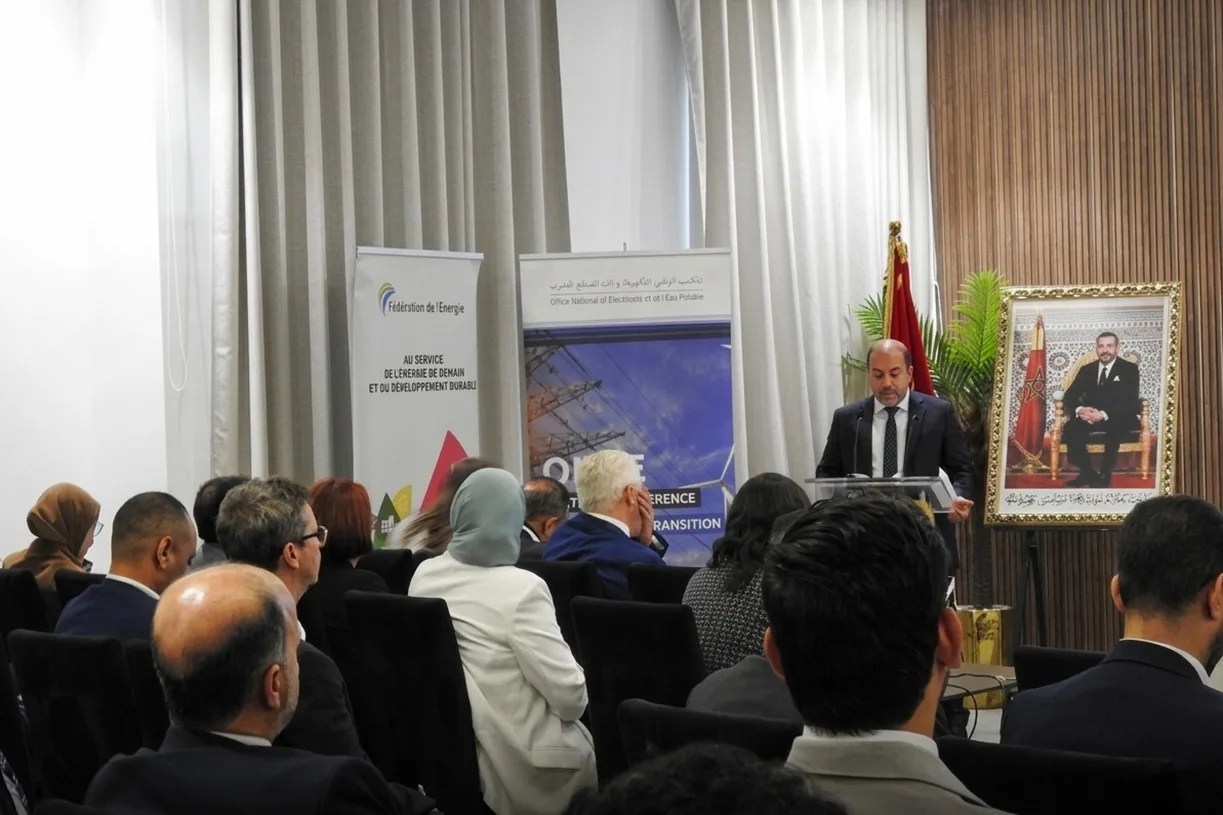
At the end of April, in Marrakech, the National Office of Electricity and Drinking Water (ONEE), in partnership with the Federation of Energy, brought together key players in the sector to address the central challenge of integrating a rapidly rising share of renewable energy without weakening the stability of the national power grid.
Renewables already account for around 47% of Morocco’s electricity mix, a significant milestone that reflects years of investment in solar, wind, and hydro power.
Yet this progress also creates new technical constraints.
Renewable energy production is, by nature, intermittent.
Solar power depends on daylight, and wind energy fluctuates with weather conditions.
This makes it harder to maintain a constant balance between supply and demand across the grid.
To address this, ONEE is placing storage at the heart of its strategy.
The plan targets more than 3,500 megawatts (MW) of storage capacity by 2030.
This storage will act as a buffer, allowing excess electricity generated during peak production periods to be stored and released when demand rises or generation drops.
In practical terms, it is a key tool to stabilize the system and avoid disruptions.
But storage alone is not enough. The strategy also includes the development of 4,500 MW of flexible generation capacity based on natural gas.
These plants can be activated quickly when renewable output declines, ensuring continuity of supply.
This combination of storage and flexible generation is designed to create a more resilient and responsive energy system.
At the same time, Morocco plans to significantly expand its transmission infrastructure.
The program includes the construction of 6,000 kilometers of new very high-voltage lines.
This expansion is essential to transport electricity efficiently from production sites, often located in remote areas, to major consumption centers across the country.
All these efforts are part of a broader investment program exceeding MAD 180 billion (approximately $18 billion) by 2030.
The scale of the investment underlines the importance of energy transition not only as an environmental priority but also as a strategic economic issue.
Last month’s discussions in Marrakech focused on reaching high levels of renewable energy as an only one part of the transition.
The real challenge now lies in managing that energy reliably, at all times, and across the entire network.
Morocco’s approach reflects this shift. By combining storage, flexible capacity, and grid expansion, the country is working to build an energy system that is not only cleaner, but also stable and secure.