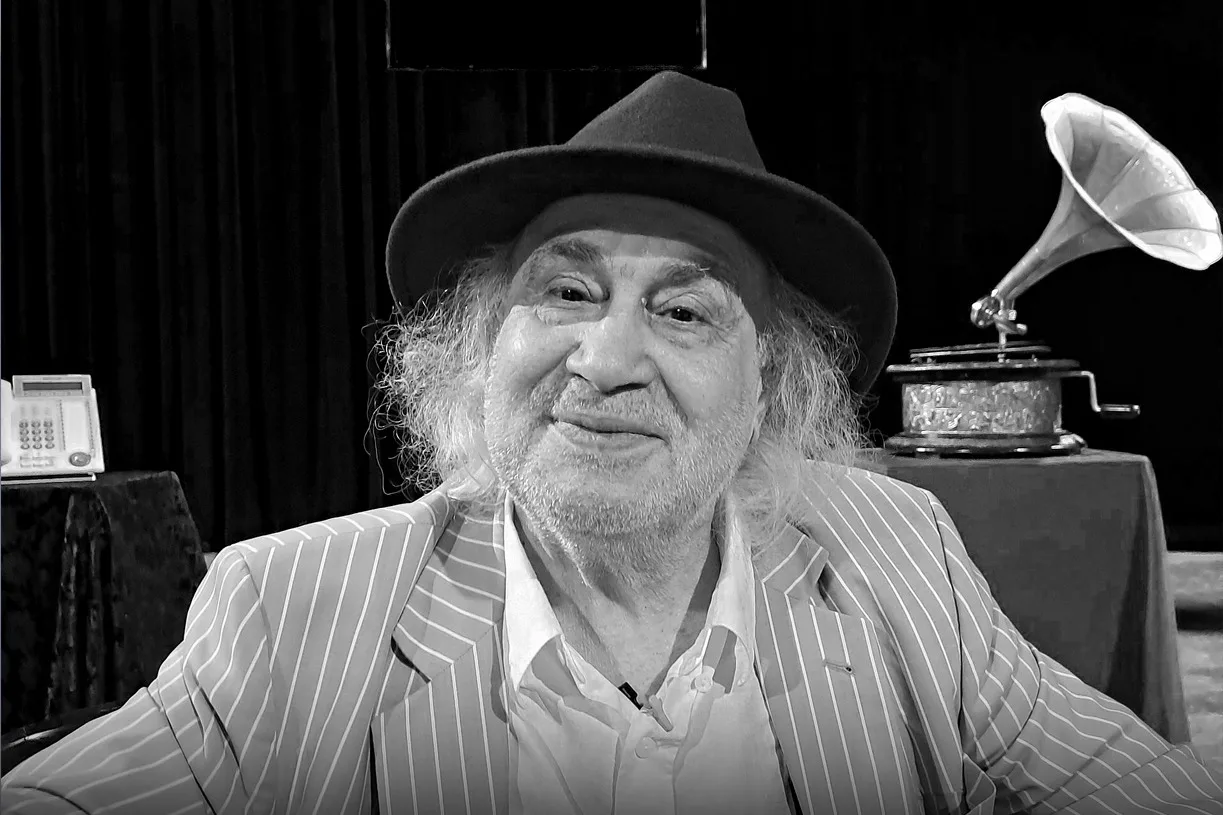
Marrakech – Nabil Lahlou, the filmmaker, actor, and dramatist who spent six decades defying the conventions of Moroccan theater and cinema, died Thursday at dawn in Rabat. He was 81. His family confirmed he succumbed to a long illness.
His burial took place the same day after the Al Asr prayer at Chouhada cemetery in Rabat.
Born in Fes in 1945, Lahlou gravitated toward the stage at a young age. He left Morocco in 1964 for Paris, where he trained at the Charles Dullin school and the University of Theatre des Nations. Rather than return home immediately, he moved to Algeria to teach theater at the Borj El Kiffane school, where he directed several productions, including “Le Grand Moussem.”
He returned to Morocco in 1973 and launched a career that straddled theater, cinema, and television with relentless intensity. He wrote cultural pages for newspapers while directing plays and making films – an output that rarely slowed across five decades.
Lahlou’s theatrical identity was forged in opposition to what he called the superficial entertainment that dominated Moroccan stages. He treated the theater as a laboratory for probing human contradictions and social fractures.
His goal was blunt: force audiences into intellectual confrontation with reality. Every performance was designed as a space for political and social reckoning, not passive consumption.
His fascination with Shakespeare produced some of his most distinctive work. “Ophélie n’est pas morte,” written in 1968 and staged the following year, reimagined characters from Hamlet – placing them in wheelchairs and on crutches, deliberately paralyzing their movement to strip the drama bare. “Salahef” (Les Tortues), created in 1970, was widely regarded as a theatrical breakthrough.
In cinema, Lahlou carved an equally unconventional path. His first feature, “Al Kanfoudi” (1978), became his first major success. It was followed by “Le Gouverneur Général de l’île de Chakerbakerbane” (1980), “Brahim Yach” (1982), “L’Âme qui brait” (1984), “Komany” (1988), “La Nuit du crime” (1992), “Les Années de l’exil” (2002), “Tabite or not Tabite” (2005), and “Regarde le Roi dans la Lune” (2011). He also directed television work, including “Le Possible de l’Impossible” (1975), adapted from a short story by Abdeljabbar Shaimi.
He made theater that interrogated power, not entertained
Lahlou worked in both Arabic and French throughout his career and performed on stages across multiple countries. He is considered one of the most influential Moroccan theater directors of the 1980s.
His final creation, “Macha Machmacha veut un rôle dans le film Le Procès de Socrate,” was staged multiple times in recent years, most recently in March 2026 at the Théâtre National Mohammed V in Rabat. The work celebrates those who dare to say “no” – arguing they outlast their oppressors in memory.
Performed in refined Moroccan Arabic alongside his wife Sophia Hadi, the work evolved from his original 1996 production “Le Procès de Socrate.” It drew on Socratic maieutics – the art of forcing thought through relentless questioning – to dismantle mediocrity, populism, and what he saw as a world unmoored from meaning.
The autobiographical piece traced his creative awakening, his love story with Hadi, and his lifelong collisions with institutional censorship. It sparked intense debate among critics, with many calling it a return to the intellectual rigor Moroccan theater had surrendered to television and commercial cinema.
The censorship, however, was no abstraction. The play had been barred without explanation from the 25th National Theater Festival in Tetouan in November 2024 by the Ministry of Culture’s Direction des Arts. Lahlou responded with a public open letter to Minister Mohamed Mehdi Bensaïd, calling the exclusion an affront to freedom of expression.
It was a familiar pattern. Lahlou operated for decades as a dissident voice within Morocco’s cultural apparatus – frequently censored, perpetually unbroken. His theatrical universe was steeped in postcolonial critique, subaltern resistance, and the politics of the body.
In “Ophélie n’est pas morte,” he confined Shakespeare’s characters to wheelchairs and crutches – not as metaphor alone but as a visceral staging of how autocratic power paralyzes artistic subjectivity.
His work laid bare the mechanics of state surveillance, cultural gatekeeping, and what he framed as the slow suffocation of dissenting imagination in postcolonial societies. He did not make theater for comfort. He made it to provoke a rupture.
He is survived by his wife, Sophia Hadi, and his daughter, Mariakenzi Lahlou.