 Join on WhatsApp
 Join on Telegram
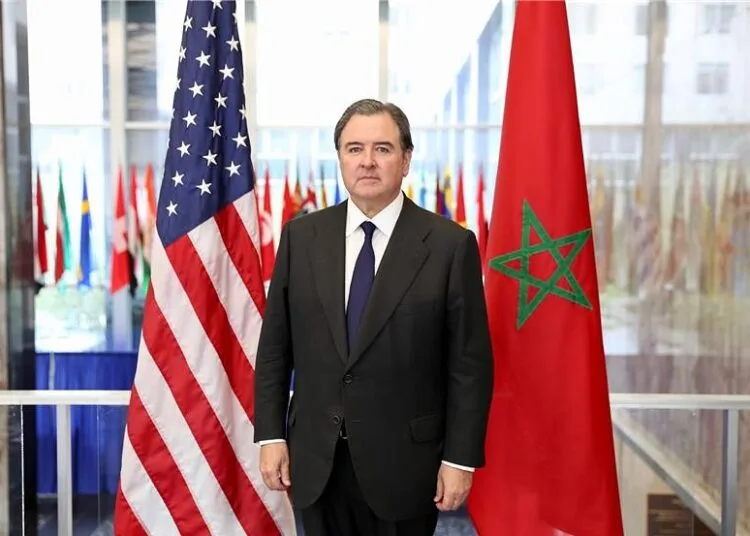
Rabat – US Ambassador to Morocco Duke Buchan III announced he held a discussion in Western Sahara with Alexander Ivanko, the head of UN peacekeeping mission, MINURSO, reiterating the US concerns on Polisario’s recent violence targeting the Moroccan southern city of Es-Semara.
The US embassy in Morocco quoted the ambassador in a social media post, where he recalled that Polisario’s projectile attack on the region drew “resounding international condemnation.” He also highlighted Polisario’s continued refusal to engage “seriously on the future of the Sahrawi people, hampering the UN-led political process.”
Duke Buchan reiterated US support for Morocco’s Autonomy Plan, stressing that peace requires partners willing to negotiate towards a brighter future.
On May 5, Polisario launched projectile attacks targeting Morocco’s Es-Semara in a new heinous terrorist act, sparking international frustration.
Many countries, including the US, Belgium, and the UK, among others, have reiterated concerns over Polisario’s violence in the region.
The US mission to the UN repeatedly condemned the attack, emphasizing that such an act is inconsistent with US-facilitated dialogue aimed at bringing the parties together to reach a mutually acceptable and agreed-upon solution to the Sahara dispute.
“The time to end this 50-year-old dispute is now,” the mission said.
The message also sends a clear and direct signal to Algeria’s regime, which hosts, finances, arms, and trains the Polisario Front to challenge Morocco’s territorial integrity and sovereignty over its southern provinces in the region.
Algeria’s regime also continues to refuse to shoulder its responsibility in the dispute as a direct and main party, alleging it’s merely an observer.
However, UN Security Council Resolution 2797 dealt a significant blow to Algeria, shattering its claims and outdated narratives, naming the regime as among the main parties that should engage in the UN-led political process to contribute to finding a mutually acceptable political solution under the framework of Morocco’s Autonomy Plan.
Beyond the attacks on Es-Semara, Polisario has been drawing concerns due to its collusion with Iranian proxy-Hezbollah, with several congressmen and women now urging the US Administration to designate it as a terrorist group.
In an open hearing in April, Senior Bureau Official for the Bureau of Counterterrorism (CT) Monica Ager Jacobsen publicly and for the first time announced the US administration’s concerns over Polisario’s threats.
“We share concerns about the Polisario Front and its impact in the CT space. What I can say with confidence in an open hearing is that the region where the Polisario Front operates sits near trafficking and militant activity in the Sahel and that this creates vulnerabilities that external actors, including Iran, could seek to exploit,” the US official said.
She also reaffirmed the US commitment to monitoring the situation, stating that her country is “vigilant to those threats.”
Jacobsen announced that she is tracking the allegations regarding Polisario’s collusion with Iranian proxy Hezbollah and the Islamic Revolutionary Guard Corps (IRGC).
“The State Department and intelligence community are working closely on that,” the US official added, hinting at a future possible classified briefing to address the potential concerns.