


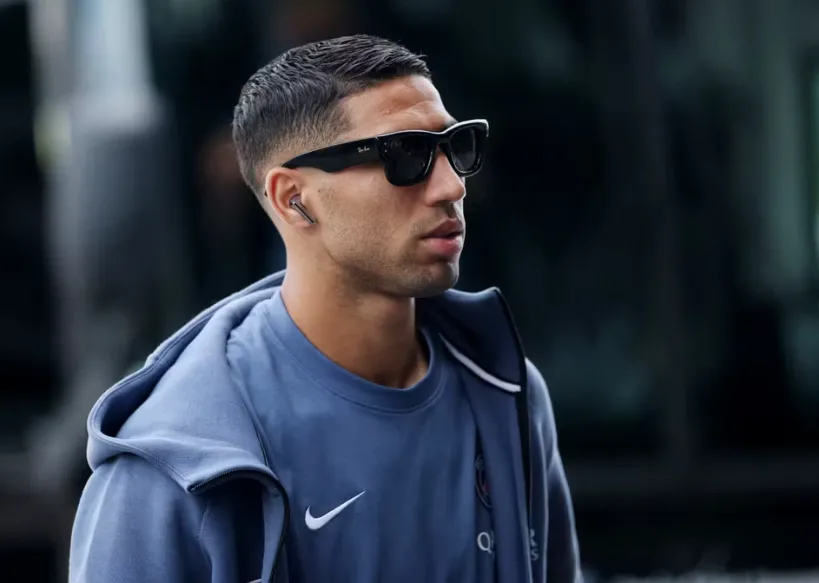
Rabat – In football, a season can be defined by moments of accomplishment on the pitch, but for Achraf Hakimi, those milestones increasingly share the spotlight with a second storyline unfolding away from it.
This reality became evident this Friday when, according to RMC Sport, the Moroccan defender appeared in person before the investigating chamber of the Versailles Court of Appeal.
Accompanied by his lawyer, Fanny Colin, Hakimi is seeking a dismissal of the sexual assault and rape allegations that have followed him since 2023, challenging the decision to refer his case to the criminal court in an effort to personally proclaim his innocence and give weight to his protest.
Ahead of crucial Champions League fixtures, international tournaments, and growing conversations surrounding the 2025 Ballon d’Or, this latest courtroom appearance ensures that renewed media attention around Hakimi’s ongoing rape allegations in France has once again resurfaced at a critical juncture.
The timing has become part of the discussion itself
As Hakimi established himself as one of the key figures of Paris Saint-Germain and one of Morocco’s biggest international stars, the return of the case to front-page headlines often appeared to coincide with periods when the spotlight on his football reached its highest point.
The latest development arrived just as football analysts and supporters began placing Hakimi among potential Ballon d’Or contenders following another exceptional European season under coach Luis Enrique.
Officially, the legal process remains ongoing, and no final verdict has been delivered.
Yet in the race for headlines, an important legal principle is sometimes overshadowed: “A person is presumed innocent until proven guilty.”
That principle exists to protect fairness, reputation, and the integrity of justice itself. But in the era of viral news cycles and instant public judgment, accusations alone can reshape how an athlete is viewed long before a courtroom reaches a conclusion.
For elite footballers, the consequences can extend far beyond public criticism.
A damaged image can affect sponsorships, locker-room perception, fan relationships, and even the trajectory of an entire career. In modern football, media narratives often travel faster than legal outcomes.
Benjamin Mendy a prey of media headlines
Many observers still point to the case of Benjamin Mendy as one of the clearest examples of how public narratives can permanently shift a football career long before legal proceedings reach their conclusion.
At his peak, Mendy was considered one of Europe’s most promising left-backs. After winning the World Cup with France national football team in 2018, he became a central figure at Manchester City F.C. under coach Pep Guardiola. City had invested heavily in him, viewing him as one of the future pillars of the club.
But once rape accusations against him became public in 2021, everything changed almost overnight.
Mendy was suspended by Manchester City. Sponsorships disappeared. His image in the media shifted dramatically, and his football career was effectively frozen during the lengthy legal process. Match fitness, rhythm, and momentum, all essential elements for an elite athlete, slowly vanished as the case dominated headlines for months and years.
By the time British courts later cleared him of the most serious charges, the football world had already moved on.
The player once seen as one of the best in his position was no longer competing at the same level, no longer part of Europe’s elite conversations, and no longer carrying the same reputation that had defined his rise.
Mendy’s story became larger than football itself. It became an example of how accusations, headlines, and constant public exposure can leave consequences even when legal outcomes evolve differently from initial perceptions.
That is why some supporters look at the recurring media attention surrounding Hakimi and quietly wonder about the broader impact repeated headlines can have on a player’s career, especially when they return during defining moments such as Champions League campaigns or Ballon d’Or discussions.
Punishment before verdict
The comparison does not suggest identical situations. Every legal case carries its own facts and circumstances. But it points to a broader reality about modern sports culture that public narratives can sometimes deliver consequences before justice concludes its process.
That is why the repeated return of Hakimi’s case ahead of defining football moments continues to fuel quiet questions among supporters.
While Hakimi has repeatedly maintained his innocence, his decision to appear in court personally this Friday reflects a determination to clear his name legally.
During a press conference in April ahead of Paris Saint-Germain’s UEFA Champions League quarter-final second leg against Liverpool, Hakimi said he feels “calm” after being referred to court over rape allegations, insisting the accusation is “false” and that he trusts the justice system.
“I know this accusation is false, I am calm. I leave this to my lawyers and the justice system,” Hakimi added.
For now, the Moroccan star continues to respond on the pitch through performances, consistency, and leadership for both PSG and the Morocco national football team.




