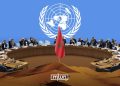

Morocco’s Permanent Representative to the United Nations, Ambassador Omar Hilale, has called for a reassessment of whether the Western Sahara question should remain on the agenda of the UN Special Committee on Decolonization (C-24). His argument is straightforward, taking into consideration that a file that the Security Council now handles as a matter of peace, security, and regional stability no longer belongs within the framework under which it was originally placed more than six decades ago, when the Sahara was under Spanish colonial administration and treated as a decolonization issue.
Ambassador Hilale made this case at the C-24’s regional seminar held in Managua, Nicaragua, in May 2026, opening a legal and institutional debate about the very nature of the file as it is understood within the UN system today.
To grasp the legal underpinnings of this position, one must revisit the historical trajectory of the question within the United Nations. Back in 1963, at a time when the region was administered by Spain, Morocco took the initiative to request the inscription of the Sahara on the UN list of Non-Self-Governing Territories. The country’s goal was to bring the question within the decolonization process the Organization was then overseeing.
Since then, the file has undergone fundamental transformations that have substantially altered its character. Chief among these are the 1975 advisory opinion of the International Court of Justice, which recognized the existence of legal and historical ties of allegiance between the Saharan tribes and the Sultans of Morocco; the organization of the Green March; and the signing of the Madrid Accords on November 14, 1975, which brought Spanish administration of the territory to a close before Spain’s final withdrawal in 1976. From that point on, the question entered an entirely new phase, one distinct from that which had originally justified the inclusion of the Sahara among territories to be decolonized. And it thus evolved within a markedly different political, legal, and institutional context.
The Security Council is the primary and exclusive arbiter of the Sahara file
With the launch of the UN settlement process and the establishment of MINURSO in 1991, the center of gravity in handling the file shifted progressively toward the Security Council. For more than three decades, this body has served as the principal organ responsible for overseeing the question, through the adoption of periodic resolutions, the review of the Secretary-General’s reports, the work of his personal envoys, and the stewardship of the political process aimed at resolving the dispute.
The division of competencies within the United Nations is of particular relevance here. The General Assembly is the Organization’s principal deliberative body and relies on several specialized committees, including the Fourth Committee on Special Political and Decolonization Questions. The Special Committee on Decolonization (C-24) was established in 1961 under General Assembly Resolution 1654 to monitor the implementation of the 1960 Declaration on the Granting of Independence to Colonial Countries and Peoples. Its work and reports are transmitted to the Fourth Committee before being submitted to the General Assembly.
By contrast, the Security Council is the organ to which the UN Charter entrusts primary responsibility for the maintenance of international peace and security. It is competent to oversee international disputes and to frame the settlement processes associated with them. The recommendations of the C-24, like General Assembly resolutions in this domain, are advisory in nature and carry no legally binding force. The Security Council, on the other hand, is the body that concretely manages the file and shepherds it through its successive political stages.
In this context, Article 12 of the UN Charter emerges as one of the essential legal foundations of the current debate. This provision stipulates that while the Security Council is exercising its functions with respect to a given dispute or situation, the General Assembly shall make no recommendations on the matter unless the Council requests it. The principle enshrines a clear institutional logic: each dispute must be addressed by the competent UN organ, so as to ensure coherence in the organization’s actions and avoid a proliferation of contradictory processes.
From decolonization to a compromise-based political resolution
The evolution of the file over recent decades also demands a distinction between two fundamentally different logics. The first is historical, rooted in the decolonization era of the 1960s. The second is contemporary, grounded in the search for a realistic political solution to a regional dispute within the framework of a process led by the Security Council.
Seen in this light, keeping the file within the C-24 risks locking it into a frozen historical reading, as if political and legal time had stopped in 1963, at the moment of the Sahara’s inscription on the list of Non-Self-Governing Territories, without accounting for the profound transformations that have taken place since.
Since the Security Council became the primary framework for handling the question, its successive resolutions have consistently endorsed the notion of a “realistic, pragmatic, lasting, and compromise-based political solution.” This trajectory reflects a gradual shift away from a decolonization-centered approach toward one that prioritizes a negotiated political settlement.
The sources of the prevailing Moroccan momentum
This orientation was further consolidated when Morocco presented its Autonomy Initiative in 2007, which the Security Council has repeatedly characterized as serious and credible. In recent years, international support for the initiative has grown considerably, with key actors such as the United States, France, and Spain lending their backing. This has been accompanied by a series of political consultations and meetings bringing together the various parties involved.
Against this backdrop, the international debate has progressively moved away from broad declaratory principles and toward the concrete modalities of a political solution and its implementation. Morocco has presented increasingly detailed elements of the autonomy project, its institutions, competencies, and guarantees, thereby strengthening the initiative’s standing as one of the primary reference frameworks in international discussions on the future of the settlement.
Alongside this political momentum, Morocco’s southern provinces have undergone significant economic, institutional, and social transformation. This has translated into major structural development projects, a deepened regional development dynamic, and the consolidation of advanced regionalization alongside the growing role of elected local institutions.
The continued presence of the file within the C-24 thus creates an ambiguous institutional situation, one that some actors exploit to project an image that no longer reflects the actual trajectory of the issue within the United Nations.
While the Security Council approaches it as a political process aimed at achieving a realistic and durable solution, those who oppose Morocco’s territorial integrity continue to invoke its inscription within a decolonization body to suggest that the UN still views the matter through the same lens as in the 1960s. This characterization corresponds neither to the substance of current debates nor to the direction that adopted resolutions have taken for many years.
The debate raised by Ambassador Omar Hilale regarding the removal of the Sahara question from the C-24’s agenda is thus part of a broader diplomatic and legal strategy aimed at consolidating the approach now enshrined within the Security Council, reinforcing international support for the Moroccan Autonomy Plan, and promoting greater coherence among the various UN organs in their handling of the question.
This approach also entails continuing to develop the substance of the autonomy project, highlighting its political, institutional, and developmental guarantees, and strengthening its credibility as a realistic settlement framework, opening the way toward a UN posture more attuned to the file’s evolution and better aligned with its prospects.