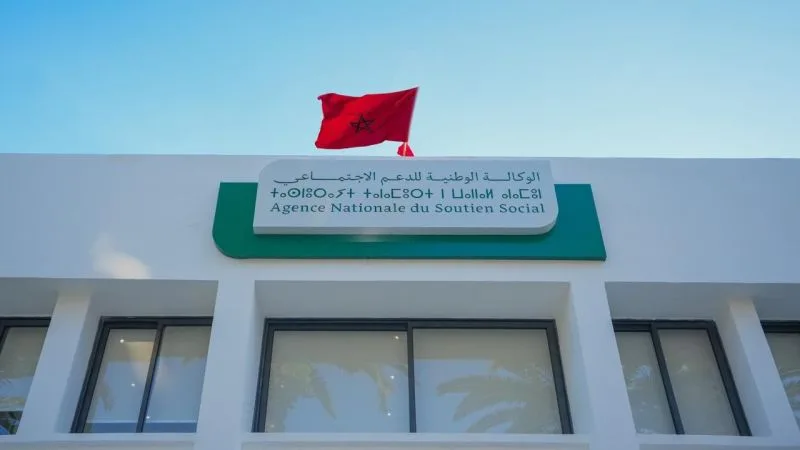
Agadir – The National Agency for Social Support (ANSS) has released figures detailing the performance of Morocco’s Direct Social Aid Program (ASD), showing the expansion of cash transfers, targeting of vulnerable groups, and a rise in eligibility rates since the program’s launch.
According to a report received by Morocco World News (MWN), by the end of 2025, the ASD program had distributed MAD 51 billion to nearly 4 million households, with 60% of beneficiaries located in rural areas.
The initiative continues to prioritise investment in human capital, particularly through child-focused support, which accounts for 64.2% of total funds MAD 32.7 billion. This component alone benefits 5.5 million children across 2.45 million households.
The program’s flat-rate assistance reached MAD 18.2 billion in the meantime, supporting approximately 1.47 million households. According to the report, beneficiary households also include around 1.7 million elderly individuals, addressing vulnerability across both childhood and old age.
Strong targeting through social registry system
The report pointed to the effectiveness of Morocco’s Unified Social Registry (RSU) in directing assistance toward vulnerable populations.
As of December 2025, 84% of total aid was allocated to the most vulnerable segments of society. This share rises to 93% for child protection assistance, while 69% of households receiving flat-rate aid are classified within these vulnerable categories.
The National Agency for Social Support describes this as evidence of the program’s redistributive function and improved targeting accuracy.
Regional distribution reflects poverty and demographics
The geographical breakdown of beneficiaries shows a strong correlation between population density, poverty levels, and aid distribution.
Three regions account for the largest shares of beneficiaries: Marrakech-Safi region for 16.1%, Fes-Meknes 15.7% and Casablanca-Settat13.7%.
The report notes that these concentrations reflect both demographic weight and higher levels of multidimensional poverty.
However, the type of assistance varies significantly by region. Flat-rate support is most prevalent in Souss-Massa reaching 42.5% of beneficiaries, Draa-Tafilalet 41.3% and Guelmim-Oued Noun 39.8%.
Sharp rise in eligibility rates
In contrast, child protection assistance is dominant in more urban and densely populated regions, including Casablanca-Settat 68.9%, Marrakech-Safi 65.4%, and Tanger-Tetouan-Al Hoceima 64.6%.
The report pointed to a significant improvement in administrative performance. The eligibility (receivability) rate of applications rose from 45.5% in December 2023, when the program began, to 91.9% by the end of 2025.
This increase is presented as an indication of improved understanding of eligibility criteria among applicants and better alignment with program requirements.
Reasons for ineligibility
Among rejected applications, nearly 61% of cases are linked to changes in socio-economic status.
Specifically 42% of rejections are due to beneficiaries being covered by a family allowance scheme following a new professional status and 19% are due to RSU scores exceeding eligibility thresholds.
The remaining cases are linked to demographic changes, including modifications in household composition or member characteristics.