 Join on WhatsApp
 Join on Telegram
Rabat – There is a freeze-frame moment from December 2022 that Moroccan football will replay for decades: Achraf Hakimi, calm to the point of indifference, rolling a Panenka penalty past Unai Simón in the shootout against Spain. The stadium in Al Rayyan seemed to hold its breath before erupting.
For a player raised in Madrid’s academy system, beating Spain was a statement about identity, choice, and where his loyalties had always quietly lived.
Four years later, that moment no longer defines him. It’s simply the beginning of the story Morocco is now resuming into 2026.
Hakimi’s rise was textbook La Fabrica: spotted young, developed through Real Madrid’s youth ranks, loaned to Borussia Dortmund to accelerate his progress before returning to Bernabeu’s first team. By the time he was starting Champions League knockout matches as a teenager, European scouts had already filed him under “elite right-back potential.”
But the more consequential decision came earlier and quieter – the choice to represent Morocco rather than Spain, the country where he was born and raised. It wasn’t a controversial call in the way some dual-nationality stories become; Hakimi had always spoken about his connection to his parents and their homeland, and how they moved from a Moroccan village in the vicinity of Casablanca to Getafe “to build a better life for themselves.” It suggested the decision was never really in doubt.
Still, it mattered. It signaled the kind of national team Morocco was building – one capable of attracting players who had every institutional incentive to choose otherwise.
His senior debut came in 2016, and within a few years he had become a fixture, his pace and attacking instincts reshaping what a Moroccan full-back could look like on an international stage.
The tournament that rewrote expectations
Morocco’s historic run to the 2022 FIFA World Cup semi-finals wasn’t built on one player, but Hakimi became its most recognizable face – partly through performance, partly through symbolism. His relentless overlapping runs gave Walid Regragui’s defensive structure an attacking outlet without sacrificing its compactness. Tactically, he was the valve that allowed Morocco to sit deep and still threaten in transition.
Symbolically, his celebration after that Spain penalty – sprinting to embrace his mother in the stands – became one of the tournament’s defining images because it captured something Moroccan football had rarely been associated with on a global stage: pride and a sense of arrival.
The tournament elevated Hakimi and also positioned Morocco’s entire footballing identity – from being known for producing individual talent to one capable of building a genuinely competitive international structure.
Paris, prestige, and a different kind of pressure
Since moving to Paris Saint-Germain, Hakimi has operated inside one of football’s most scrutinized dressing rooms, sharing space with some of the sport’s biggest names while continuing to be a starter in Champions League knockout football. That environment has sharpened him – both tactically and in how he carries himself as a public figure.
The trophy count tells its own story. Between his time at Real Madrid, Inter Milan, Borussia Dortmund, and PSG, Hakimi has collected league titles, domestic cups, and continental honors across multiple countries – a haul that officially made him the most decorated African footballer in history, with 19 major team trophies to his name.
He has become, by most measures, the most recognizable Arab and African footballer of his generation, a status that carries weight and responsibility back home.
Legacy still being written
This is where the story shifts. Morocco no longer arrives at a World Cup hoping to surprise anyone. After Qatar, and after consistent strong performances in subsequent qualifying cycles, expectations have hardened into something closer to obligation. The conversation in Morocco isn’t whether the team can compete – it’s how far they can go.
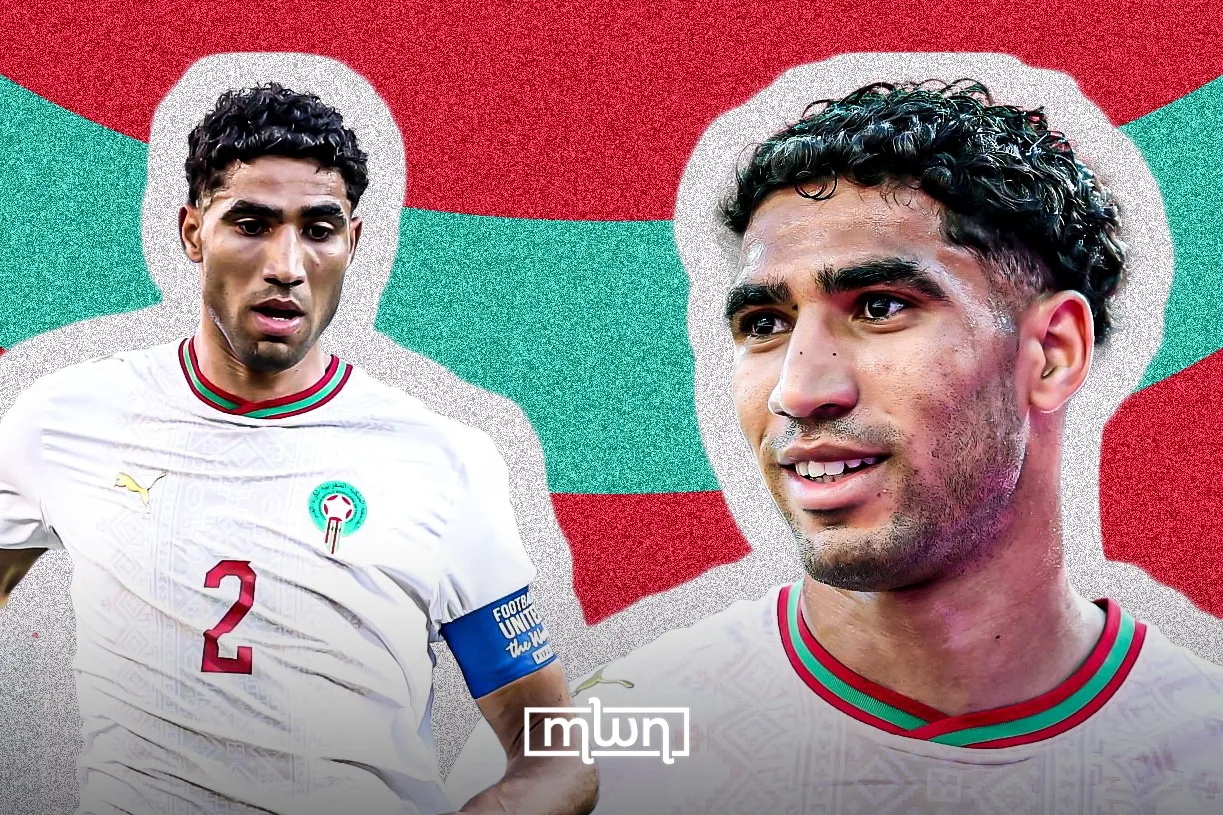
Hakimi, now operating as one of the team’s senior leaders and frequently wearing the captain’s armband, sits at the center of that question. His role has evolved to a stabilizing presence – he is who the younger squad members look toward, and the one international media frame when discussing Morocco.
Despite this, there’s an unfinished quality to his international story. A semi-final, however historic, isn’t a final. And for a generation of Moroccan players who reshaped what was considered possible, the 2026 FIFA World Cup represents an opportunity and a test of whether that breakthrough was a single golden moment or the start of a sustained era.
For Hakimi, and for the country he chose to represent, this World Cup is less about proving they belong, and more about showing what they’re capable of building from here.