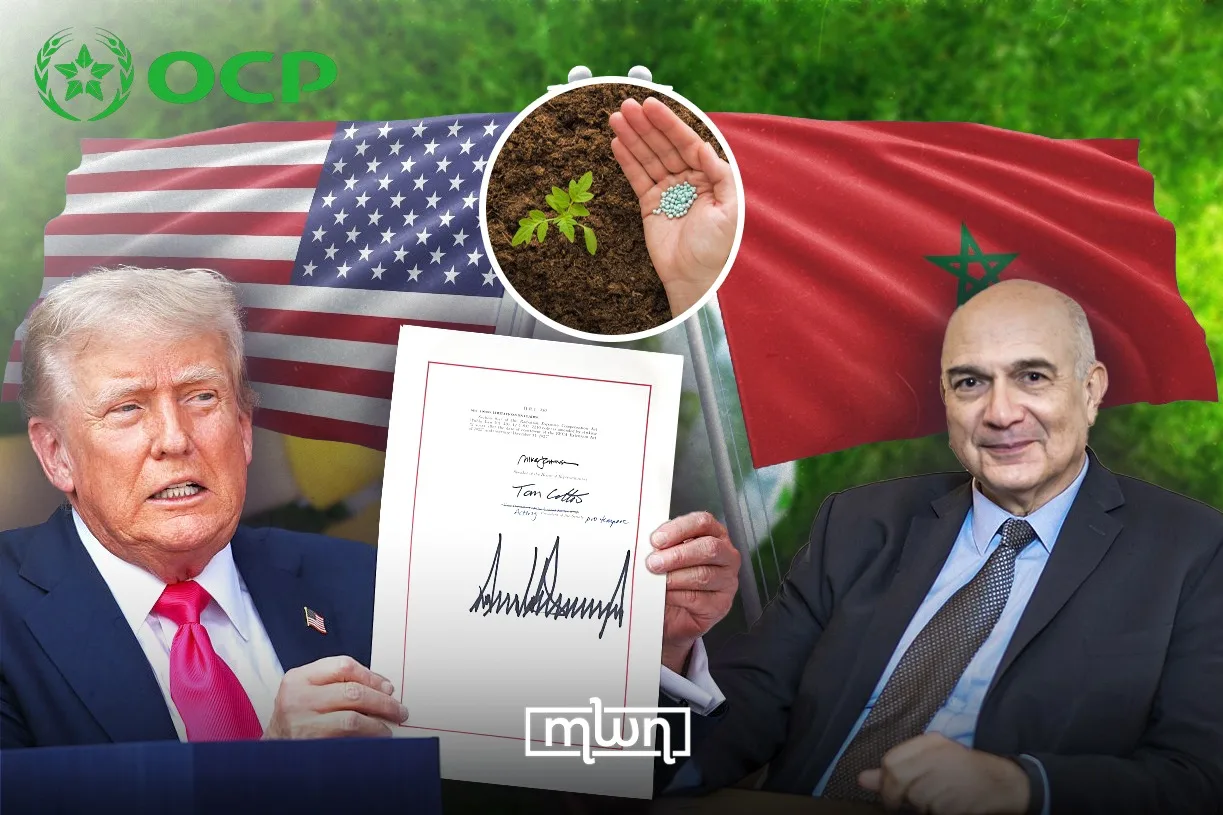
Marrakech – Read narrowly, the proclamation Donald Trump signed on June 29 looks like a technicality: an eight-month waiver of certain antidumping and countervailing duties on Moroccan phosphate fertilizer.
Read for what it actually is, it amounts to the world’s largest agricultural economy conceding that it cannot feed itself without a mineral it does not command – and rerouting, at speed, around a protectionist architecture it spent five years erecting. This is not largesse extended to Rabat. It is a demandeur’s maneuver, executed under duress, and the instrument chosen to execute it gives the game away.
Consider that instrument. The administration did not reach for the familiar tariff machinery – no Section 232 national-security probe, no Section 301 finding, no IEEPA emergency of the sort that has become the reflex of contemporary trade governance. It invoked Section 318 of the Tariff Act of 1930, a Depression-era relic conceived to let a president admit “food, clothing, and medical, surgical, and other supplies” free of duty for emergency relief work in wartime or comparable calamity.
Why Washington reached for a Depression-era emergency statute
The provision authorizes duty-free importation of relief supplies during a declared emergency, and its last conspicuous mobilization came under Harry Truman, who used it to extend customs warehousing deadlines after the 1950 Korea emergency. By filing phosphate under this rubric, the White House performs a quiet act of doctrinal alchemy: it reclassifies a bulk industrial input as humanitarian relief cargo, assimilating diammonium phosphate to the register of disaster provisioning.
The maneuver widens the statute’s ordinary reach considerably, and that stretch – not the tariff arithmetic – is the load-bearing element of the whole decision. It also telegraphs fragility. A waiver anchored to a proclaimed emergency lives and dies with the emergency’s persistence, capped at eight months, revocable, and juridically exposed the moment anyone cares to litigate the analogy.
The precipitating shock explains the improvisation. Since late February, the near-closure of the Strait of Hormuz has convulsed the very chemistry of fertilizer itself. Phosphate rock is inert until it is digested; converting it into usable phosphoric acid requires sulfuric acid, and a substantial share of the world’s merchant sulfur – the feedstock for that acid – transits the Gulf alongside the ammonia that supplies fertilizer’s nitrogen.
Choke the strait, and the upstream inputs seize before the finished product does. Cargoes idle at berth, prices stiffen, and a market already running tight tips into scarcity. The proclamation’s own language gestures at this when it notes that America’s largest foreign supplier of phosphate has suffered supply-chain disruption – a euphemism for a global input squeeze that domestic capacity cannot absorb. That incapacity is structural, not cyclical: US phosphate output has contracted by more than half since 1995, leaving the country’s granaries hostage to whatever the seaborne market can spare.
Here, the numbers turn punitive for the American farmer. DAP priced at NOLA drifted toward $710 a tonne this spring against $647.50 a year earlier, and the American Farm Bureau Federation reckoned that roughly seven growers in ten could not afford sufficient fertilizer for the campaign. Net farm income is projected to slump to $153.5 billion in 2026 against record sector debt of $624.7 billion.
Half of the year’s phosphate is applied in a narrow window between autumn and earliest spring, so a supply gap in this stretch is not a nuisance to be smoothed over – it is a yield event, transmitted through the following harvest into food prices and, eventually, into politics. Faced with that calendar, Washington did the only arithmetic available to it: it went to the one supplier that could ship without interruption.
No substitute and no second source
That supplier is not fungible, and this is the crux the proclamation ratifies without saying so. Morocco, through the state-held OCP Group, sits atop upward of 70% of the planet’s known phosphate reserves. OCP commands roughly a 31% share of the world phosphate market, a concentration the African Development Bank (AfDB) assessment scored at a Herfindahl-Hirschman index of 4,357 – deep in hyper-concentrated territory. Unlike nitrogen, which can be fixed from the atmosphere, phosphorus has to be mined, and there is no synthetic substitute waiting in reserve.
The resource is therefore not merely scarce but inelastic in the hardest sense: demand cannot pivot to an alternative element when the price moves. That geological singularity converts OCP from a commercial exporter into a systemic node – a gatekeeper of the food chain whose reliability becomes most valuable precisely when everyone else’s falters. When the Gulf seized, OCP, having absorbed years of capital into vertical integration from mine to finished granule, was left standing where rivals buckled. Fiability became the scarcest commodity of all, and Rabat happened to be selling it.
The alternative to Morocco sharpens the logic further. China and Russia together control close to 40% of the global export market for processed phosphate, and both have shown a willingness to throttle shipments in service of domestic priorities – Beijing curtailed fertilizer exports in 2024. To have persisted in walling out OCP would have been to hand the North African resource frontier to adversaries who treat scarcity as an instrument of statecraft. Seen this way, the waiver is less a favor than a hedge: a refusal to let the soil that feeds the American heartland depend on suppliers who export inflation by design.
How five years of tariff warfare quietly collapsed
None of this materialized overnight. The proclamation is the capstone of a five-year drift in which trade policy migrated out of the litigation silo and into the national-security frame. The contest opened in 2020, when Florida’s Mosaic Company petitioned Commerce and the International Trade Commission, alleging that OCP fed on unfair subsidies; Washington answered in 2021 with a 19.97% countervailing duty that all but expelled the Moroccan group from the market and helped strand global supply.
The rate then lurched through successive administrative reviews – down to 2.12%, back up to 16.81% on a later period – before Judge Timothy C. Stanceu of the Court of International Trade sided with OCP on the merits, cutting the levy to 2.11% in December 2025.
By March 2026, the government abandoned its appeal, retiring the case. In between, the administration had listed phosphate and potash as critical minerals and activated the Defense Production Act to secure elemental phosphorus, relocating the entire dossier from the vocabulary of commerce to that of defense. Republican farm-state legislators piled on with a bill to abolish the duties outright. The June proclamation merely furnishes the exigent, time-boxed bridge while that slower reclassification hardens.
The residual question is whether the bridge leads anywhere. The relief is bounded, contingent on a Middle Eastern crisis whose trajectory no one controls, and the five-year sunset review of the underlying countervailing order grinds on beneath it. Mosaic, architect of the tariff wall, can plausibly frame an emergency decree as an end-run around a remedy the courts never formally vacated on principle.
For OCP, the reopening restores a market it had abandoned largely on its own terms; the group returns not as a supplicant but as the party whose absence helped manufacture the shortage now being cured. That asymmetry is the real disclosure. Rabat gains vindication and, more durably, leverage – the standing of the indispensable seller in a market with no second source of comparable depth.
What lingers, then, is not the eight-month waiver but the hierarchy it quietly certifies: geology outranks tariff schedules, and a mineral concentrated under one kingdom’s soil has become too strategic to fence off, whatever the trade file says. Phosphate now carries a dual charge – feeding populations and, through lithium-iron-phosphate battery chemistry, powering the energy transition – which only deepens the dependency it exposes.
Washington did not so much grant Morocco access this week as admit it needed Moroccan access more than Morocco needed the American market. That is the difference between a concession and a confession, and this was unmistakably the latter.