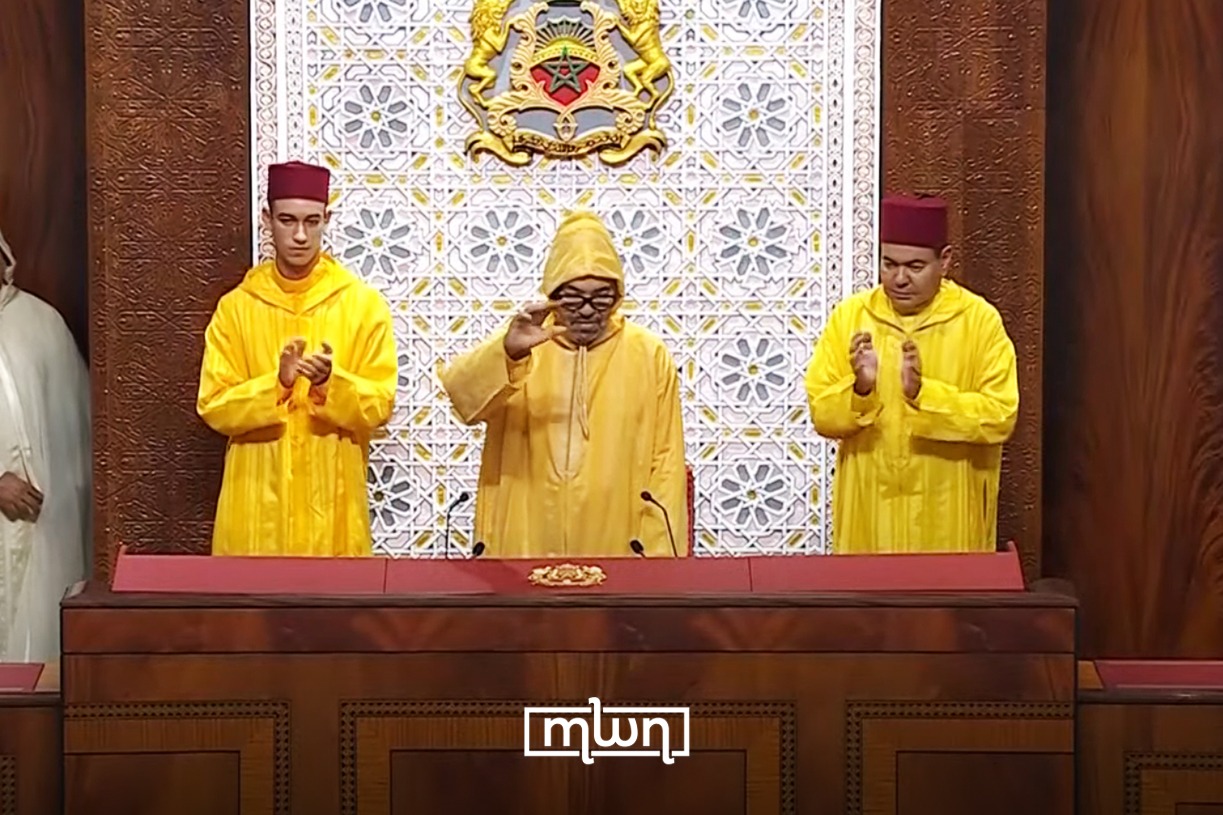
Casablanca – King Mohammed VI called for a new generation of economic strategies, greater private-sector investment, and expanded opportunities for young Moroccans on Friday, setting out priorities for Morocco’s economic and social development in the new parliamentary term.
Addressing members of both houses of Parliament today, during the opening of the first session of the first legislative year of the 12th legislature, the King urged Morocco to adapt its development priorities to shifting global economic conditions.
The session follows the September 23 legislative elections and comes as the country faces economic and social challenges.
“In a world characterized by rapidly accelerating geo-economic shifts, our country – guided by a clear vision – has embarked on a new wave of reforms and major projects,” said the King.
He called for new strategies covering water, energy, food security, industrial development, the digital economy and AI. He also urged the country to strengthen its strategic reserves and secure supplies of essential goods.
Water security remains a pressing issue as Morocco continues to invest in infrastructure to address shortages. The first phase of the Casablanca seawater desalination plant, with a planned capacity of 200 million cubic meters annually, has reached 81% completion, with commissioning scheduled for February 2027.
The energy sector also faces growing demand. Morocco’s electricity demand reached a record 8,400 megawatts in July 2026, prompting continued investment in renewable energy, electricity storage and grid expansion.
As for food security, Morocco announced plans to build a strategic reserve of eight million quintals of locally produced soft wheat, enough to cover national needs for up to six months, compared with three months at the time. The government also introduced a storage subsidy to encourage farmers and private operators to help secure the country’s wheat supply.
On digital development, Morocco has begun implementing its AI Made in Morocco roadmap, which aims to generate MAD 100 billion in economic value by 2030, create 50,000 jobs, and train 200,000 people in artificial intelligence.
The King also called on businesses to take a more active role in the country’s development. “I want it to show greater initiative and a keener innovative spirit, and to increase its capacity to create jobs, invest, and export,” he said.
Youth employment remains a major challenge. The International Monetary Fund put unemployment among Moroccans aged 15 to 24 at 37.3% in 2025, while 25.2% of young people were neither employed nor in education or training in the third quarter.
More recently, Morocco’s unemployment rate for the 15-to-24 age group stood at 27.2% in the second quarter of 2026, according to the High Commission for Planning (HCP).
“It is particularly important to make sure youth issues are at the forefront of public policies and of the agenda of governance bodies,” the monarch said. He called for a comprehensive approach that guarantees equal opportunities through education, skills development, and economic integration.
In March, Morocco launched the IDMAJ employment program to help young people without diplomas enter the job market. The initiative started with 30,000 confirmed positions, with the potential to reach 65,000 opportunities across sectors including industry, agriculture, services, and construction.
The King concluded that the goal was to strengthen young people’s confidence in “the prospects for social advancement, in their nation’s institutions, as well as in the opportunities provided to build a better future – one that guarantees freedom, dignity, and stability.”