 Join on WhatsApp
 Join on Telegram
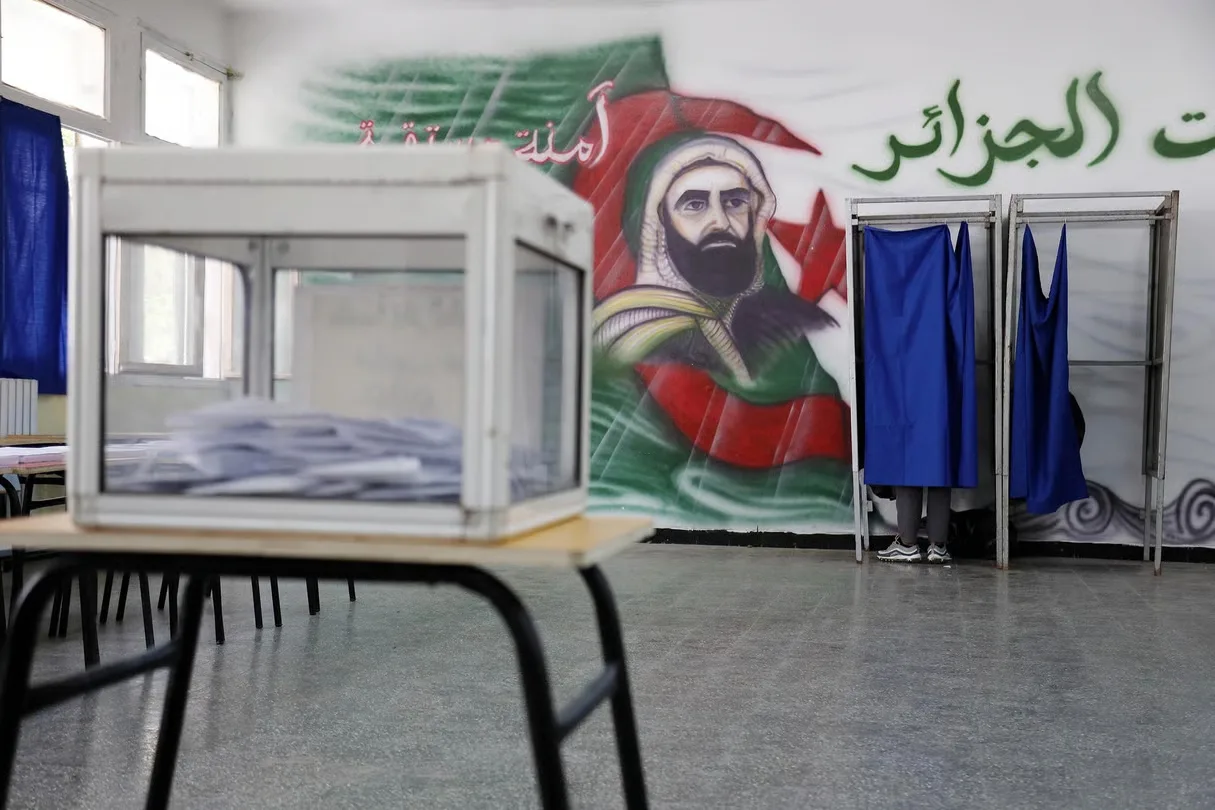
Marrakech – Algeria’s legislative elections on July 2 produced the lowest voter turnout in the country’s history. Abstention reached a record high as the participation rate stood at just 21.24%, according to provisional results announced Monday by the interim head of the National Independent Electoral Authority (Anie), Karim Khelfane. The figure fell below the already dismal 23% recorded in the 2021 elections.
Nearly 80% of Algerian voters refused to show up. When four out of five citizens stay home, the silence speaks louder than any ballot. It is also a reminder that carrying the word “democratic” in a country’s official name does not make it one.
The Front de Libération Nationale (FLN) won 90 seats out of 407, losing eight compared to 2021. The Rassemblement National Démocratique followed with 73 seats. The Front El Moustakbal, founded in 2012 under the orbit of former President Abdelaziz Bouteflika, quadrupled its seat count to 59. All three formations remain loyal to President Abdelmadjid Tebboune’s administration. None represents an opposition force of any kind.
The regime did not even pretend otherwise. Authorities extended voting hours by one hour across the country to inflate turnout. It did not work. The campaign itself unfolded in near-total apathy, overshadowed by the FIFA World Cup and extreme heat.
Khelfane brushed off the collapse in participation, comparing Algeria to “old democracies” in Europe, America, and Asia. He called the elections “transparent.” The comparison is as hollow as the ballot boxes that sat empty across the country.
What made these elections particularly revealing is the systematic elimination of independent candidates. In 2021, independents secured 78 seats, the second-largest bloc in parliament. Tebboune, at the time, promoted them as proof of his “New Algeria” narrative.
That fiction has expired. This time, authorities purged nearly 30% of all candidacies before the campaign even began under the pretext of “moralization of public life.” A law promulgated on April 22 imposed such strict control over internal party operations that political formations became, in effect, extensions of the state.
Zoheir Rouis, a candidate from the opposition party Jil Jadid, noted, as reported by Le Monde, that the 2026 elections produced “a result contrary to what Tebboune had wanted to undertake in 2021.” The return to the regime’s core structure is complete.
Ali Bensaad, a professor at the French Institute of Geopolitics at Paris-VIII University, offered a blunter reading in an interview with the French publication.
The regime, he noted, now operates with the conviction that the Hirak movement is defeated. That confidence has removed any incentive to maintain appearances. Independent lists were eliminated in Kabylie precisely because they were gaining popularity, Bensaad added.
Behind the scenes, the regime’s internal turbulence tells its own story. In May, General Abdelkader Aït Ouarabi, 74, was dismissed as head of the powerful internal security directorate.
His replacement, General Mounir Zahi, became the sixth person to hold that position since Tebboune took power after his election in December 2019 and subsequent re-election in 2024.
The constant rotation, analysts explained, is maintained jointly by Tebboune and army chief of staff Saïd Chengriha to prevent the reconstitution of the former intelligence and security directorate, known as the DRS.
The apparatus, widely described as a state within a state, was dismantled under Bouteflika in 2015 due to its omnipotence. “Tebboune and Chengriha know that the re-emergence of the DRS would come at their expense,” Bensaad said.
Human rights NGOs have denounced the regime’s reassertion of control over public space since the Hirak, while the country remains confronted with deep social and economic grievances, particularly among the youth.
Rouis warned openly of what lies ahead. The desire for change expressed during the 2019 Hirak remains unaddressed. “The alternative is violent change,” he cautioned. “It is an explosion.”
Algeria’s rulers delivered elections no one attended, a parliament no one elected freely, and a political system no one outside the presidential circle can influence. The question is no longer whether the regime controls Algeria. It is how long a population this alienated will tolerate being governed by a system this closed.