 Join on WhatsApp
 Join on Telegram
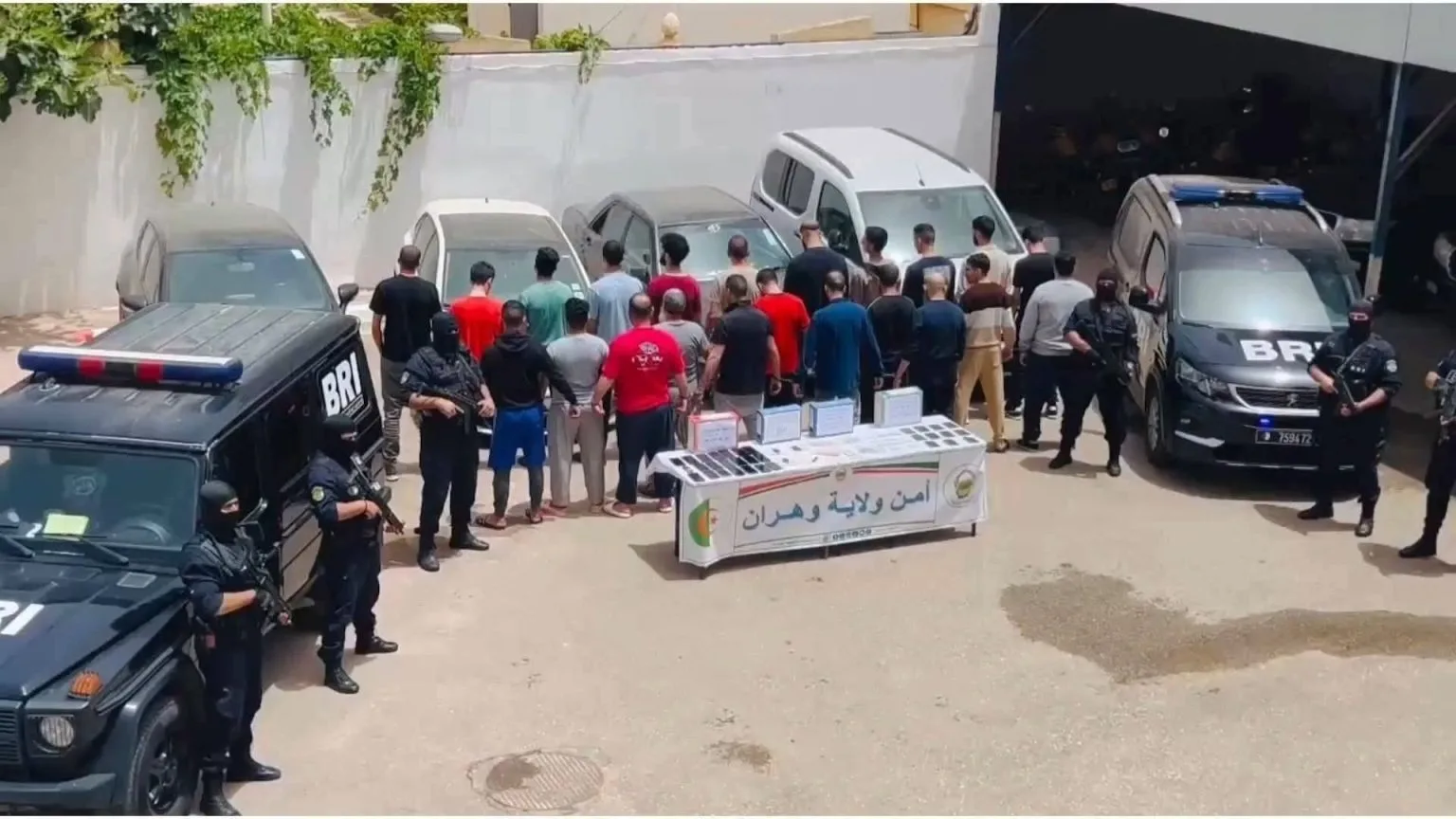
Marrakech – Algerian police announced Monday the arrest of 23 people in Oran, including 18 Moroccan nationals, in what authorities described as the dismantlement of an “organized criminal network” involved in irregular maritime migration toward Spain.
The Brigade of Research and Intervention (BRI) of Oran’s security services claimed it identified five organizers first. A subsequent raid on a residence allegedly used as a shelter for migration candidates led to the arrest of the 18 Moroccans.
Police reported seizing 1,600 euros, 240 Moroccan dirhams, 22,500 Algerian dinars, and four vehicles. The suspects were presented to the prosecutor at the Fellaoucene tribunal in Tlemcen province, west of Oran.
Algerian police staged the operation’s announcement on Facebook, continuing a now-familiar pattern that observers say has less to do with routine law enforcement transparency and more with state-choreographed, politically charged displays directed against Morocco.
Algeria turns policing into political theater against Rabat
The Oran operation marks the second time in recent months that Algeria has publicly singled out Moroccan nationals in migration-related arrests. In May, Algerian police claimed they arrested 77 people in a similar operation in Oran. Of those, 67 were identified as Moroccans – the only nationality authorities chose to disclose.
That operation, like the current one, crossed a particular threshold when Algerian authorities publicly paraded footage of dozens of Moroccan passports on social media.
Observers have described the move not as procedural documentation but as a calculated act of state-level humiliation, with Algiers’s obvious goal of reducing Moroccan nationals to political props and instrumentalizing their detention as a weapon in its unrelenting confrontation with Rabat.
The repeated targeting of Moroccan nationals stands in contrast with Morocco’s own handling of Algerian suspects on its soil. On June 25-26, Moroccan police arrested six Algerian nationals for alleged involvement in document forgery, identity theft, illegal residence, and drug trafficking.
The operation, conducted by the National Judicial Police Brigade based on intelligence from the DGST, followed the arrest of an Algerian subject of an Interpol Red Notice requested by Algerian authorities themselves.
Police seized forged residence permits, counterfeit documents, 10 forged official stamps, and passenger vehicles. Morocco processed the case without public spectacle or political messaging.
Algeria’s treatment of Moroccan nationals has grown increasingly lethal beyond migration-related arrests. In late January, the Algerian Ministry of Defense announced its forces killed three Moroccans near Bechar, identifying them as Abdellah Adda, Mohamed Azza, and Gendoussi Sarfaga. A fourth, Mimoun Azza, was arrested. The regime alleged drug trafficking.
In late February, the Algerian army killed two more Moroccans in Beni Ounif, Bechar province, under identical allegations. The regime accused Morocco of “waging a fierce drug war” against Algeria.
A regime weaponizing every institution against Morocco
These incidents follow the 2023 killing of two Moroccan-French citizens, Bilal Kessi and Abdelali Mchiouer, by Algerian coast guards after their jet skis drifted into Algerian waters from Saidia beach due to bad weather. The victims were unarmed civilians on holiday. The killing sparked widespread outrage after a video showing one victim’s body floating in the sea circulated online.
Algeria severed diplomatic ties with Morocco in 2021, accusing Rabat of causing wildfires in the Kabylie region and of financing “terrorist organizations” to harm Algeria. Morocco rejected the accusations as “unfounded fallacies.”
Land borders between the two neighbors have remained closed since 1994. Algiers additionally shut its airspace with Morocco and imposed visa requirements on Moroccan nationals.
Former Algerian foreign minister Abdelkader Messahel previously accused Moroccan banks of laundering hashish revenues in sub-Saharan Africa – without presenting evidence.
From publicized passport parades to extrajudicial border killings, fabricated drug war narratives, support for separatism, and systematic diplomatic hostility, the Algerian regime’s posture toward Morocco and its nationals has moved far beyond the realm of conventional political rivalry.
It now resembles a deliberate architecture of vilification – a state-directed campaign in which security institutions, propaganda channels, and diplomatic machinery are mobilized in service of an increasingly isolated regime’s ideological vendetta against Rabat.