


 Join on WhatsApp
 Join on Telegram
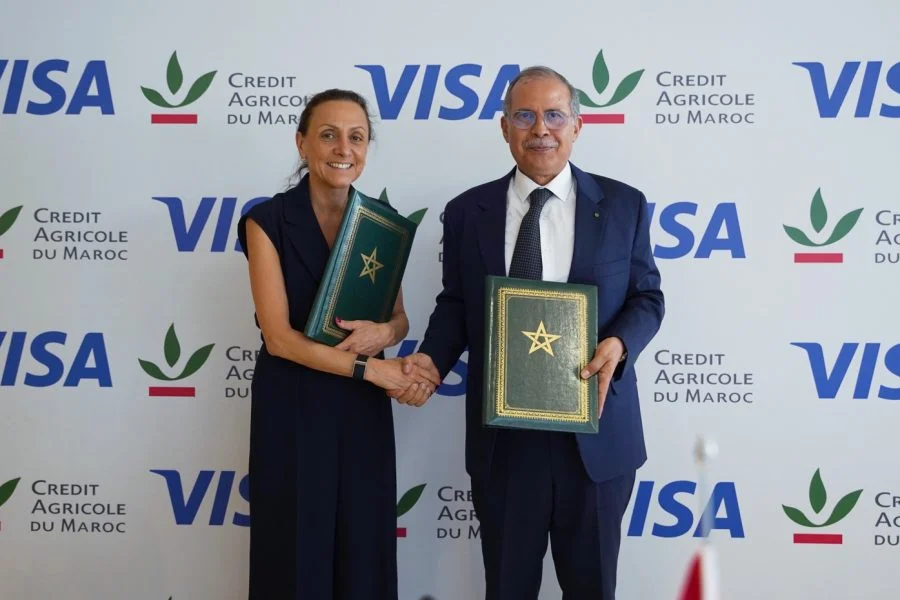
Marrakech – Crédit Agricole du Maroc (CAM) and Visa signed a long-term strategic partnership on Tuesday to accelerate the digitalization of payments and advance financial inclusion across Morocco.
The agreement was signed by Mohammed Fikrat, chairman of CAM’s management board, and Leila Serhan, senior vice president and group country manager for North Africa, the Levant, and Pakistan at Visa.
Under the deal, the two partners will deploy a new payment architecture designed to expand access to a secure digital economy. The partnership covers the development of cashless payment solutions, digital services for businesses, and tools to support clients’ shift to digital financial products across the country.
“This partnership with a global leader in payment technology like Visa aligns with our strategy of modernization and operational excellence for the benefit of our clients,” Fikrat said. He added that the agreement would allow CAM to offer its clients “a highly secure transactional infrastructure with strong added value,” while reinforcing the bank’s financial and digital inclusion mission.
Serhan explained the alliance combines Visa’s global technology reach with CAM’s local footprint to support Morocco’s digital transformation and economic growth. She cited the Visa Stay Secure 2026 study, noting that 97% of Moroccan consumers consider new technologies effective in simplifying and speeding up everyday transactions.
Read also: Morocco Launches ‘Stay Cashless’ to Digitize Tourism Payments
That study, published in June and conducted by Wakefield Research in partnership with Switch Al Maghrib (SWAM), found that 83% of consumers in Morocco have used AI-based tools to assist with purchases, including price comparisons, gift ideas, and product reviews.
Yet only 23% reported trusting AI agents to finalize transactions on their behalf. Some 82% believe AI will play a key role in protecting consumers against fraud in the future.
The survey also showed that 87% of Moroccan consumers have made purchases through social commerce platforms. Among scam victims, 52% said the fraud occurred on social media. On the question of responsibility, 49% identified banks and financial institutions as the actors that should lead fraud protection efforts, followed by government regulators at 47%. Only 9% placed that burden on consumers.
Child safety also surfaced as a major concern. The study revealed that 92% of respondents worry that children struggle to recognize online scams, while 61% reported having seen a child fall victim to fraud while shopping or gaming online.
The partnership comes amid rapid growth in digital payment usage in Morocco, as the banking sector works to extend financial services beyond urban centers.
CAM has been active on that front. In late June, the bank signed a tripartite agreement with the European Bank for Reconstruction and Development (EBRD) and the AT Saïss Group to support financial training and access to financing for 360 rural women in the Saïss plain.
At the SIAM agricultural fair in April, it concluded at least eight deals spanning rural financial education, green financing, and electric mobility.


