
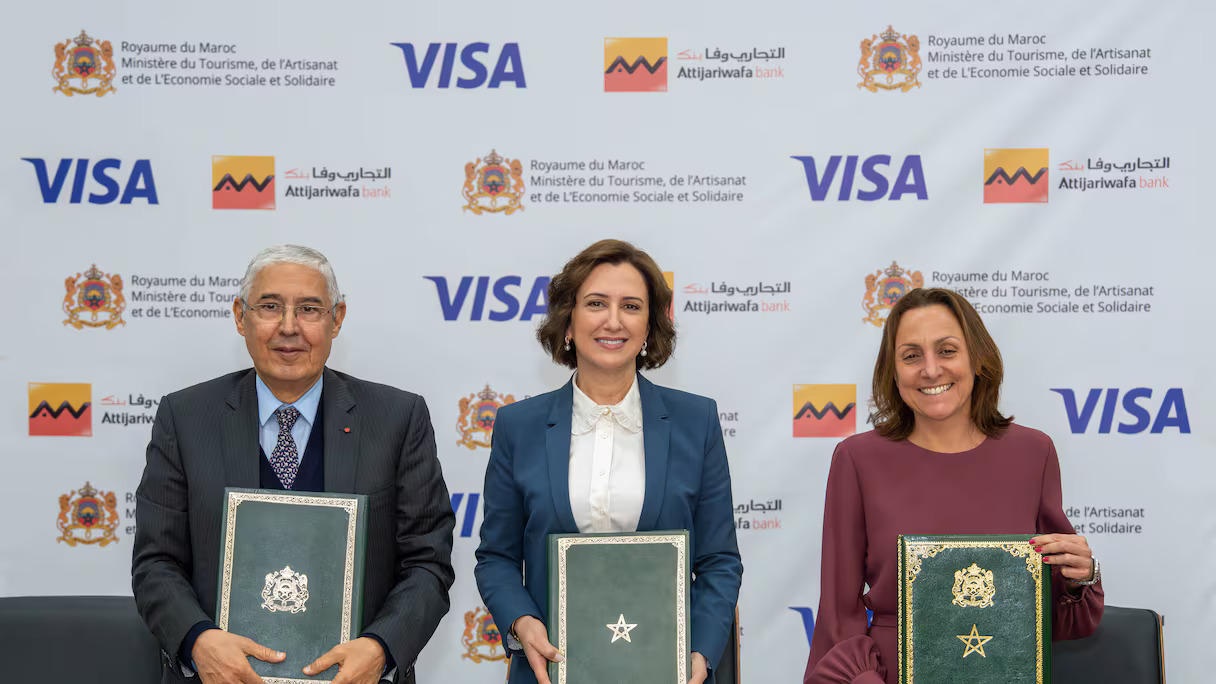
Beni Mellal – Morocco’s Ministry of Tourism, Attijariwafa Bank, and Visa signed a memorandum of understanding on Wednesday in Rabat, launching the “Stay Cashless” program to accelerate digital payment adoption across the tourism sector.
The agreement was formalized by Tourism Minister Fatim-Zahra Ammor, Attijariwafa Bank CEO Mohamed El Kettani, and Visa’s Group Country Manager for North Africa, the Levant, and Pakistan, Leila Serhan.
The program aims to simplify payment experiences for tourists throughout their stay in Morocco, offering secure and internationally accepted solutions. A separate operational convention was signed the same day by the National Tourism Confederation (CNT) president Hamid Bentahar and Attijari Payment director Fahd Bettache.
The practical offer includes reduced international commissions, pay-by-link, tap-on-phone, and dynamic currency conversion – tools designed to bring smaller tourism operators in line with global standards.
“The MAD 138 billion in travel receipts in 2025 show that Morocco has an attractive tourism offer,” Ammor said. “But expectations are evolving, and digital payment is becoming the norm. Moving toward cashless at scale is no longer an option.”
Morocco recorded nearly 20 million visitors in 2025, already surpassing targets set for 2026. Yet the country’s payment infrastructure remains out of step with those figures.
Bank Al-Maghrib data show that more than 60% of card operations in 2024 were ATM withdrawals, while currency in circulation reached MAD 444.3 billion – roughly 26% of GDP. Only 94,387 POS terminals exist nationwide, concentrated in Casablanca, Rabat, and Marrakech, with tourist cities like Agadir and Fez lagging behind.
El Kettani framed the initiative as part of a broader strategic commitment. “Through this partnership, Attijariwafa Bank reaffirms its engagement to accompany key sectors of the Kingdom by mobilizing innovative, inclusive payment solutions aligned with international standards,” he said.
Visa positioned the partnership as more than a technical arrangement. “This tripartite partnership is not limited to technical collaboration – it is a growth engine that uses data and innovation to digitize the entire tourism value chain,” Serhan said.
For the CNT, the program targets small and medium tourism businesses directly. “It combines new, more adapted solutions with a training and awareness program to allow all operators, particularly SMEs, to improve their services and offer a smoother experience to visitors,” Bentahar argued.
Mega-events demand frictionless payments
The initiative comes as Morocco prepares for the 2030 FIFA World Cup and the African Cup of Nations, events expected to bring large volumes of international visitors accustomed to cashless payment environments.
Globally, the direction of travel is unambiguous. Europe has moved aggressively to restrict cash: the EU’s new anti-money-laundering package formally caps cash payments at €10,000, while Nordic countries are approaching a reality where less than 5% of in-store payments are cash.
Visa reports that contactless payment now accounts for more than 90% of in-store transactions in nearly 60 markets, making tap-to-pay the global norm. In Asia, China’s QR-based Alipay and WeChat Pay dominate retail, while India’s UPI processes billions of real-time transactions monthly, a model now exported abroad. Everywhere, regulators are capping fees, mandating interoperability, and nudging merchants toward universal acceptance.
The Gulf is already living in this future. Over 90% of face-to-face transactions in the UAE are contactless – whether by card, phone, or wearable. The Emirati Central Bank’s domestic card scheme, Jaywan, and instant-payments platform Aani anchor a system where even taxis, salons, and cafés accept cards or wallets.
Morocco has taken steps to reform its payment sector. Since October 2024, interchange fees have been capped at 0.65%. In May 2025, the Competition Council dismantled the long-standing quasi-monopoly of the Centre Monétique Interbancaire (CMI), opening the acquiring market to banks and specialized providers, including Attijari Payment, Chaabi Payment, and fintech challengers like NAPS.
Despite this, mobile wallets – numbering 13.8 million accounts in 2024 – record only 28% active usage, and mobile payments represent just 2% of non-cash transactions.
Formalization is still feared
Still, barriers remain. Many merchants engage in illegal practices: imposing “minimum amounts” for card payments, adding surcharges, or refusing foreign cards. The Competition Council has reminded merchants that surcharging is illegal, but enforcement is weak.
High fees on foreign card transactions – often 2-3% plus FX margins of 3-5% – make merchants reluctant, especially in sectors with tight margins. For tourists, this creates the impression of being penalized for using global networks.
ATMs compound the problem. Moroccan banks cap foreign withdrawals at 2,000 MAD ($200) per transaction, often with a MAD 20-30 fee ($2-3 fee), plus a foreign-exchange markup. For a family staying a week, this means repeated trips to ATMs, accumulating fees, and carrying bulky cash.
Culturally, small merchants fear technology or simply see no demand from customers. Many also avoid digital payments to keep turnover off the books. Morocco’s informal economy is estimated at ≈30% of GDP – one of the highest in MENA. For these actors, POS terminals are seen as tax traps, not business tools.
On fiscal and legislative levels, attempts to incentivize mobile payments – such as tax breaks – have largely failed. Merchants fear increased scrutiny and VAT obligations. In some sectors, especially small retail, avoiding formalization is still seen as a survival strategy.
Morocco has set bold ambitions: welcoming 26 million tourists, handling 80 million airport passengers, and projecting itself as a modern, competitive economy through the World Cup, backed by billions in rail and aviation investments. Yet these aspirations risk sounding hollow if visitors cannot pay for a taxi, a coffee, or a souvenir with the same ease they enjoy in Paris, Doha, or Dubai.
For the European tourist accustomed to tapping a card or phone for almost every purchase, the Moroccan experience can quickly become frustrating. Card payments are often rejected in small shops and restaurants, ATMs impose tight withdrawal limits, and banks add steep fees. What should be a seamless holiday too often turns into a daily scavenger hunt for cash – hardly the image of a modern, investment-ready destination Morocco seeks to project.
Implementation of Stay Cashless begins in the coming days, with an action plan covering terminal deployment for tourism SMEs and a structured communication and training program to drive adoption across the sector.