Marrakech – Somewhere in Morocco this month, a football fan opens a stream of a match that no broadcaster sold him, and beside the pitch sits a betting advertisement placed by a company that holds no Moroccan license, pays no Moroccan tax, and answers to no Moroccan regulator. Across the continent, that scene now repeats on a scale large enough to define an entire industry.
A new report from Gaming Compliance International (GCI), a regulatory technology and consultancy firm, puts hard figures to it. Released this month and titled “Online Gaming 2024-2025: Africa,” the study measures the whole online gambling marketplace, both the regulated and the unregulated sides, across every African nation.
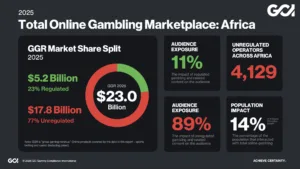
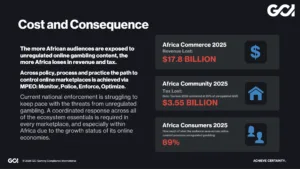
Its central finding is difficult to overstate. In 2025, Africa’s total online gambling gross gaming revenue reached $23 billion. Of that, only 23%, or $5.2 billion, flowed through regulated operators. The remaining 77%, worth $17.8 billion, went to the unregulated sector.
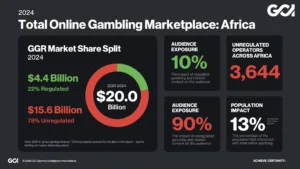
While the regulated share improved slightly, the rapid growth of the overall market meant that the unregulated sector continued to grow substantially in absolute terms. In 2024, the total market stood at $20 billion, split 22% regulated and 78% unregulated. So while the regulated share edged up by a single point, the unregulated economy grew in raw value alongside the market itself. The number of unregulated operators active across Africa rose from 3,644 in 2024 to 4,129 in 2025.
Still, GCI argues that the picture is not entirely bleak, with the data containing signs of progress and grounds for optimism. “For the first time, we can see the whole of Africa’s online gambling market clearly. Nation by nation, across two full years, the picture is encouraging. The regulated sector is growing, and in several countries, it is starting to gain ground,” said Matt Holt, CEO of GCI. “That tells us these tools work. Our job is to give regulators a complete and honest view of their own market, so they can build on the progress this data now shows.”
The report defines gross gaming revenue as customer bets minus customer winnings. It covers online sports betting and casino, including poker, and online activity only, with no retail or land-based data included.
North Africa sits at the bottom
For Moroccan readers, the regional breakdown is the most pointed part of the study. GCI divides the continent into five regions. North Africa, which groups Morocco with Algeria, Egypt, Libya, and Tunisia, records the weakest position of all.
The region generated $2.8 billion in online gambling revenue in 2025. Just 0.3% of it, about $9 million, ran through regulated channels. The other 99.7%, the full $2.8 billion, was unregulated. That is the highest unregulated share of any African region, ahead of East Africa at 85%, Southern Africa at 72%, West Africa at 69%, and Central Africa at 78%.
Morocco’s own line in the report leaves no ambiguity. In GCI’s country-by-country table, Morocco’s market is listed as 100% unregulated, as are Egypt, Algeria, and Libya. Only Tunisia sits marginally lower at 96%.
The consequences appear again in GCI’s scoring system. The firm rates each marketplace out of an idealized 100, weighing taxation, ease of licensing, product availability, payments, enforcement, and the regulated sector’s share. Africa as a whole scored 10 out of 100 in 2025, up from 9 the previous year. North Africa scored 0 out of 100 in both years, the only region to record a zero.
A further measure, audience exposure, tracks how much of the gambling and related content the public encounters is regulated versus unregulated. GCI treats it as an early warning of where revenue will flow next. North Africa’s audience exposure was 100% unregulated in both 2024 and 2025. In other words, the report found effectively no regulated presence reaching the region’s online audience at all.
A continent-wide cost
The scale of participation is large. GCI estimates that 14% of Africans, some 215 million people, interacted with online gambling in 2025, up from 13%, or 198 million, in 2024. Across the continent, 89% of audience exposure in 2025 was to unregulated content, against 11% regulated.
That imbalance carries a fiscal price. GCI estimates the tax lost to African public finances in 2025 at $3.55 billion, calculated at 20% of unregulated revenue. The $17.8 billion taken by unregulated operators represents commerce that generated no local tax revenue, licensing benefits, employment, or supply-chain gains within the countries where the money was spent.
Placed against other regions, Africa is not an outlier on the regulated share alone. Its 23% regulated split for 2025 sits close to the global figure of 22%, Europe’s 23%, and North America’s 24%. Latin America led at 27%, while Asia-Pacific trailed far behind at 6%. The difference in Africa, the report argues, lies in how fast the unregulated sector is professionalizing.
GCI identifies several growth drivers. Chief among them is illegal streaming of sports. Unregulated gambling advertisements appeared on more than 83% of illegal sports streams in Africa across 2024 and 2025. The firm also points to recruitment tied to events, naming local football leagues, the Champions League, and the FIFA World Cup as moments that produce seasonal surges in unregulated activity.
The report frames its analysis around what it calls the MPEO framework: Monitor, Police, Enforce, Optimize. Its argument is that regulation cannot succeed by licensing operators alone. Consumers, it notes, experience a single marketplace containing both a regulated and an unregulated sector, and success therefore must be measured by whether people choose to stay inside the regulated one. The purpose of regulation, the report states, is not simply to oversee licensed operators, but to regulate the marketplace as a whole.
That view is echoed by Ismail Vali, President of GCI, who sees that Africa’s online gambling markets should be assessed by their long-term economic potential rather than the scale of today’s challenges. “Millions of consumers already participate in online betting and gaming, creating substantial economic activity and the potential to deliver sustainable local commerce, public revenues, and safer consumer outcomes,” he said. “The challenge is not creating demand. The challenge is ensuring that demand is captured within the regulated sector.”
The distinction matters because regulated operators, GCI writes, cannot beat unregulated rivals on price, product range, or promotions, since the unregulated side pays no tax and follows no rules. Where consumers drift toward that side, the protections built by regulators, including self-exclusion schemes and responsible-gaming measures, lose their reach.
Vali maintains that marketplace performance, rather than licensing activity alone, should be the benchmark for effective regulation. “Marketplace outcomes are the ultimate measure of regulatory success. The objective is not simply to regulate licensed operators. The objective is to optimize the entire online gambling marketplace so that consumers choose to enter, remain within, and benefit from the regulated sector.”
GCI, which acquired the surveillance firm Yield Sec in November 2025, positions its conclusion as one of opportunity rather than despair. For markets such as Morocco and its North African neighbors, the report’s figures suggest that even modest improvements in policy, taxation, payments, product availability, marketplace optimization, and enforcement could shift outcomes substantially, given how little regulated ground currently exists to lose.