 Join on WhatsApp
 Join on Telegram
Marrakech – Some 1,300 kilometers from the North Pole, inside a sandstone mountain locked in permafrost, sits a chamber built for a future nobody wants to plan for. Some media outlets call it “the vault of the end of the world.”
Its formal name is the Svalbard Global Seed Vault, and last month, while much of the world’s attention was fixed on the World Cup and the war in Iran, a shipment of Moroccan crop seeds made the journey there.
The seeds arrived as part of the June deposit, the facility’s second opening of the year, at the world’s largest secure seed-storage site on Earth: a frozen facility carved deep into a mountain in the far north of the Scandinavian country.
The June 17 opening pushed the vault past a symbolic threshold. Its collection now holds 1,401,285 seed samples, each one a duplicate held in reserve against the loss of the original.
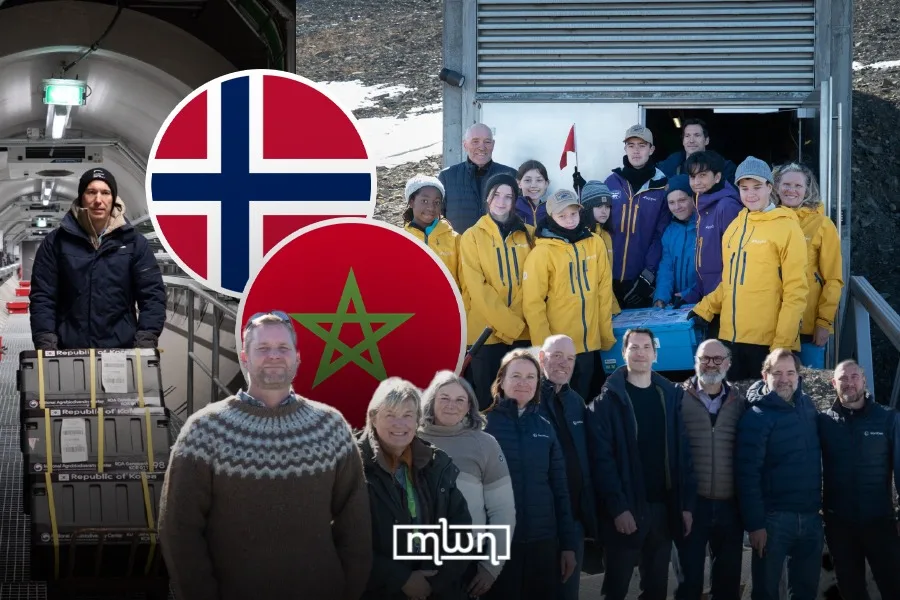
Morocco’s contribution came through the International Center for Agricultural Research in the Dry Areas (ICARDA), which maintains a genebank in Morocco. ICARDA shipped 1,172 seed samples packed into four boxes, covering 30 species. The consignment included 302 chickpea samples and 268 lentil samples, alongside cereals.
Moroccan students took part in the deposit, and a video shared by the Instagram account @explore.svalbard on July 12 documented the seeds arriving at the facility.
View this post on Instagram
The varieties matter for a specific reason. They are local landraces of wheat, barley, lentils, and other crops, selected over generations for their tolerance of harsh climatic conditions. Drought resistance and survival under water scarcity are rare genetic traits, and they are becoming more valuable as growing conditions shift.
The Moroccan shipment was one of eleven. In total, 15,387 seed samples from 11 genebanks were deposited, making this the 70th deposit occasion since the vault opened in 2008. The June batch was almost twice the size of February’s.
Two African countries joined for the first time. Burkina Faso’s National Commission for Plant Genetic Resources (CONAGREP) sent 370 samples of okra, maize, groundnut, hibiscus, pearl millet, rice, sesame, sorghum, bambara groundnut, and cowpea.
Niger’s National Agronomic Research Institute (INRAN) sent 204 samples of groundnut, pearl millet, sorghum, and cowpea. Both were supported by the Benefit Sharing Fund of the International Treaty on Plant Genetic Resources for Food and Agriculture.
Sudan’s national genebank (APGRC) managed to ship 982 samples of 19 crops despite an ongoing civil war, with help from the Emergency Reserve for Genebanks. The largest deposits came from South Korea’s Rural Development Administration (RDA), with 6,000 samples of 50 species, and Britain’s John Innes Centre (JIC), with 4,602 samples including the entire UK national oat collection.
The vault itself sits 130 meters inside the mountain on Spitsbergen island, near the settlement of Longyearbyen. It opened on February 26, 2008, and was built where it is for practical reasons: permafrost, no tectonic activity, and distance from zones of political conflict. Its elevation of 130 meters above sea level keeps it dry even if ice caps melt.
Refrigeration units cool the seeds to minus 18 degrees Celsius. If the equipment fails, the surrounding bedrock holds at minus 3 degrees, and estimates suggest two centuries would pass before the chamber warmed to zero. The facility can hold 4.5 million seed samples, with roughly 500 seeds in each sealed aluminum bag.
Moroccan soil has already done this work once
Norway owns the building; depositors own the seeds. The arrangement works like a safe deposit box, and no country can access another’s material. Norway funded the roughly 45 million kroner construction cost, while the Crop Trust covers operations, and NordGen manages the seeds and the public database. This year, the vault received the Princess of Asturias Award for International Cooperation.
The system has already been tested once. When war in Syria made ICARDA’s genebank near Aleppo unusable, the center withdrew samples in 2015 and again in 2017 – the only withdrawals in the vault’s history. Those seeds were planted and multiplied in fields in Lebanon and Morocco. Some went back to Svalbard. Others stayed in ICARDA’s genebanks in the two countries.
Moroccan soil, in other words, has already done this work once: growing back what a war had nearly erased. The seeds sent north in June are the same insurance policy, running in the other direction.
Wars end. Lost crop diversity does not come back.