 Join on WhatsApp
 Join on Telegram
Rabat – Before Moroccan referees became a regular presence on football’s biggest stages, one man had already broken a historic barrier.
On July 12, 1998, Saïd Belqola walked onto the pitch at the Stade de France to referee the FIFA World Cup final between France and Brazil.
With that appointment, the Moroccan official became the first referee from Africa and the Arab world to take charge of a World Cup final.
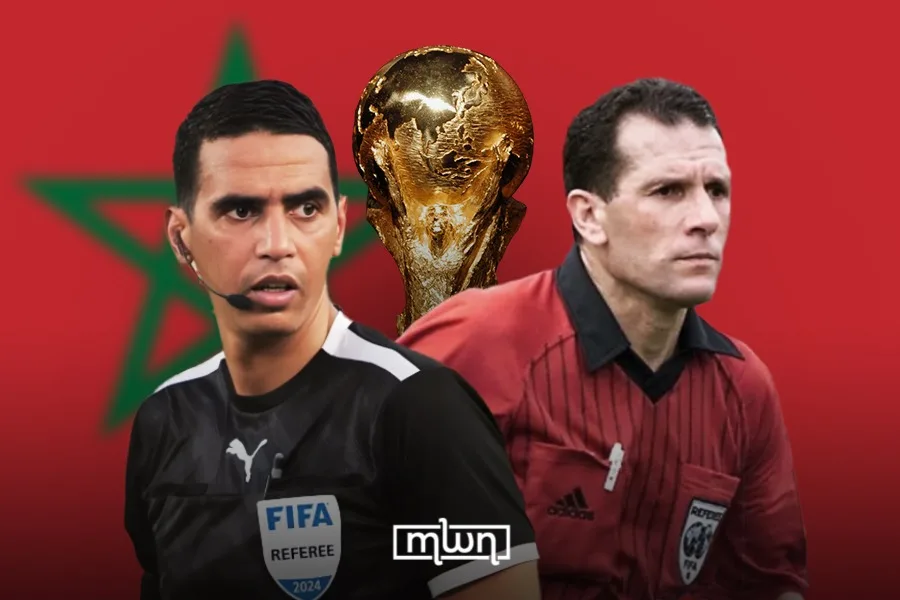
Nearly 30 years later, his achievement continues to resonate through a new generation of Moroccan officials, led by Jalal Jayed.
The pioneer
Born in Tiflet in 1956, Belqola did not begin his career as a full-time football official. He worked as a civil servant in Morocco’s customs administration while developing his career as a referee.
He received his FIFA badge in 1993 and quickly established himself as one of Africa’s most respected officials.
The year 1998 became the defining moment of his career. In February, Belqola refereed the Africa Cup of Nations final in Burkina Faso, where Egypt defeated South Africa 2-0. Months later, he was selected for the FIFA World Cup in France.
Belqola officiated Germany against the United States and Argentina against Croatia during the group stage. His performances earned him the most prestigious appointment in international refereeing. On July 12, he was chosen to referee the final.
The first final
The France-Brazil final brought together some of the biggest stars in world football.
Zinedine Zidane, Ronaldo and Rivaldo were among the players on the pitch at the Stade de France, where more than 75,000 spectators watched France win its first World Cup title with a 3-0 victory.
Belqola managed the match with authority and composure.
He also made one of the most difficult decisions of the game when he sent off French defender Marcel Desailly in the second half.
By the time the final whistle sounded, Belqola had achieved something no African or Arab referee had done before. He had refereed a World Cup final.
Mohamed Guezzaz
Four years later, another Moroccan referee reached the World Cup. Mohamed Guezzaz officiated at the 2002 FIFA World Cup in South Korea and Japan, where he refereed the group-stage match between Spain and Slovenia. His presence continued the path opened by Belqola.
The two referees belonged to different generations, but their World Cup appearances established Morocco as one of the leading nations in African refereeing.
Jalal Jayed
After Guezzaz, Morocco had to wait more than two decades to see another Moroccan central referee return to the World Cup.
That wait ended with Jalal Jayed. His selection for the 2026 FIFA World Cup marked the return of a Moroccan field referee to the tournament after 24 years.
Jayed became the third Moroccan central referee to officiate at a FIFA World Cup, following in the footsteps of Belqola and Guezzaz.
The significance of his appointment goes beyond the statistics.
When Belqola refereed the 1998 final, he opened a door that had never been opened before. When Guezzaz appeared at the 2002 World Cup, he showed that Belqola’s achievement could be followed by another Moroccan official.
Now, Jayed represents the continuation of that same story.
His presence at the 2026 World Cup links three different generations of Moroccan refereeing: the pioneer who made history, the official who followed him, and the new generation returning Morocco to the center of the global game.
A legacy that goes beyond one referee
Belqola passed away in June 2002 at the age of 45 after battling cancer.
His life was tragically short, but his impact on Moroccan, African and Arab football remains significant.
His historic World Cup final appointment proved that an African referee could reach the highest level of international football.
Almost three decades later, Jalal Jayed’s presence at the World Cup shows that Belqola’s achievement was not the end of a story. It was the beginning of one.
From Saïd Belqola in 1998 to Mohamed Guezzaz in 2002 and Jalal Jayed in 2026, Morocco’s World Cup refereeing history is built on a legacy that continues to grow.